NPA @60: Dauda leads Nigeria’s book industry ‘home’ as Ibadan hosts historic diamond jubilee


By Olufemi Timothy Ogunyejo
HISTORY was recorded on Thursday, December 4, 2025, when Nigerian Publishers Association (NPA) etched its Diamond Jubilee into Nigeria’s cultural and intellectual calendar in letters of gold. At the Kankanfo Hotel, Joyce B Road, Ring Road, Ibadan, the association did not merely mark 60 years of its existence, it celebrated 60 years of impact, innovation and inclusion, a triple legacy that has reshaped Nigerian education, energised its creative economy and expanded access to knowledge across generations and communities.
The gathering in Ibadan was no accident of geography but a triumph of heritage. The city has long been the cradle and cathedral of Nigerian publishing, the womb that birthed indigenous publishing houses and the forge that moulded the country’s earliest editors, scholars and authors. Publishing houses such as University Press, Spectrum, Heinemann/HEBN, Evans, Onibonoje, and a host of others either took root or flourished in Ibadan, making the city the lifeblood through which Nigeria’s publishing ecosystem first found its pulse. For veterans and new professionals alike, the Diamond Jubilee felt like a sacred homecoming, publishing returning to its ancestral hearth to rekindle its flame.
Presiding over the high table of history was the association’s President, Alhaji Lukman Dauda, who, in his welcome address, framed the anniversary around the theme ‘Publishing in Nigeria: 60 Years of Impact, Innovation and Inclusion.’ He described the journey of NPA as “a story written not in ink alone, but in impact,” noting that Nigerian publishing had evolved from a modest trade into a continental knowledge industry.
He explained that impact was seen in the millions of learners educated by Nigerian textbooks, innovation in the industry’s embrace of digital publishing and creative technologies, and inclusion in NPA’s commitment to expanding access to books across regions, languages and socioeconomic divides. He reflected on how the association had entrenched professional standards, defended copyright, expanded indigenous content and elevated Nigeria’s reputation in global publhsing spaces.
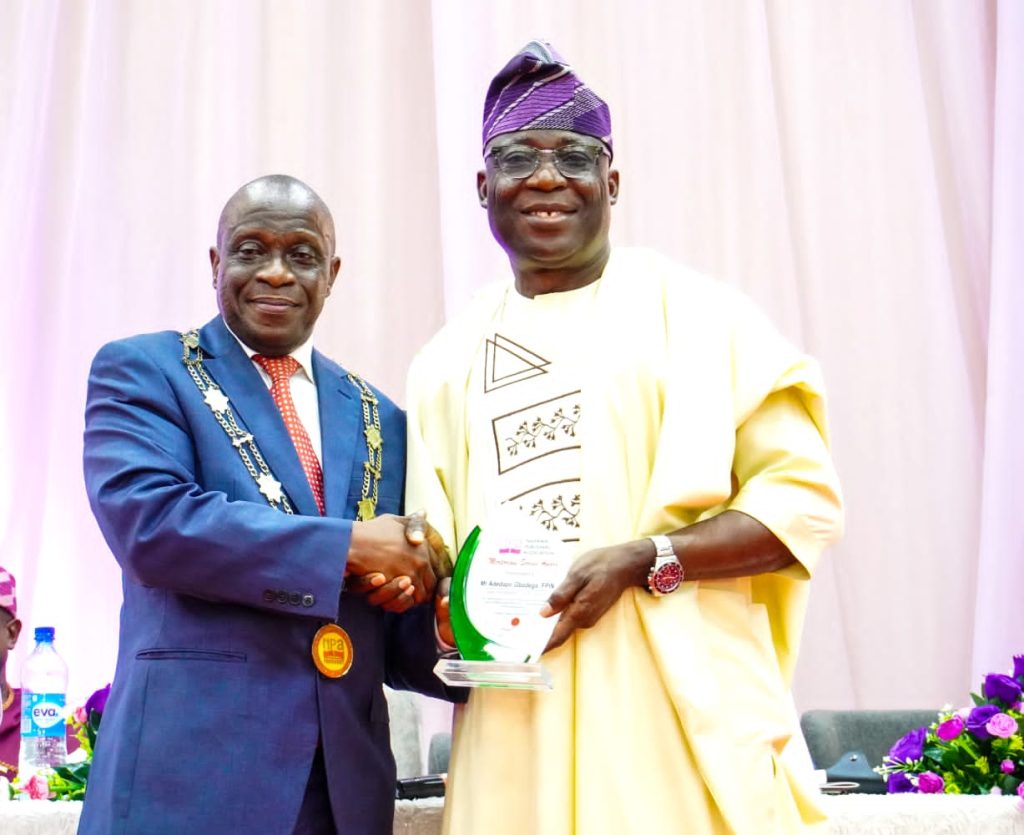
NPA President, Alhaji Lukman Dauda present award to former NPA President and MD/CEO, Accessible Publishers Ltd, Mr. Gbadega Adedapo at the 60th anniversary celebration last week… in Ibadan
According to Dauda, books had become Nigeria’s most faithful diplomats, adding that Nigerian publications now travel farther than Nigerian passports, carrying the nation’s thinking, stories and scholarship into classrooms and bookstores across Africa and the world.
Beyond culture and learning, the president stressed that publishing had matured into a strategic economic sector, one that creates jobs, stimulates innovation and sustains an interconnected value chain from authorship to printing, from distribution to digital platforms. He affirmed NPA’s determination to intensify collaboration with government and regulatory agencies to strengthen copyright enforcement, promote reading culture and deepen educational development.
In a moment that symbolised both gratitude and foresight, members of the association made collective financial donations toward the construction of a corporate headquarters for NPA. The gesture, warmly received, was described as a landmark statement of institutional confidence. The proposed headquarters, delegates said, would serve as an enduring monument to 60 years of labour and as a rallying point for future generations of Nigerian publishers.
Alhaji Dauda closed his address by describing publishing as “nation-building in paperback and hardback,” warning that education without publishing is “intention without translation,” and reminding participants that democracy itself weakens where books are silenced.
The intellectual summit of the celebration came with the keynote address by the Secretary-General of the Pan African Writers Association (PAWA), Dr. Wale Okediran, who deepened the conversation on the anniversary theme. He described Nigerian publishing as Africa’s intellectual engine room, and challenged the industry to treat its Diamond Jubilee as a moment of institutional self-renewal.
Speaking to the theme, he noted that impact requires publishers to remain agents of national transformation, innovation demands meaningful engagement with digital technologies, and inclusion compels the industry to ensure that no community, language or generation is left behind.
He warned that innovation without ethics could erode originality and compromise copyright, describing integrity as “the spine of publishing.” He also urged publishers to rediscover the early idealism of African publishing, when books meant not merely profit, but purpose, enlightenment and liberation.
Calling the Diamond Jubilee “not the sunset of a great institution, but the sunrise of a reinvigorated one,” Dr. Okediran challenged emerging publishers to see themselves not merely as entrepreneurs, but as guardians of Africa’s memory and architects of its future.
One of the emotional high points of the evening was the awards presentation that turned out a roll-call of pioneers and trailblazers whose sweat laid the industry’s foundations. The Meritorious Service Award went to past presidents: Mr. Modupe Oduyoye (1974–1975), Mr. A. O. Echebiri (1993–1995), Mr. Gbenro Adegbola (2004–2008), Mr. Samuel Kolawole (2008–2012), Chief N. O. Okereke (2012–2016), Mr. Gbadega Adedapo (2016–2020), and Chief Uchenna Cyril Anioke (2020–2024).
A Posthumous Meritorious Service Award honoured late Chief G. A. Alawode, while the Distinguished Industry Players Award went to Dr. Kolade Mosuro, Dr. Yemi Ogunbiyi, Mr. Dagunduro and Mr. Olowoniyi. A Posthumous Award of Excellence celebrated the legacy of Prof. Sanya Adelekan and Otunba Olayinka Lawal-Solarin.
Awards of appreciation were extended to partners like the Directcor-General of Nigerian Copyright Commission (NCC)), Dr. John Asein, ReproIndia, Quarterfold Printabilities (India), Nixin Paper Mills, and Everest Pulp & Paper Ltd as well as to invited guests, Dr. Wale Okediran and Conference Chairman Deacon Solomon Adeleke.
The celebration drew an array of eminent personalities, industry leaders, scholars, regulators and cultural icons, who transformed the gethering into a parliament of books and ideas.
As night fell, Ibadan reclaimed its ancient title as Nigeria’s publishing capital, reminding all that while publishing may live across the nation, it truly breathes in Ibadan. And when the applause finally softened into silence, one truth remained unmistakable: Publishing in Nigeria is not fading, it is forging. NPA@60 became both mirror that reflects yesterday’s triumphs and signposts tomorrow’s possibilities.
As Ibadan slipped into night, the diamond celebration left one final inscription upon the heart of the nation: Nigeria publishes. Therefore, Nigeria progresses.