Mike Awoyinfa pens ‘The Ibru Story’

By Godini G. Darah
THE publication of the book, The Ibru Story, is one of the most positive and inspiring news from Africa in the 21st century. This point is important because much of the news about Africa in the global media tends to project a continent where things permanently “fall apart” and where nothing works for the public good. This perception of Africa is deliberately distorted in order to cover up the truth about how the Western nations benefit from and undermine our continent for their economic wellbeing. To the foreign predators and plunderers of African resources and misfortunes, nothing good is to be expected from Africa and its people. In millions of stories and images of Africa circulated around the globe since the end of Black Civilisations 2000 years ago, Africa is caricatured, mostly ignorantly, as a continent that is bound to violence and stagnation. Yet Africa, the cradle of humanity and the most colonized territory in history, is endowed with about 40% of the world’s mineral wealth, an endowment that guarantees the prosperity of the industrialised nations. It is, therefore, appropriate that Mike Awoyinfa resolutely and robustly refuted challenges this centuries-old propaganda with the salubrious story on the Ibru Dynasty of ingenious and prosperous investors.
It is even more edifying and instructive that The Ibru Story is being unveiled at this critical juncture in the history of Africa and the world. We are entering the third decade of the 21st Century, a century that was heralded in the year 2000 as the open sesame to a glorious and trouble-free Millennium for humanity. At the cockcrow of the New Millennium, it was predicted that the world would enter a paradisiacal and auspicious era of an end to poverty and conflicts. At the advent of this Millennium, the global media was abuzz with prophecies of sustainable development, universal inter-racial harmony, and ideological/political tranquility. But today, many parts of Planet Earth are still troubled and famished by hunger, inequality, politico-economic turbulence, as well as the boom of the weapons of mass destruction. For example, the wars raging between Russia and Ukraine as well as Iran and the United States warn us that all is not yet well with the world. It is, therefore gratifying and salutary that we are gathered to celebrate, not chaos and catastrophe, but how our own Ibru brothers and sisters overcame myriad obstacles to create and nurture “A Pioneering Nigerian Business Family” as the book’s sub-title proudly proclaims. The Ibru Story is a classical epic narrative that thrills and charms enduringly.
The Ibru Story is a 342-page saga rendered in elegant and sublime prose style of rapturous episodes and sagacious insights. The experiences are recalled and enacted in dramatic form and, in each one, there is something of value for every reader. I think this is partly why Mike Awoyinfa says that the book is “dedicated to Olorogun Michael Ibru for his pioneering and landmark effort in establishing a leading Nigerian indigenous conglomerate, The Ibru Organisation.”
The book is organised in 21 chapters segmented into Seven Parts covering various epochs in the life of the family. The first part titled “Genesis” deals with the background, starting with “The Patriarch Who Was Michael Ibru”. Nigerians born from the 1950s may readily remember the name Olorogun Michael; but not so the majority of young people from the 1980s and 1990s. The trend in Nigeria’s population growth shows that those aged forty and below constitute over 70% of the total. Demographers think that Nigeria, nay Africa, hosts the youngest proportion of humans in the world. For those who may not easily know who the Ibrus are, Awoyinfa fills the gaps in the history by first giving a profile of Michael, “how he steadfastly introduced frozen fish into the Nigerian market and turned it from an untouchable product or a taboo to a highly popular household food item that it is now a delicacy in every Nigerian pot of soup or stew!”. The ornate voice of Olorogun Michael himself is invoked from the celestial real thus:
“The thing to do was to harvest the fish from the sea and get the fish to the people at the cheapest possible price. With God’s guidance and men’s counsel, I examined several ways to bring my vision to realization.”
Plural voices are invited to testify to this unique marketing method. Among the testifiers are Jimmy Large, the Briton with whom Michael braved the world of business in the mid-1950s. Some of the Nigerian voices are from the alumni of Igbobi College, Somolu, Lagos, where Michael and several of the brothers schooled and were groomed for a life of business and charitable disposition. In this choir of truth-bearers is Dr. Alex Ekueme, the former vice-president during the president Shehu Shagari government (1979-1983). Other “witnesses” are Arthur Mbanefo, Felix Ohiwerei, Mrs Bola Kuforiji Olubi, Chief Olusegun Obasanjo, Aliko Dangote, Subomi Balogun, Segun Osoba, Dele Cole, Goodluck Ebele Jonathan. Much later in Chapter Twenty, our knowledge about the Ibru dynasty is updated with testimonies from members of the “Second Generation Ibrus” such as Oskar, Elvina, Oboden, Bernard’s children, Akofure, Ufuoma, Obukome, and so on onto enernity.
The Ibrus hail from Agbarha-Otor sub-culture of the Urhobo nation in Delta State. Peter Epete, their father worked as a nurse for many years. The family sojourned to the eastern and northern regions of Nigeria before settling for work at the Igbobi Orthopaedic Hospital in Lagos. Epete’s wife is Janet Omotogor, described by Awoyinfa as the “last child of the fabulously wealthy Chief Osadjere of Ovwor, the late traditional ruler of the Olomu Kingdom in Delta State.” The matrimonial liaison produces seven children: Michael, Felix, Goodie, Bernard, Alex, Mabel and Grace.
The background to the story reveals that the success of the Ibru business family can also be explained in terms of what the Urhobo people call otarhe (destiny) the divine force that guides a human being through life. If this spiritual force radiates positive energy, the individual goes through his/her life’s journey with a string of accomplishments. The Ibrus have this positive energy in abundance and, therefore, their story attains the stature of epic grandeur, a universal model that benefits and guides others to reach similar peaks of endeavor. Traditional African spirituality of predestination is reinforced with the ethics of Christianity that enjoin each one to be humble, hardworking, prudent, and charitable. The Ibrus imbibed these essential virtues from their egalitarian Urhobo roots, Igbobi College, and the Anglican mission.
Olorogun Michael Ibru was the visionary extraordinaire who graduated from Igbobi College in the mid-1960s and chose enterprise in place of a civil service work for which he eminently qualified on the basis of his excellent school certificate results. When Michael stepped into the domain of business and wealth creation, a new dawn opened up in Nigerian indigenous enterprise. He marshalled his brothers and sisters into a fraternity of economic frontier breakers. Each venture yielded more lucrative openings; from the frozen fish terrain, the Ibrus diversified and multiplied. The Nigerian indigenization policy of the early 1970s ushered in a floodgate of opportunities. By the 1990s The Ibru Organisation became the unrivalled leader in Africa. The British economic historian, Tom Forrest provides a portmanteau portrait of the Ibru conglomerate:
“The Ibru Organisation grew to become one of the biggest conglomerates in Africa; by 1990, it had between 9,000 and 11,000 employees. Some years later it had grown, it had grown into a multi-billion-dollar conglomerate with interests in shipping, port operations, hospitality, agriculture, aviation, banking, oil and gas,…The Ibru Organisation was listed by Forbes as one of the ten leading family businesses in Africa. The growth of the Ibru Organisation is a testament to how exceptional the Ibrus were. Their story demonstrates a high level of shared values in the family and it also demonstrates the fact that they have exceptional entrepreneurial dispositions spread across different sectors. That diversified outlook of their investments is something that stands the Ibru family out.” (The Making and Makers of Nigerian Enterprise).
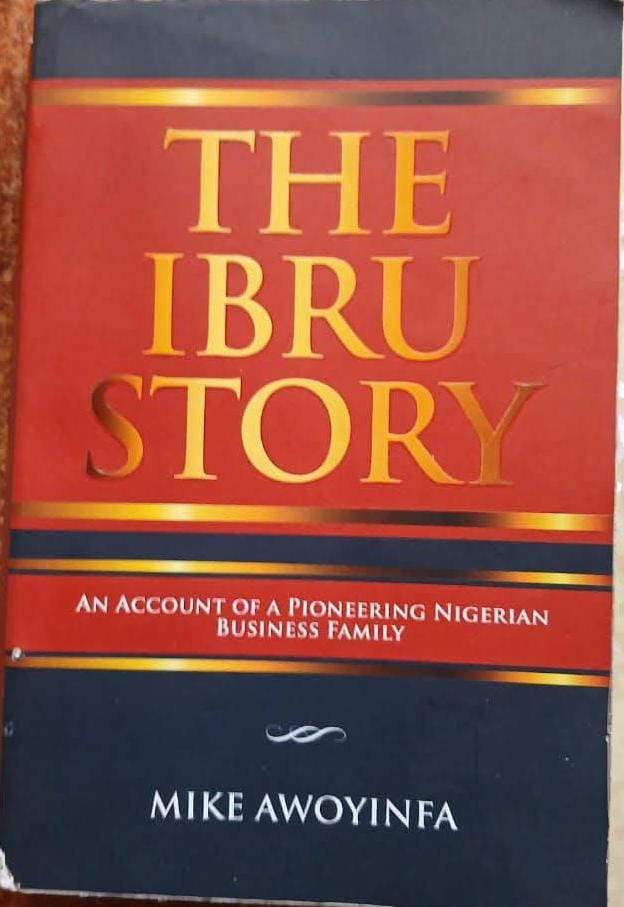
The second part of the book is appropriately named “Ibrus in Business”. This part constitutes the thematic core of the biography; it examines epochal aspects such as the first Ibru business involving the import and distribution of frozen fish, the investment that transformed the Ibrus from relative obscurity to the global brand that it is today. This part also examines issues such as “Ibrus Means Business”, “Goodie Ibru’s Path to Business”, “Sheraton” as well as “Goodie, the Nigerian Stock Exchange and LCCI”. The chunk of the book devoted to Goodie derives from his supportive role in working with Michael, expanding the business canvas, and in being “the last man standing” as Awoyinka describes him. Business people who seek to benefit from the book are advised to read and evaluate these experiences in order to gain requisite insight and courage to invest and succeed in Nigeria’s enormously endowed economic environment.
The focus on Goodie unravels some fundamentals about the miracle of the Ibru phenomenon. He is described as “a compelling character” who “brought a different angle to the Ibru story dynasty…because this particular Ibru brother stakes a claim to the protagonist role in the Ibru story after the demise of Michael Ibru.” Goodie’s innovative angles encompass new brands such as G. M. Ibru & Company (legal practitioners), Ikeja Hotel Plc, Sheraton Lagos Hotel and Towers, The Tourist Company of Nigeria Plc, Federal Palace Hotel and Casino, Hans Gremlin Nigeria Limited, Capital Hotels Plc, Abuja Sheraton Hotels & Towers, Federation of Tourism Associations of Nigeria, Niger Delta Exploration and Production Plc, Lagos Chamber of Commerce and Industry, Nigerian Stock Exchange, NEPAD Business Group Nigeria (NBGN), African Business Roundtable
If the Ibrus mean business, what then did they have to do with politics? This enigmatic matter is explored in the third part of the book under the heading ‘The Ibrus in Politics.’ As ancient philosophers say, all humans are in politics. But how did the Ibrus manifest this inherent trait of humans? Which type of politics did the ibru Brothers play, for whose interest, and how did they fare in Nigeria’s turbulent and unpredictable political firmament? Some answers to these puzzles are adumbrated by the biographer in two topical chapters. There are allusions to attempts made by Olorogun Michael to delve or dive into Nigerian political waters. He contested for the post of governor in Bendel State, now Delta and Edo States, but the giant in business did not succeed. Did Olorogun Michael hearken to the warning of “once bitten, twice shy?” The biographer tells us that he did not because epic figures do not succumb to challenges. In situations of forbidding challenges, epic heroes and heroines surge on with boundless energy to defeat ogres and anti-human principalities. Thus in the late 1980s Olorogun Michael took the political bull by the horns and aspired to contest for the office of president during the transition from the rule of military junta regimes to a civilian dispensation. In this “second coming” into electoral politics he did not go far too. Some of his businesses suffered losses in the course of this political adventure. There are useful lessons here for all those who believe they can combine these two gruesome duels in one life time.
However, it was the political adventure of Felix, Michael’s younger brother that yielded compensatory reparation for the Ibrus. As Awoyinfa recounts at page 115 of the book, it was Felix Ibru who successfully stamped the Ibru name on Nigerian politics. While Alex had a stint in public service as a federal minister in Sani Abacha’s government, and Michael had a brief but unsuccessful attempt at politics, It was Felix who was the most eminent Ibru in Nigerian Politics. Felix was the first democratically elected governor of the newly established Delta State and senator for Delta Central Senatorial District.
Gender balance in the Ibru story is evident in Part Four devoted to the Ibru Women, that is, the Ibru sisters and “the women married by the Ibru brothers”. Chapter 10 offers short profiles of the two Ibru sisters – Grace and Mabel. Awoyinfa thinks that while “they were not as prominent as their brothers, they were significant nevertheless and they contributed to writing the Ibru business story” and “the humble disposition of the family permeated the Ibru girls too.
It is instructive that the biographer notes that to “understand the Ibru ladies, one must understand the mother of the Ibrus, Janet. She was like an “iron lady”: strict and disciplined. This influenced the way she brought up her boys. Since she did not have girls for a long time, she made the boys do everything: household chores, getting water from the well, washing clothes, making fire and cooking.” The biographer adds that “It must have been a pleasant relief for the mother when the girls came that she decided to handle them more delicately and kept them in the background, which perhaps explains why the girls were less prominent than the boys.”
We are further informed that the “brothers all had eyes for beautiful women and, with the exception of Goodie, each married multiple wives and women of mixed races or, at the very least, fair skinned”. The roll call of the women is given, with emphasis on how each and every one contributed to building the Ibru business empire and global fame. Respectful mention is made of each of Michael’s six women, starting with Elsie Nelly, a polyglot who was fluent in eight language and mother of Oskar, Peter, Emmanuel, Gloria, Obukome, and Elvina. But Oyenike Fatungase was the first to bear children for Michael. A banker, Elsie was also “instrumental in helping Michael secure the first loan facility for his fish business.”
Considerable attention is devoted to Cecilia nicknamed by the mass media as ‘The First Lady’ of Oceanic Bank and one of such few bank chief executives in Africa. Her account of how she married Michael when she was 18, the love-nourished life the couple lived and her controversial exit from the exalted office of the bank’s chief executive office occupy a substantial part of the book. The average reader will be saddened hearing from Cecilia the account of her travails with the Central Bank of Nigeria, the seizure of Oceanic Bank and other precious properties as well as the prolonged illness of Michael leading to his death at 86 in 2016. Some of these tragic experiences are examined in Cecelia’s charming and brave recollections in her autobiographical book published few years ago. Her audacious and erudite reflections in that book bear testimony to her pivotal role in the making of the Ibru brand and odyssey. It is appropriate that Chapter 17 of this book is devoted to the story of “Cecilia and Oceanic Bank”
The relay of Cecilia’s narrative is continued by Goodie’s only wife, Emuobowho Oghenekohwo. The biographer introduces us seamlessly to her story, saying that although she is not fair-skinned or half-cast “like the wives of the other Ibru brothers, Emuobowho is “a pure full-blooded Urhobo woman” “who won the heart of Goodie in a romantic odyssey” because what attracted Goodie to her were “her outward and inner beauty which…are better than all the mulattoes of this world.”
This brief portrait of Goodie’s wife endears us to ponder the philosophical depth of her candid words about how to choose a good wife. As she cautions men, you “have to be careful and prayerful. You have to be prayerful in order to pick the right wife, because that is where the problem is…If you are not prayerful, you are likely to make a mistake with the kind of wife you take. And the most important decision a man ever makes in his life time is the choice of wife he marries, because the wife a man marries can make or mar him.” These are words of wisdom loaded with experience and prophecy. Thus, married people as well as those awaiting nuptial rites of passage have much to gain from the extraordinary experiences of feminine characters in the Ibru epic story.
The thematic identity of Part 5 of the book is named “Headlines” owing to unexpected and traumatic events it contains. Chapter 15, the first in this section is titled “Dimka’s Coup and Felix” and takes us into the breath-taking episodes during the years of trial and tribulation in the family. On February 13, 1976, there was an abortive military coup in Nigeria that resulted in the assassination of the Head of State, General Murtala Mohammed and the emergence of General Olusegun Obasanjo as his successor. The leader of the failed coup was Lt. Col. Cukar Suka Dimka. Some military personnel are arrested, together with civilians suspected to accessories to the bloody event. Felix Ibru was one of those arrested, a misfortune that landed him in what Awoyinfa calls “hot water due to his relationship with the military”. Eventually Felix is set free because he was innocent.
Felix’s “narrow escape” seems to be a swelling prelude to that of their younger brother, Alex, the publisher of The Guardian newspaper, the widely acclaimed flagship of the Nigerian print media. This chapter carries the worrying title of “Alex: The Guardian and the Great Escape” A doyen of the Nigerian press, Dr. Dele Cole describes Alex as a man who never flaunted his position as chairman and publisher of The Guardian. But unfortunately, Alex seemed to cross paths with another man, General Sani Abacha, who ruthlessly “flaunted his position” as the military head of state from 1993-1998. Against his pacific disposition, Alex is persuaded to join Abacha’s government as the Interior Minister. It turned out to be like the proverbial fate of riding with the tiger and ending in its claws. We are now in the era of the June 12, 1993, presidential elections and its bloody aftermath. General Abacha hoped The Guardian would be a reliable accomplice to his tyrannical rule; Alex insisted that the paper was “independent”. In the opinion of Goodie the “Abacha government took it to mean that Alex and his paper were against the government”. Consequently, Alex resigned from the government in 1995, but Abacha did not cease haunting Alex as assassins attempted to kill him in February 1996. He survived but thenceforth he chose to donate all his wealth to charities, saying “I came to the world with nothing, so I am going to leave nothing for them (children). That is another prototypical Ibru for you: a heart full of purity and charitable disposition.
Parts Six and Seven are headlined respectively as ‘The Ibrus Also Cry’ and ‘Reminiscences.’ They deal with the closing scenes of this magnificent and gregarious tale about the Ibrus. The chapter include “The Last Years of Michael Ibru”, “Family Feuds”, “Second Generation Ibrus” and “Testimonies: Friends and Associates”. Readers are advised to read carefully the voices of the second generation because their lives and opinions epitomize the ideas of generic continuity and renewal, for the Ibru family, Nigeira’s enterprise spirit, as well as insights about whether or not Nigeria can survive as a nation that sustain the superlative accomplishments of the Ibrus. The opening paragraph of Chapter 10 sums it up adroitly and we may end our review with it:
“Felix, Bernard, Grace, Goodie, Alex and Mabel, led by Michael built the Ibru name into the powerful brand it is today. Sadly, they have almost all departed. Only Goodie and Mabel are alive. The Ibru torch has more or less been passed to the next generation – their children – led by Oskar Ibru. This chapter is a compilation of a few excerpts from interviews with some of them for this book. The excerpts are revealing in terms of knowing some of those who now bear the responsibility of carrying their family’s legacy and their views about their parents, thereby helping us to better understand the Ibru dynasty.”
* Darah is a professor of English and African Oral Literature