Lagos State Govt needs to build an Owanbe City to harness Detty December, says brand specialist, Ebbi

* ‘You don’t brand a country when things are going well’
By Anote Ajeluorou
WHEN does a country rebrand and wean herself from a certain unsavoury past or current negative perception? Is it when things are rough and tough or when the going would have become rosy and smooth? Topmost brand and image strategist and CEO of Whitedove Publicity Ltd, Mr. Kenn Ebbi, believes it’s the former when things appear dire for a country or company, arguing that moments of adversary bring out the opportunity for nations, firms and individuals to reach into their innermost recesses and show their true authenticity. Mr. Ebbi noted that Nigeria and some states in the country keep missing golden opportunities to rebrand and keep focused and sustained narratives that bring the best out of them.
Mr. Ebbi made these revelatory remarks at the virtual launch of his new book titled, Brand or Bland on Monday, December 23, 2025, with guests joining from all over the world to honour him and his creative genius in brand and image strategy that has earned him accolades over the years.
“Branding isn’t done when things are working perfectly, but when things are going bad,” he submitted, noting that Nigeria is in a unique position to rebrand herself with all indices – economic, security, global perception – showing in the negative. “New York wasn’t a good destination place many years ago,” he said. “In fact, New York was a very dangerous city, a calamitous city, but they got a brand company to rebrand it, which came up with the iconic ‘I Love New York’ (I Love NY). You’re dealing with human minds. Some would ask: how can we talk about a country not being good as the best time to brand it? You don’t brand when things are going well.”
Ebbi said he’d approached the federal government in the past to rebrand the country’s image, but people in government didn’t understand it, arguing that things should be better first before any rebranding could be done. This would prove costly in the long run, he said, as things kept getting worse. He said the fact that a lot of things are not going well for the country and her people present the right moment to brand both country and her people, so as to bring out their intrinsic values that current challenges overshadow.
“In order to change Nigeria and her people,” he said, “you brand; you don’t change your country or company before your brand. You brand in order to get your country or company better.”
Ebbi also made a startling submission that’s at the heart of Nigeria’s failure to turn her tourism potential to golf, explaining that it’s why Nigeria’s tourism continues to lag behind others on the African continent. “You cannot run tourism by foreign arrivals. Local people sustain tourism. If local people aren’t in it your tourism will die. From Ibadan to Bauchi’s Yankari Games Reserve to Obudu Cattle Ranch and many others across the country are all dead, because no local patronage. Whatever tourism you’re engaged it, make sure the locals are involved. If locals can’t find tourism, it means as a government you do continuous subventions that still won’t add up.”
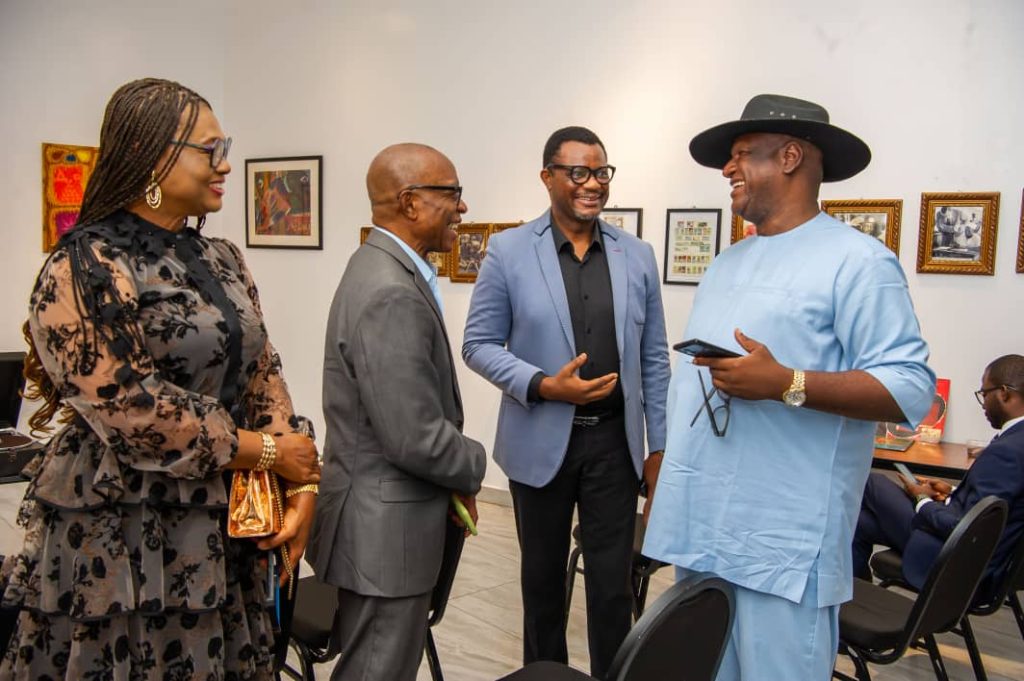
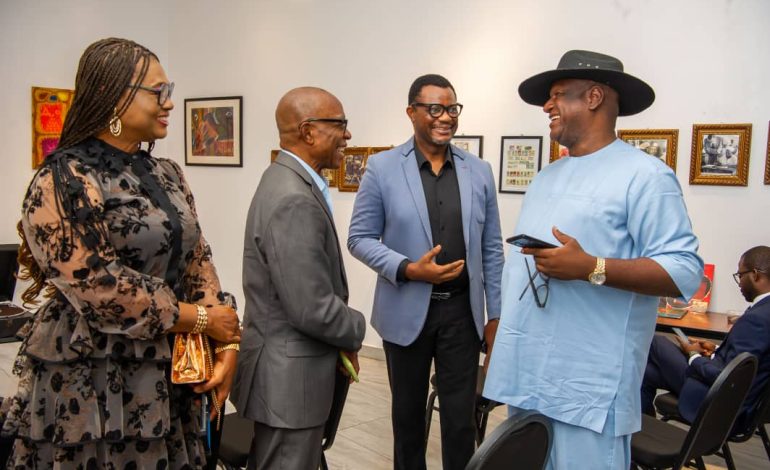
Financial expert, Mrs. Ori Grace Ogba (left); former Commission for Finance, Abia State, Pastor Onyegwere Ogba; brand and image consultant and author of Brand or Bland, Mr. Kenn Ebbi and real estate mogul, Mr. Afolabi Adams Akindele at the inperson book launch on December 16, 2025… in Lagos
He gave the instance of the opening of Ikeja City Mall a few years ago when over four million people turned in the first few weeks, noting that those people weren’t foreigners but local people. He added that that instance could be replicated to other areas that have tourism potential like the revamped National Theatre, Lagos.
“The National Theatre is one of those sites we want to work, to maintain the facilities,” he said. “The first week Ikeja City Mall opened, it had over four million people; that tells you the amount of input local people have on tourism. When Nigerians are returning from abroad, the airport is in pandemonium because of the amount of goods they bring. It’s what is innate and what’s natural with us; it’s in us to shop. Why don’t we have a shopping mall at the National Theatre? If you have four million people coming to shop at the National Theatre, people going to see shows (film shows, stage plays, musical shows) become easy. It brings in funds to run the National Theatre.”
Mr. Ebbi said most times perception “about branding focuses on the wrong things. While talking to the Lagos State Government, someone was talking about building the largest canopy in West Africa. But that was grandiose and would be a waste. In branding, we need to look at ourselves and propose what we want to project to the world. There’s no branding without authenticity. What is it that we have? You talk about the positive and negative things about us.”
Mr. Ebbi then said the absence of a defined value to project is the major bane of Nigeria’s development and tourism proposition, noting that there is no focused national value that the country and her people pursue with vigour and project to the world. Merrymaking, he argued, is one strong value that Nigerians have across board, but lamented that this natural, authentic national value or narrative has not been properly defined and projected as a destination point for both for Nigerians and foreigners alike. Religion, he added, is another tourism goldmine Nigeria was still sleeping on.
“We are a merrymaking people,” he said. “Why don’t we sell Owanbe to the world? Why sell something else? We are a miliki people. What are we doing with it? How are we harnessing it to bring the world here to see us at our Owanbe best? …like Owambe, Shakisman…is authentically us! Most arrivals in Nigeria is religious tourism. Most people coming are doing so for that. But we love to sell business tourism instead of religious tourism.”
He explained the mindset that should be at work rather than what currently obtains, saying, “What other countries do is get the figures (about what’s working or could work for them) and work around those figures to project their best. We have the largest religious houses in Nigeria. Make them interesting and sell them to people, to outsiders. Can you imagine Israel not selling religion? Do you know how much she would lose? It’s easy to sell what’s authentic to you. You’re selling who you are; you’re not pretending. It’s difficult to sell narratives that are not natural, authentic to a people. What’s authentic to 200 million Nigerians? Brand it, make it look good and sell it to the people, to the world.”
Mr. Ebbi explained the philosophy behind selling a people’s innate authenticity as encapsulated in his new book, Brand or Bland, when he said, “Who you are, who you say you are, and who people say you are! That’s branding. Who am I? Then you take that who you are, prune it, horn it and sell it to the people. Then there will be authenticity. Then you won’t vacillate on who you are. Who you are = Who you say you are = Who people say you are = Brand! When you make these three align, then you’’re better for it!”
Detty December has gained global currency and particularly put Lagos on a destination pedestal. But Mr. Ebbi is not hugely enthused about its current state, saying that Detty December has not received the sort of attention it should get, fearing that its sizzle was already going down instead of revving up.
“It’s a pointer to what we are selling, knowingly or unknowingly,” he stated. “Detty December is about the merrymaking that happens in December. The shows, the merrymakers, everything. Even without selling merrymaking, the world is already seeing us as merrymakers. But as citizens we can only go this far in selling Detty December. Government has to step in. When you have this kind of idea, the world gave us that publicity, we didn’t write about it, we didn’t talk about it. It’s the world that talked about it. I’m so surprised that Lagos State Government hasn’t done anything about it. Lagos State Government needs to build an Owambe City. We need to get Lagos State Government interested, because it needs a vast expanse of land to build such a city. We need to make that merrymaking field viable. Like Dubai did with its medical tourism business that has become global today. When you do such a thing, you locate yourself on a map.”
He gave the instance of Brazil that won the World Cup thrice and her government decided to build the largest stadium in the world as tribute to the country’s footballing wizardry. Lagos, he argued, should do the same for Detty December. Reggae music, he also argued, is a Jamaican music genre and brand that has lost its lustre, because the country’s government didn’t incentivise it with enduring structures.
“Brazil won the World Cup three times”, he noted, “they have said something to the world, but the government was wise enough to build Maracana stadium that entrenched that footballing lifestyle to the citizens and the world. These are things governments do in order to deepen any tourism opportunity that has reared up its head. For Detty December, Lagos needs to build that structure that entrenches the culture. Otherwise, it will fizzle out after a while.
“Like reggae music is associated with Jamaica. But what did Jamaica do with reggae music? Not a lot. Though they owned that space but it’s not heavy with them any more. If they’d built a centre for reggae as a genre and brand, it would have entrenched reggae as a genre that’s authentic to Jamaica. What do you really do if your citizens give you something creative like Detty December? You build on it. We may not be the rave forever with Afrobeats. We adore these young musicians for what they’re doing with Fela’s music, but what is government doing about it? What should government do about it? You institutionalise it; you own it. What are you doing about Nigeria being the world’s best cable producing country in the world? Or best jollof rice maker country? Likely nothing!”
Mr. Ebbi also weighed in on the raging controversy over Ini Edo’s Dirty Christmas film that sparked outrage among Christian community in Nigeria. He said although he hadn’t seen the film, he cautioned that subjects that have to do with a people’s culture and religion have to be treated with a lot of sensitivity, so as to avoid a backlash like Edo’s film. He counselled creatives to be mindful of subjects that are likely sore points in their society and work around them and not run into trouble. He further advised the filmmaker to simply go back to edit or makeover the film’s title that’s at the heart of the controversy. He quipped that if he were consulted, he would rebrand the film such that it would generate more people to want to see the film in cinemas than it would have originally attracted.
At the virtual book launch, journalist and writer, Mr. Anote Ajeluorou, was the reviewer of Mr. Ebbi’s Brand or Bland.