LABAF 2025: Ebhohon affirms Africa as wellspring of global knowledge, innovation, civilization


By Editor
AT one of the sessions at this year’s Lagos Book and Art Festival (LABAF), held on November 15 at Freedom Park, Lagos, playwright and winner of ANA Prize for Drama 2025, Majekodunmi Oseriemen Ebhohon, delivered a deeply reflective session on his acclaimed tragic play, The Great Delusion, which interrogates historical erasure, racism against Black in the global North, and the architecture of global dependence. These have become major talking points in African literary circles.
Ebhohon told the audience that his commitment to African renaissance was shaped by the “benevolence of elderly Africans” who exposed him to the intellectual and civilizational wealth of the continent. Their teachings, he said, convinced him that Africa holds the capacity to become a global power—provided its youth resist the impulse to flee in search of Western validation.
“The economic strength of any nation is tied to the energy of its young people,” Ebhohon said, arguing that mass youth emigration weakens Africa’s productive force. His play, he noted, confronts the psychological damage wrought by colonial miseducation: “The Black child has been fed a disinformation that buries Africa’s precolonial achievements. The Great Delusion is my attempt to correct that.”
A cultural journalist and writer, Mr. Anote Ajeluorou, who was present at the session, pressed the author on what concrete actions could ensure that the message of African renaissance does not end as mere rhetoric.
In response, Ebhohon insisted that the “Afrocession” dramatized in his play is no longer fictional, adding, “A few months ago, the Ghanaian government granted over 500 African-Americans and Caribbean Africans automatic citizenship. Diaspora Africans are funding housing projects on the continent in preparation for their return. And we have figures like Idris Elba announcing plans to relocate to Africa. The movement has already begun. What African governments must do now is create the conditions that make the African homeland livable, credible, and welcoming.”
Ebhohon also used the platform to call for an overhaul of African school curricula, arguing that current educational systems remain overwhelmingly Eurocentric.
“We teach science and philosophy as if they originated solely in the West,” he said. “But early Western philosophers studied in Africa—Kemet, Timbuktu. Our curricula must reflect Africa as a foundational cradle of knowledge.”
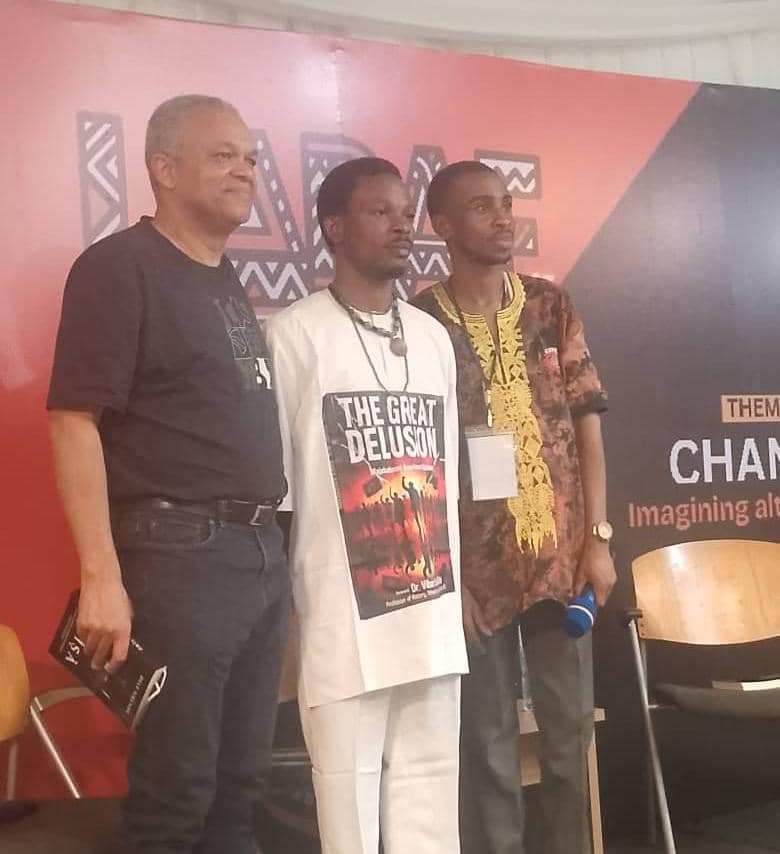
Author of Orisha, Dele Sikuade (left); author of The Great Delusion, Majekodunmi O. Ebhohon and book chat moderator, Olakunle Fadairo at LABAF 2025
The session drew contributions from other notable cultural figures, including veteran playwright and journalist, Pa Ben Tomoloju. After congratulating Ebhohon on his ANA Prize win, Pa Tomoloju praised the ideological convictions that inspired Ebhohon’s The Great Delusion, saying its arguments “are correct and deeply resonant.” He recalled an experience from decades ago in the United States, where he challenged a tutor who taught an entire module on American civilization without mentioning a single Black figure. “This,” he said, “is why works like The Great Delusion are necessary.”
In the play, Ebhohon imagines a world collapsing after Africans withdraw their labour and brilliance from Western systems. Historical Black figures—Katherine Johnson, Daniel Hale Williams, George Stinney, and the unnamed Africans who built the White House and Capitol—returning as ancestral witnesses demanding justice.
“Drama is my way of telling history,” Ebhohon said. “You laugh at the satire, but beneath the humour lies an existential crisis Africa must confront.”
He also challenged Nollywood to elevate its content beyond glossy visuals: “Our cinematography and sound are strong, but the storytelling must carry more truth, more history, more responsibility.”
As the festival session closed, it was clear that The Great Delusion has become a call to reimagine Africa not as a continent defined by lack, but as the wellspring of global knowledge, innovation, and civilization.