Kome, Anyadu share commitment to cultural depth, others at NLP’s ‘Writing Unconventional Stories’ meeting

By Godwin Okondo
TWO Nigerian writers Erhu Kome and Nnamdi Anyadu have shared insights into their storytelling processes, thematic choices and genre explorations during an Instagram Live session hosted by Narrative Landscape Press under its ‘Authors in Conversation’ series.
The session, moderated by Hannu Afere, focused on Kome’s novel, The Smoke That Thunders, and Anyadu’s short story collection, A Meal Is a Meal, had both writers reflecting on unconventional approaches to narrative construction.
Describing the protagonist of The Smoke That Thunders, Kome said she envisioned her as “a fast rushing stream of water that can’t be stopped,” emphasizing the character’s relentless determination and emotional intensity. The novel draws from Urhobo mythology and cultural spirituality, weaving elements of folklore into a coming-of-age fantasy narrative. While speaking on her research process, Kome said she consulted texts containing images and descriptions of Urhobo gods, as well as academic materials and documentaries.
“There was a book I read which contained pictures of Urhobo gods,” she said. “It was made by foreigners and talked about the Urhobo gods and how they were worshipped. You can also read research papers online about Urhobo culture.”
She explained that reverence for trees and shrines within family compounds informed aspects of her world-building, adding, “There’s always a snippet of mythology or religion in my book.”
On the time it took to build the fictional world, Kome said the foundational work lasted about a month but continued evolving throughout the writing process. “You need to know your protagonist, and from there, start thinking of the world they’re in, where she lives and how she interacts with her world,” noting that world-building can take weeks or develop gradually depending on the story.
Anyadu, whose collection A Meal Is a Meal blends humour, realism and speculative undertones, said one of the stories he most enjoyed writing was ‘Battle for Akara,’ noting, “I used a gossipy kind of voice in the writing. I was trying to write something funny, that I could read and laugh. I wrote this story in a day and it was the easiest and smoothest for me.”
On another story, ‘Saara,’ Anyadu said the narrative was inspired by personal experience and communal religious traditions common in both Christian and Islamic settings, noting, “Saara is common in both Christian and Islamic communities, and the story is from a personal experience. My aunt was a member of a white garment church and they would take fruits to church to share with people. If you grow around and understand that kind of community where people support each other, you realize it’s not far-fetched.”
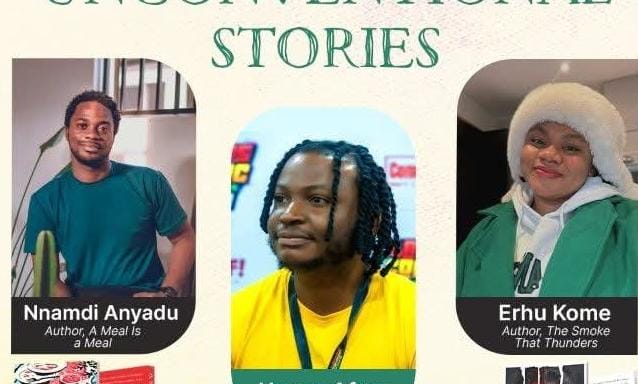
Nnamdi Anyadu (left); Hannu Afere and Erhu Kome
Addressing his decision to allow a villain to triumph in one of his love stories, Anyadu said literature sometimes mirrors uncomfortable realities. “Bad people win sometimes more often than good people,” he said, explaining that the idea emerged from exploring why individuals remain in abusive relationships, introducing a mystical force as a narrative device. “Women give love potion to men, but I wanted to do a story where a man does it,” he added.
Also, Anyadu directed a question to the moderator regarding Khaki in the Sun, a collaborative poetry collection written by Afere and other writers, including Jindu Enugbe and Emebiriodo Ugochukwu. Responding, Afere explained that the project originated from Jindu’s idea and evolved into a multimedia work incorporating photography.
According to him, “The book was Jindu’s idea and he reached out to me to add some things to bring it to life. We had a friend who was a photographer and he had some photos he had taken within and outside Nigeria, and we made use of some of them. It was an interesting experience. I have two different mediums — photos and text. I want you to see the imagery and action in my works.”
On narrative ambiguity in his story ‘The Recipe for Comfort,’ Anyadu said he intentionally leaves interpretive space for readers, saying, “I’ve always been interested in a way that readers come to literature with their own tools, to finish the story themselves,” explaining that readers are invited to determine how the relationship at the centre of the story ultimately concludes.
When asked about future projects, Kome revealed she is working on a story about a girl who attends a school to learn how to speak to gods, which she believes could translate effectively into a comic format, though it is not currently a priority. On the other hand, Anyadu also disclosed that he has written an unpublished fantasy novel structured so that each chapter tells its own story. He said he has experimented with fantasy and science fiction, while his romance ideas remain in development.
Speaking on his post-manuscript process, Anyadu said he depends on candid feedback from beta readers before publication. “I run a ghost writing service, so I’m never not writing. Sometimes, writing my works feel like resting,” he said. “When I write, I send the work to beta readers, and those guys don’t care about my feelings. They would tell me if the story isn’t good enough… So, I have to go and work on the manuscript before I publish.”
The session highlighted the authors’ shared commitment to blending cultural depth, experimentation and reader engagement in contemporary Nigerian literature.