Kofi Anyidoho: ‘See What They’ve Done to Our Sunrise’

By Toyin Falola
POETRY, for centuries, has served as a repository of human thoughts and memory, in which moral values are observed. Within a traditional African setting, poetry is a crucial vehicle in communicating social growth, misgivings, and contemporary issues within the present to reawaken the subconscious in the present and the future. Within these exemplary traditions lies the work of Professor Kofi Anyidoho. This is a poet whose work exemplifies historical awareness with spiritual depth; Anyidoho writes with the full understanding of the dynamics that define African literature. His works convey the awareness that literature in Africa is not an isolated enterprise. His work portrays literature as a work of art that is tied to the fate of communities and the moral imagination of nations.
This is why his new collection, See What They’ve Done To Our Sunrise: New Poems from an Old Loom, comes with a sensibility that invokes striking clarity. His collection is truly an artistic play with words. On one hand, the work comes as a lyrical meditation, on the other hand, it serves as commentaries to historical facts, and in other instances, it doubles as a philosophical reflection on the unfinished journey of African self-realization.
At first contact, the book title establishes the emotional and intellectual weight of the collection. The symbolic use of “sunrise” made it a relatable subject matter in line with many cultures. Sunrise here represents rebirth, renewal, and the promise of new beginnings. However, in this context, Anyidoho transformed the emergence of the sun into something of a lament. The sunrise, as he formulates, has been tampered with, implying a change in existing expectations of a rebirth and new beginning. The dawn explicitly mentioned here, which should have illuminated the future of a people, appears obscured.
Within this poetic gesture is a call for reflection for the African continent on how early promises of liberation, independence, and cultural awakening remain overshadowed by recurring disappointment. The poems in this collection are, therefore, more of moral inquiries than talks of despair and lamentations. There are inquiries about how the light of possibility may be reclaimed after periods of historical darkness.
The subtitle, New Poems from an Old Loom, has another compelling metaphor. Culturally, the loom suggests craftsmanship, continuous efforts, and ancestral inheritance. Across many African societies, cloth-weaving is a technical but philosophical act with underlying messages. Each movement on the loom represents the conceived meaning of historical values, obvious only to the craftsman. Just like the loom, Anyidoho’s poetic loom is inspired by multiple standpoints that include individual memory, Ghanaian histories, pan-African ideals, and a touch of spiritual sensibility. From this fusion is a collection that models a carefully intertwined experience, where individual memories align with the wider narrative of a continent questioning its past and future.
Throughout this collection, the poet’s engagement with memory stands as a major defining feature of the book. Through its pages, the collection views history not as one distant element in discussing the past but as an active agent of the present. The author in this work repeatedly calls ancestral voices, tapping into the sacred place of its forebears and their legacies in shaping the moral landscape of modern-day Africa. With this, the author is placed closely within the ranks of revered writers like Kofi Awoonor and Christopher Okigbo, whose works preserved history through their artistic imagination.
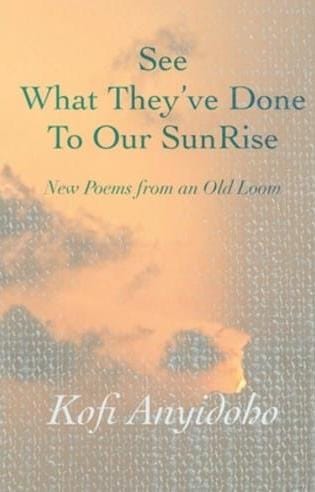
An encounter with this collection leads to a realization that the poems do not just reflect the past. They interrogate and attest meaning to every detail possible. A crucial aspect of this is seen in the constant encounters throughout the collection with persistent questioning of the conditions that shaped Africa’s postcolonial timelines. The imagery of clouds blocking the rays of the sun is none other than a metaphor depicting the forces that frustrate the continent’s moral and political awakening in the post-colonial era.
As stated along these lines, a large part of these forces is external, dating back to the heights of colonial domination in Africa. Other forces arise internally, such as failure in leadership, avoidance of ethical responsibility, and disregard for communal values in the modern age, in a display of tension between hope and disillusion through poetry.
The tension between these two forces situates this collection within the broader intellectual scope of African postcolonial reflection. From the early days of independence movements inspired by national figures such as Kwame Nkrumah and others, African writers have struggled to bridge the gaps between revolutionary aspirations and political realities.
As a solution, poetry becomes the vehicle through which these realities are discussed. Anyidoho’s poems are a preservation of the past. It acts as a witness to precedence while acting as a pointer towards social consciousness in the present. Through his lines, the poet recounts the betrayals of the past alongside a burning optimism for hope and change. Metaphorically, the poet relayed an important message. The African sunrise may have been obscured, but it has not vanished.
Remarkably, the poet humbly affirms the sense of spiritual orientation peculiar to the African setting in his collection. The poems depict a common African belief in ancestral significance. Across the pages, the poems frequently evoke their ancestors, not as distant historical figures but as active presences whose wisdom serves as guidance to the living. This spiritual sensibility reflects the popularity of these beliefs within African cosmology. Oftentimes, African history rarely places boundaries between its past and present. Culturally, the dead are not assumed to be absent. It is maintained that they remain companions in the moral journey of the community. With this perspective, Anyidoho transforms the act of writing poetry into a form of communion with past generations.
In addition to the above are moments of profound personal reflection in the collection. The poet meaningfully reflects on the passage of time, using the scenically shifts from sunrise to sunset. His meditations on aging and death should rather not be perceived as expressions of resignation but that of contemplative maturity. It should be seen as the poet’s recognition of time and that each generation only possesses a fraction of it. Hence, the moral duty of writers is to ensure that the moral and imaginative resources of the past are transmitted to those who come after.
In these reflective passages, the reader can deduce the voice of a writer with a decade-long experience in understanding the intellectual and artistic life of his society. The poems not only address national concerns, but they also seem meaningful to contemporary, universal human questions. They include the search for meaning, the responsibility of memory, and the enduring quest for justice. By looming personal thoughts alongside historical awareness, Anyidoho creates a space where individual experience becomes intertwined with collective identity.
In style, the collection is deeply inspired by African oral traditions. Its rhythms mirror African storytelling, chants, and communal performance. At the same time, the consistent use of repetitions, invocations, and lyrics gives the musical quality befitting of a recital and a slow read piece.
Empathically, the language reveals a sophistication in literary awareness. The illustrations move from sensitive personal intimate thoughts to explain social reflections on family, friendship, and meditations on the fate of nations. This transition demonstrates the poet’s ability to link private emotion with historical experience. In this way, the collection moves alongside the paths of the literary activism that has defined a larger part of modern African poetry, just like the works of great writers like Wole Soyinka, who treats writing to confront the realities of the modern world.
Ultimately, See What They’ve Done To Our SunRise demonstrates evidence of the enduring power of poetic imagination in times of uncertainty. The collection reminds readers that cultural renewal is not achieved alone through political change. It also requires the cultivation of moral awareness and historical memory. By emphasizing the sunrise, the collection positions its readers to imagine a future where the obscured clouds of injustice and forgetfulness disappear for a new dawn.
Categorically, this book is more than just another addition to the continent’s poetic collections. It is the result of years of historical intellectual engagement in the past and present, and an affirmation of a brighter dawn soon. Across boards, Anyidoho has genuinely preserved bits of Africa’s past and present through his collection, shaping these bits with resilience in expectations of the radiance of a new SunRise when it eventually comes through.
(A Praise In Praise of Kofi Anyidoho)
O singer of the wound that remembers,
O drummer of the word that refuses silence,
Kofi Anyidoho—
Child of the Ewe earth where the drum speaks before the tongue,
Where memory is not past,
But a river that circles the living.
You stand where poetry is not ornament.
But obligation—
A calling to gather scattered names,
To lift the fallen syllables of history
And return them to the people.
Like rain after harmattan dust.
Your lines move like dirges—
Not to bury,
But to awaken.
Each word a footprint
Of those who walked before, the nation learned to forget.
You call to the spirits of grief—
And they answer in chorus.
For in your voice,
The disappeared are never lost,
The silenced are never silent.
O keeper of the Sankofa gaze,
You bend time backward.
Not to dwell,
But to retrieve—
The broken calabash of memory,
The scattered proverbs of justice.
In your poetry, Ghana breathes—
Not as a map or an anthem,
But as a struggle,
As laughter stitched with sorrow,
As a people still becoming.
You remind us:
That poetry has not escaped—
It is a return.
Return to truth,
Return to pain,
Return to the possibility of healing.
Kofi,
Your words do not end on the page—
They walk,
They drum,
They insist.
And we, who listen,
Are called—
To remember,
To speak,
To become.
* Falola is Professor of African History and Culture, University of Texas-at-Austin, US