Jeyifo: A battle-tested Marxist @80

By Ajibola Amzat
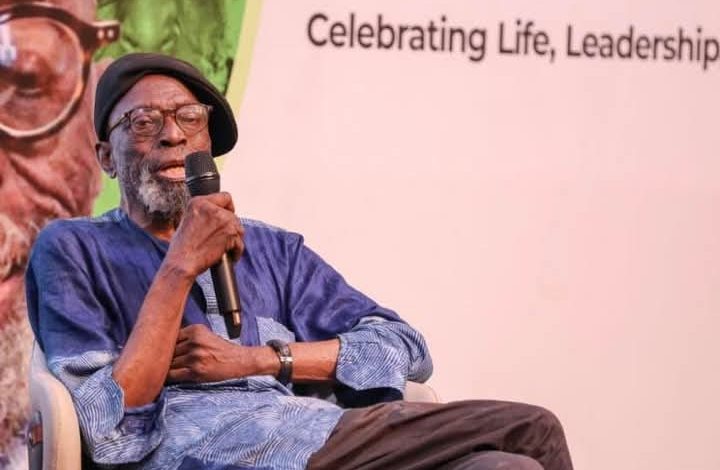
A couple of weeks ago, I virtually attended the public lecture organized by Wole Soyinka Center for Investigative Journalism in honor of the Emeritus Professor Biodun Jeyifo. Titled ‘Pedagogy, curriculum and decolonisation: Then and now,’ the symposium was held in Lagos.
It was an event I would have loved to attend in person because of the deep respect I have for the personage of Prof Jeyifo. He is a deep thinker. But more than that, he is a humanist. When an individual combines both qualities, I find them irresistible.
Listening to Prof. Jeyifo again analysing the failure of post-colonial Africa leaders to empower their people was illuminating. I particularly find his concept of “restructuring” and “redistribution” as a way of illustrating the failure of post-colonial Africa very powerful.
African leaders, in their attempt to wean the continent of the colonial legacy of economic inequality, often seek institutional “restructuring,” and neglect wealth redistribution.
That administrative reorganisation approach explains the economic inequality observable in many African societies, Jeyifo has argued.
“Restructuring without redistribution changes nothing,” he said.
This distinction helps me to clearly see what is wrong with Tinubu government’s policy on oil subsidy. Any government that prioritizes administrative restructuring above redistribution of wealth cannot be trusted to solve the problem of poverty.
It is no surprise then that many more millions of Nigerians have been thrown into the abyss of multidimensional poverty in the last few years. My reading of Jeyifo’s thesis is that we may not be able to address the challenge of insecurity in Nigeria without simultaneously fixing the problem of poverty.
However, Jeyifo did not explain how the redistribution of wealth should be carried out without enabling indolence such as you find in South Africa.
Charles Murray, in his seminal work, has argued that welfare programmes create “perverse incentives” that make it more rational for individuals to rely on government support than to work, leading to a “culture of poverty” and a jobless underclass.
Should the Nigerian government provide security grants to those who are unemployed and unemployable? Should the government raise minum wage in consonance with the economic reality and make it compulsory for both the private and public sectors? How should we design a policy architecture that will result in equitable distribution of wealth in an economy that is largely informal?
There is a lot more to figure out to actualise Jeyifo’s thesis in a sustainable way.
Notwithstanding, I wish the Nigerian press understands public policy from Jeyifo’s distinctive perspective, and frame public discourse accordingly. There is no doubt that we need more of public lectures like the one organised by WSCIJ.
Universities and civil society groups in Nigeria should be convening public lectures such as this. And we need the likes of Professor Jeyifo to intervene regularly on issues of public interest.
Jeyifo is Professor Emeritus of English at Cornell University and of Comparative Literature and African and African American Studies at Harvard University. He is widely regarded as one of Africa’s most influential literary critics. His work on African literature, drama, and critical theory, including foundational scholarship on Wole Soyinka, has shaped generations of students and thinkers across the world.
In his critique of Soyinka’s work, Jeyifo found Kongi more idealistic in his approach to analysing African society, therefore failing to engage with the material world of post -colonial Africa.
I thank Motunrayo Famuyiwa Alaka who invited me.
Happy 80th birthday Emeritus Professor Biodun Jeyifo!
* Amzat, an investigative journalist, is a scholar at Stellenbosch University, South Africa