
Husseini pledges support for arts writers, details wide-ranging reforms, data-driven industry

By Godwin Okondo
THE Executive Director of the National Film and Video Censors Board (NFVCB), Dr. Shaibu Husseini, has pledged the board’s support for the newly inaugurated leadership of Arts Culture Writers Association, describing the rebirth of the body as both timely and essential to restoring a strong, informed and influential voice for Nigeria’s arts, culture and creative industries. Husseini said he was excited by the successful election and reorganisation of the association, noting that arts writing once played a decisive role in shaping cultural policy and institutional development in Nigeria. He recalled that in earlier decades, arts writers produced detailed, historically grounded reports that helped policymakers make informed decisions, rather than limiting coverage to entertainment headlines or celebrity performances.
According to him, the revival of a credible and organised body of arts and culture writers is crucial at a time when the creative sector has expanded beyond a narrow definition of “art” to include multiple and interconnected sub-sectors. He said the dynamism of the present era demands a more structured, knowledgeable and policy-aware media presence capable of engaging regulators, government and practitioners meaningfully.
He assured the new executive of the board’s willingness to collaborate on programmes and projects, including workshops and capacity-building initiatives, to foster mutual understanding between arts journalists and regulators. He said such engagements would help both sides better appreciate their respective roles and challenges, adding that partnership, rather than suspicion, was necessary for sustainable growth of the sector.
Speaking on his two years in office, Husseini said his appointment Executive Director of the NFVCB came as a surprise, stressing that he neither lobbied for the position nor had prior discussions with the supervising minister before the announcement. He said the appointment was made public on January 12, 2024, and that his first direct contact with the minister came only afterwards, when he called to express gratitude.
He explained that his professional background is rooted in the performing arts, cultural administration and long-term engagement with film criticism and documentation, particularly through his work as a writer and analyst. He said platforms such as The Guardian, and individuals like Mr. Jahman Anikulapo, provided him opportunities to study, critique and document the Nigerian film industry extensively over the years.
Husseini noted that, at the time of his appointment, he had planned to return to the university to pursue a full-time academic career, with the goal of becoming a professor, the first in his community. He said he had spent over 23 years in the performing arts sector and felt professionally fulfilled but no longer sufficiently challenged, prompting his desire to focus on teaching and research. However, he said circumstances changed when the appointment was announced, and he accepted the role as a call to put his long-standing critiques and ideas about film regulation into practice.
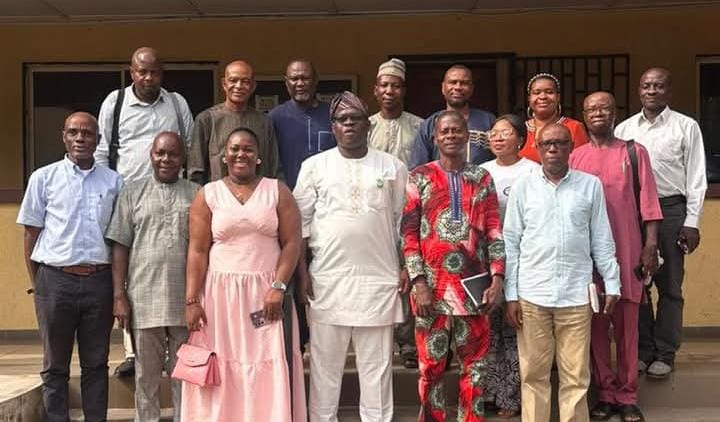
Frontrow: Mr. Terh Agbedeh (left); Sec.-Gen., ACWAN, Mr. Anote Ajeluorou; Vice Chairperson, Tomi Falade; Executive Director, NFVCB, Dr. Shaibu Husseini; ACWAN Chairman, Mr. Tony Okuyeme; NFVCB’s Director of Corporate Affairs, Mr. Ogbonna Onwumere. Backrow: Mr. Armsfree Ajanaku (left); Chief Ben Njoku; Mr. Greg Nwakunor; staffers of NFVCB, Philip Eigbire and Abdul Kolawole; Assist. Sec.-Gen., Ngozi Uma; Joan Odafe; Mr. Uhakheme Ozolua and Mr. Damiete Braide
On resumption at the NFVCB, Husseini said he encountered an agency with a clear statutory mandate to license and regulate film distribution, staffed by officers who were eager to work but required renewed motivation, clearer direction and improved operational tools. He said he made a conscious decision not to overhaul the workforce but to work with existing staff, adding that apart from a few personal aides, no major external recruitment was done.
He said one of his first observations was that despite the board’s establishment in 1994, many Nigerians were unaware of its functions, a situation he described as unacceptable for a regulatory agency. According to him, visibility, transparency and stakeholder engagement therefore became immediate priorities.
Husseini said the board reviewed its mandate and committed to pursuing it strictly and consistently, while actively engaging stakeholders and seeking the resources needed to deliver on its responsibilities. He said the board moved quickly to address complaints from filmmakers about outdated, largely manual processes that slowed down classification and approval.
As part of reforms, he said the online film classification system was strengthened and made more effective, significantly reducing turnaround time. He explained that while an online system existed before his tenure, it was poorly utilised and inefficient. Under the new arrangement, filmmakers can now receive classification decisions within 24 hours in some cases, a development he said has eased production schedules and reduced frustration within the industry.
He added that the board is working towards fully digitised operations that would allow staff to work more flexibly, noting that modern regulatory work should not be restricted to traditional office hours or physical locations. He said improved funding would further enhance this transition.
Husseini also disclosed that his administration prioritised rebuilding relationships with stakeholders across the film value chain. He said regular meetings are held with filmmakers, distributors and exhibitors to explain the board’s role and to understand industry challenges. He noted that several court cases inherited by the board were resolved amicably out of court, as he believed that prolonged litigation was counterproductive to creativity and regulation alike. He stressed that the board’s role is not to stifle creativity but to guide it responsibly, adding that disputes are best resolved through dialogue except in cases of serious legal breaches.
On film classification controversies, Husseini addressed public reactions to certain films, including A Very Dirty Christmas. He said the board approved the film as a work of fiction and did not consider the title a direct reference to the Christian celebration, as the content did not relate to the nativity or religious themes. He explained that the law allows the board to review decisions where public concerns arise, particularly when films transition from cinemas to other platforms.
He said the board does not ban films but may restrict those that threaten national security or promote ethnic, religious or social division. He added that films already released in cinemas cannot be completely erased from digital spaces, but agreements can be reached with filmmakers to make necessary changes for future distribution.
Husseini called on filmmakers to exercise restraint and responsibility, warning against generalisations that could stigmatise entire communities. He also urged the media to help educate the public on the meaning of fiction and the importance of disclaimers in film content.
One of the most significant reforms underway, he said, is the planned removal of the word “censors” from the agency’s name. He explained that globally, film regulatory bodies are referred to as classification boards, and that the term “censorship” often creates misconceptions, especially at international forums. He disclosed that the NFVCB has approached the National Assembly to amend its enabling Act, expressing confidence that the name change would be concluded by mid-2026.
Husseini further announced that the board has secured a permanent headquarters in Abuja, ending decades of operating from rented premises since the late 1990s. He said the property, obtained with presidential approval from assets recovered by anti-graft agencies, is currently being renovated and will be formally commissioned later in the year.
According to him, the new headquarters will support expanded activities, including the establishment of film museums in Abuja and Lagos. The museums will house relics such as old film posters, VHS equipment and archival materials, alongside a hall of fame celebrating pioneers of Nigerian cinema.
He also revealed plans to digitise over 280,000 films in the board’s archive, spanning from the VHS era to the present, through a proposed partnership with a German firm. He said this would make the archive accessible to researchers, students and industry stakeholders.
Husseini disclosed that the board has compiled a comprehensive index of all films classified between 1994 and 2026 into a four-volume publication, with both electronic and physical editions that will be launched on September 2 to coincide with the release of Living in Bondage, the film reputed to herald the new cinema culture in Nigeria, on same date in 1992. He said the books would be distributed to universities offering theatre and film studies, as well as major libraries across the country.
On industry data and compliance, he said enforcing mandatory classification and registration of films would be a major focus in 2026, noting that technological advances have made it easy for filmmakers to distribute content without submitting it to the board, resulting in inaccurate production statistics. Husseini said official figures of about 2,800 films annually significantly underrepresent actual output, estimating that Nigeria produces close to 800 films monthly. To encourage compliance, he said classification fees for online submissions were significantly reduced, stressing that the board’s priority is data collection rather than revenue. Husseini warned that unreliable data could undermine Nigeria’s global standing in film production, noting that previous international recognition was based largely on volume of output.
He also highlighted the board’s media literacy initiatives, which he described as critical to consumer education and child protection. He said the NFVCB operates six zonal offices and 24-state offices that conduct monthly outreach programmes in schools, markets and community groups, including women’s August Meetings in the South-East. According to him, the media literacy department educates parents and guardians on classification symbols, content suitability and digital monitoring tools, helping families better manage what children consume on screens.
Husseini said the overarching goal of his administration is to build a well-regulated, data-driven and globally aligned film industry that balances creative freedom with social responsibility, adding that informed journalism and constructive engagement remain vital to achieving that vision.
Earlier in his response, Chairman of Arts and Culture Writers Association of Nigeria (ACWAN), Mr. Tony Okuyeme assured the Executive Secretary, Dr. Husseini of the body’s cooperation and timely publicity of programmes and events of the board. He sued for stronger collaboration with the board and culture journalists to effectively educate the public the board’s enlightening programmes.