
Adesola’s ‘Dancing with My Tongue’ and the poetry of theatrical disillusionment

By Kehinde Folorunsho
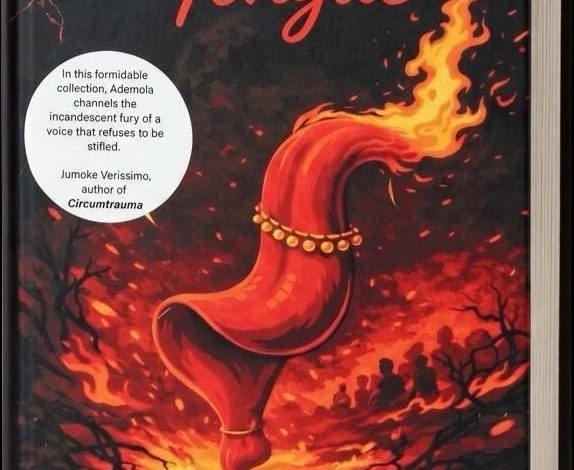
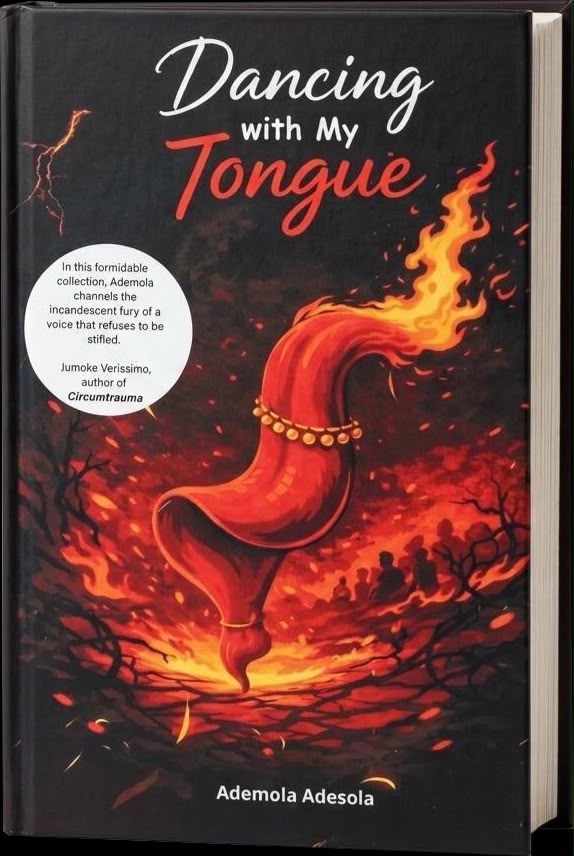
THERE is no denying that the implosions of post-independence politics remain fertile ground for the poet. Ademola Adesola’s Dancing with My Tongue presents a satirical lens through which the reader encounters the failures of governance – the enduring hydra of African rulership. The collection shows a society in which leaders twist and bend the destiny of citizens while the poet lays bare the absurdities and cruelty of their machinations. Yet the scope of the anthology extends beyond politics. It addresses social insecurity, racial and cultural tensions, and the individual’s struggle under systemic pressures. At its core, the poetry responds to contemporary crises of disillusionment and despair, grounding its concerns in a temporal and universal relevance that makes it both urgent and accessible.
The collection is structured under four thematic sections: ‘Political Ponderings’, ‘Razors of Race, Balm of Belonging,’ ‘Medicine for the Mind’ and ‘A Playful Seriousness’. Each section has a distinct focus. ‘Political Ponderings’ examines the failures of leadership, the violence of war, and the erosion of human dignity. ‘Razors of Race, Balm of Belonging’ explores racial identity, administrative inequities, and the tensions of diaspora and displacement. ‘Medicine for the Mind’ attends to personal resilience, love, and the cultivation of inner fortitude, while ‘A Playful Seriousness’ interrogates human beliefs and the contingencies of life and friendship under the weight of decisions. By identifying these structures early, the reader understands the imperatives of the poems and their thematic intentions in order to formulate a coherent frame of appreciation.
In ‘Political Ponderings,’ the poet foregrounds the suffering of individuals under failed governments. The opening poem detailing the plight of Gaza immediately establishes a pattern: collective trauma, inhumanity, and the exploitation of power. Adesola’s lines depict the cruelty of imperialism and the manipulation of social systems for private gain. The biting criticism against leadership here evinces the conscious effort at sabotaging the social welfare of the masses in the economic interest of a few. Here, the poet shows that the tragedy of one region reflects a wider pattern of governance failure. These poems do not only lament loss but illustrate how leadership deficits prevent the flourishing of human potential. Citizens are trapped in systems that amplify unemployment, poverty, inflation, cultural decay, and psychological distress – predicaments forcing them to struggle against insurmountable odds.
The critique of governance is extended to the global stage. The anthology demonstrates that poor leadership is not bound by geography; Africa, the Americas, and other continents alike experience similar forms of bureaucratic incompetence and social injustice. Adesola writes that no nation can be an island of stability while plagued by systemic failures. This suggests that the consequences of leadership reverberate globally. The poetry therefore situates local experiences of political negligence within universal contexts; it shows readers that these failures are both particular and emblematic.
‘Razors of Race, Balm of Belonging’ interrogates racial inequity and identity crises with both subtlety and clarity. Poems in this section examine the ways in which social and political systems perpetuate exclusion. For context, the poet articulates the universality of human rights in lines encapsulating the interdependence of humanity and emphasises that oppression of one group affects the whole. Moreover, it critiques governmental microaggressions that masquerade as civility thus revealing how superficial gestures conceal structural exclusion. By linking personal experience to wider societal practices, Adesola makes the reader see discrimination in both intimate and institutional forms.
Diaspora, displacement, and cultural alienation also feature prominently. For context, a poem such as ‘DDS: Diaspora Dislocation Syndrome’ portrays how immigrants internalise the prejudices of host societies thereby fostering self-loathing and alienation. Through this lens, the collection highlights the psychological cost of systemic oppression and not merely the physical or social. These poems demonstrate that the poet does not simply describe conditions of racial tension but analyses the mechanisms that perpetuate them. Thus it offers a reflective and sustained critique.
‘Medicine for the mind’ pivots toward individual resilience and collective well-being. The poems celebrate the human capacity for reflection and perseverance. The poet urges readers to recognise the influence of consistent effort: “The fruitful and sweet-smelling orchard emerged from everyday labor.” Here, personal discipline becomes a metaphor for societal progress. It connects the private cultivation of mind and spirit with broader human flourishing. Likewise, the sections on love, forgiveness, and courage present relational and ethical wisdom as a balm for social and personal crises. These poems are instructive without lapsing into abstraction. More incredible is how the poet balances ethical imperatives with practical guidance.
Section Four, ‘A Playful Seriousness’, returns to the interplay of human thought and contingency. Adesola explores ethical decisions in this section. The poems emphasise the provisionality of human knowledge and the necessity of vigilance in moral reasoning. The poet’s use of rhetorical questions and parallel structures – “If you do, you become in life… Life is a bunch of ifs” – clarifies the stakes of choice and the conditions under which action and reflection operate. Similarly, poems on trust and decision-making articulate universal concerns through concrete scenarios that offer insight without relying on abstraction.
The literary techniques employed throughout the anthology are noteworthy. Adesola demonstrates exceptional control of diction, rhythm, and lineation. This is what gives each poem a musicality that complements its thematic concerns. Puns, rhetorical questions, and repetition are deployed to emphasise political and emotional points, as in “I’m a Woman”, where repetition underscores agency and identity: “I’m a woman; not a woe-man… I make and mother humankind!” These devices are not ornamental but functional: they engage the reader in active interpretation and reflection. The attention to sound and structure makes each poem an immersive experience that communicates both content and form.
However, the collection is not entirely without tension. Lineation and diction fluctuate between complexity and simplicity. It therefore produces occasional unevenness. Some poems shift from sophisticated constructions to simpler phrasings which create a minor tension between accessibility and literary elegance. Yet this is a conscious stylistic choice. It reflects the poet’s attempt to engage both general and specialised readers. The variability does not detract from meaning; rather, it mirrors the multiplicity of human experiences the poems seek to convey.
Dancing with My Tongue is a capacious work of satire and social critique. It addresses local and international politics, race, identity, war, despair, and resilience in demonstrating that no society or individual is insulated from the pressures of systemic failure. While grounded in the African experience through the poet’s nationality, the work’s concerns are universal. They span continents and contexts. Adesola’s poetry confronts injustice, interrogates human belief, and celebrates perseverance and love. It is an anthology of layered intervention in contemporary literature. The collection achieves a rare balance of moral urgency with its aesthetic sensibility and practical insight.
Overall, Dancing with My Tongue is a deliberate and poignant engagement with human conditions. Its structure is coherent and purposeful; each thematic section clarifies its focus while contributing to the collection’s cumulative impact. The poet’s use of imagery and diction makes abstract ideas tangible while careful textual references prevent claims from floating unsupported. Ultimately, Adesola succeeds in rendering the theatre of socio-political and human absurdities in compelling memorable verses that create an anthology that critiques and consoles. This is a poetic work whose urgency is matched by craft and whose empathy is coupled with a keen moral vision – a testament to the power of poetry as critic and healer.