
14 years after, Usman’s ‘A Case for Local Police’ gains national resonance

By Anote Ajeluorou
THE recurring failure in Nigeria’s national life is not because of a lack of experts and actionable ideas. Nigeria has these in abundance. However, it’s at the point of harnessing these ideas and getting the right expertise to implement them to work that vested interests sabotage national development.
Take the case of state police or local policing, for instance. Way back in 2012, a Nigerian of repute, historian, cultural archivist and astute retired public administrator, Dr. Bukar Usman, had proposed local policing system in informed articles as antidote to the rising spate of crimes and criminality across the country. But nobody listened. Today, Nigeria has circled back to his proposition that would have saved the country countless lives, property and huge sums of money fruitlessly sunk in trying to resolve what now appears intractable security problems. As they say, ‘better late than never’ is Nigeria’s poor consolation for failing to heed sound advice that should have been implemented several years ago.
Usman is one of Nigeria’s finest public administrators, who retired as a Permanent Secretary in the Presidency, and he has worked in security situations as a resource person. He took time to look back both in nostalgia and missed opportunity at his floundering nation and penned an incisive essay on how best to curb the growing security menace in the country. But as with many things Nigerian, nobody took heed. But 14 years down the line, his advice now strikes an uncommon resonance, as the country’s leadership scrambles to do what should have long taken root – local policing or state policing.
Usman has summed up the root cause of the current malaise, when he recalls the nationalistic fervour that swept across the newly independent country to centralise every aspect of national life without much thought as to possible future consequences. The adoption of the American presidential system of government didn’t alert the country’s leadership to the imperative of a decentralised policing structure (among other forms of governance structures like fiscal federalism, etc) as practised in America where it was borrowing her governance system.
In a little pamphlet titled A Case for Local Police (Klamidas Communications, Abuja; 2026), Usman documents the sentiment that informed what has now become a misguided central police structure, and how the country lost the initiative to criminal elements thus, “At independence, fired by the zeal to build a strong and united nation, we had unified armed forces, unified prison services, etc. So, in that nationalistic mood, we also mistakenly created a national police force, which had under-performed over the years. It is high time we corrected that mistake and decentralised this troubled Nigeria Police Force, whose serious handicap has made our armed forces to operate routinely as the “first line of defence,” and militarised the society.”
There’s a sense of vindication that this brings to the elder statesman although an uneasy one, as countless lives have needlessly been lost. Yet again, he has lent his voice, putting his thoughts in a small document to assist government in getting the local or state police policy right. And Usman’s document is instructive in reminding Nigerians where the proverbial ‘rain started beating the country.’
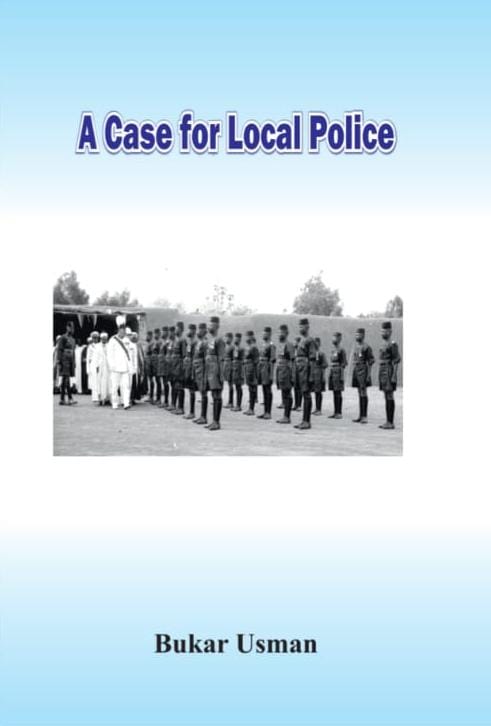
Governor General of Nigeria, Sir James Robertson (accompanied by the Royal Father of Biu Federation) inspecting a Parade mounted by Biu Federation Native Authority (NA) Police in Biu. The Kuthli’s mud palace wall in the background (picture 1957) Source: Baba Shettima (Shettima photo)
Usman states from historical record that the formation of the current Nigeria Police structure was one of the many rash and wrong decisions taken after independence in attempts to centralise control of governance organs without proper thought to consequences. Otherwise, before independence there was Native Authority Police that was localised within communities that took charge of crime control and was truly effective. This colonial policing structure, he recalls, had its men being recruited from among the local populations as against what currently obtains where individuals with no knowledge of local environments are thrown into it to fight crime. The result, he says, is what stares us in the face – unmitigated failure of ineffective policing that now requires the army being indiscriminately drafted into local crime situations.
Usman recalls his experience as a schoolboy in his native Biu Emirate of Borno State, how the emir inspected the local police formations every Monday, and how they not only burst crime but also provided other services to the local community. However, the formation of The Nigeria Police Force came to dilute that effective policing and ushered in a new era where crime has overwhelmed the organ set up to fight it.
Usman is not unmindful of concerns of abuse being raised in certain quarters that local or state police structure proposition could be put to defeat its purpose. But he quickly allays such fears by proposing effective safeguards to mitigate abuses that may arise.
“The NPF is one of those experiments Nigeria embarked on as an extension of her interpretation and application of the uneasy concept federalism,” he recalls. “Several years after, with corruption and criminality threatening the peaceful co-existence we once took for granted during the era of the local police, isn’t it time we jettisoned the NPF experiment? As an experiment, the NPF has outlived its usefulness. The time is ripe for Nigeria to reintroduce the local police.”
Looking back to his childhood days, Usman says, “I must confess that I am somewhat nostalgic about the local police as I cast my mind back to the days of the Native Authority Police of the 50s and 60s. As a primary school pupil in my home town, Biu, I had admired, from a distance, the strict rules of the “Charge Office,” the revered name the local divisional police headquarters in Biu was called by the local folks… We slept literally with our eyes closed. We had mainly petty thieves. We also had occasional cases of burglary, assault and elopement. There were a few daring robbers, the most notorious of whom was Malam Gulani. He operated in the style of Robin Hood, but he was tracked down by the local police. News of nabbing that elusive robber brought relief to the community.”
Usman is also critical of the current police structure that encourages wastefulness, saying, “The present zone structure of the Nigeria Police Force, which incurs heavy administrative overheads, merely provides promotion posts, as decision-making is still largely centralised.”
Usman then points at Nigeria’s current complex social configuration as necessitating the restructuring of the police structure for a more effective one. The unfamiliarity of local environments to police men posted from far-flung places is another constraint to effective policing that local or state police will remedy, he argues.
According to him, “Today’s local or state police, I must observe at this juncture, would necessarily be a modification of the local police structure of my childhood days. Population has increased and the social environment has become much more complex. Today’s criminals are very mobile, sophisticated and use very dangerous and mass-destructive devices. But our modern criminals generally succeed in the hide-and-strike games because the average NPF policeman is often a stranger to the community the criminal is very familiar with. “Local knowledge” is vital and it is the absence of this (knowledge), which is at the root of the failure of the police to deal effectively with criminal activities across the nation.”
Usman therefore advocates setting up of safeguards to prevent abuse to assuage the sentiments of those who express misgivings about state police. According to the retired statesman, while noting that “Distant hose can’t put out local fire”, said, “The power of the State to establish state police should be granted by law stipulating conditions and standards the breach of which could warrant the withdrawal of such licence. The federal government should institute a supervisory authority or inspectorate whose periodic reports may be placed before the National Assembly. This is in addition to the federal power to declare a state of emergency, where there is any abuse or action which threatens peace and stability in any state.”
The casual observer might ask: what qualifies Usman to hold such strong views about policing and national security? The answer isn’t far-fetched from his outstanding profile in public service. As a top class civil servant, Usman was Secretary for the Committee on Public Safety and National Security from 1972 – 1999; a member of National Intelligence Agency Personnel from 1984 — 1999; Secretary for the Committee on the Re-organisation of the Nigerian Security Organisation (NSO); member of the Implementation of Armed Forces Ruling Council (AFRC) Committee Report on Internal Security in 1989; Nigeria-Benin Republic Great Joint Military Commission in 1988, and delegation of Commonwealth Security Conference in Malaysia in 1989. He was also Chairman, Security Sub-Committee of the Organising Committee on Organisation of African Unity (OAU) Summit in Abuja in 1991, delegate of Commonwealth Security Conference in Uganda in 1992, and member of the Presidential Panel on National Security in 2001, among others.
When A Case for Local Police was first written, many commented on as a masterstroke suggestion that could curb the growing insecurity threatening national peace. These comments are well captured in the pamphlet to amplify its timeliness. Indeed, states’ Assemblies mulling the new bill with a view to adopting and passing into law in their respective states would do well to read Usman’s piece and be better informed. A stich in time, the proverb goes, saves nine! The timing of this material could have been better.