Azerbaijani’s Aylisli’s ‘People and Trees: A Trilogy’ wins EBRD Literature Prize 2026

By Editor
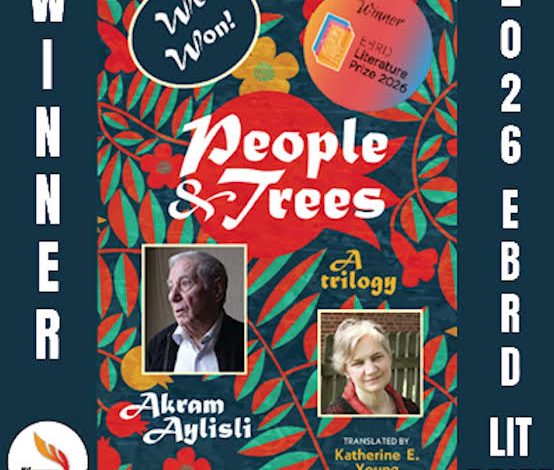
THE winner of the 2026 European Bank for Reconstruction and Development (EBRD) Literature Prize is People and Trees: A Trilogy by Akram Aylisli, translated into English by Katherine E. Young and published by Plamen Press in Washington DC. The €20,000 prize is shared equally between author and translator.
The winning title is chosen by an independent panel of judges. The award recognises outstanding works of literary fiction originally written in a language of an economy where the EBRD invests and translated into English, celebrating both the authors and the translators who bring these voices to new audiences.
Originally published in Azerbaijani in 1970, People and Trees: A Trilogy is a classic of modern literature from Azerbaijan. The first English translation, rendered by Katherine E. Young from the Russian edition, brings new readers into Aylisli’s mountain village setting in the years following the Second World War. Through a child’s-eye perspective, the linked novellas illuminate the shifting rhythms of traditional life and the resilience of the women who hold the community together.
The independent panel of judges was chaired by writer and critic Dr. Maya Jaggi, alongside Dr. Marek Kohn, Professor Chigozie Obioma and Professor Lea Ypi.
Chair of judges Jaggi praised the winning book for its luminosity, when she said, “Not since Kurban Said’s Ali and Nino, published in German in 1937, or his contemporary Banine, writing in French, has a writer from Azerbaijan in the Caucasus won global acclaim among the greats of world literature. Our winning author, born Akram Naibov in 1937, adopted the pen name Aylisli after his mountain village on the Silk Roads, Aylis in Nakhchivan, the setting for his trilogy of novellas, People and Trees.
“A portrait of the artist as a young boy, this engaging trilogy charts the birth of a writer’s sensibility in a harshly realistic yet magical locale of scented orchards, thyme and mint, in a part of the Soviet empire where grandmothers tend samovars, and mosques are converted into silk factories. Like the author – whose father died at the front when he was five – the boy narrator is brought up by women, their menfolk conscripted into the Red Army in the Second World War. The tale bristles with mischievous, child’s-eye insights into a transitional society at war – not least between the sexes.
“Drawing on both Azerbaijani folklore and Russian literature, Aylisli’s clear-eyed, nuanced portrayal of a village he regards as a paradise, for all its flaws, elevates it into a fictional microcosm akin to Faulkner’s Yoknapatawpha County, or García Márquez’s Macondo.
“For this classic trilogy, originally published in Azerbaijani in 1970, the author was once garlanded at home. Thanks to Katherine E. Young’s superb English translation via the Russian, more readers can now discover for themselves an outstanding artist, aged 88, whose fraught life as much as his courageous works reflects the challenges facing his country, and who has described himself humbly as a ‘writer and humanist with the ability to feel pity for another’s pain.’ Aylisli’s artistry shines through these pages, bringing long-overdue international recognition for the rich culture that produced him.”
The authors and translators of the two other finalist works – Ice by Jacek Dukaj, translated by Ursula Phillips, and On the Greenwich Line by Shady Lewis, translated by Katharine
Halls – each received €2,000.
The EBRD Literature Prize has been running since 2018 and is an annual award for a work
of literary fiction originally written in a language of an economy where the Bank invests,
translated into English and published in the past year. It aims to champion the literary
richness of the EBRD’s diverse regions of operation across three continents and to celebrate the role of translators as “bridges” between cultures. To date it has helped to highlight writing from Albania, Croatia, Czechia, Georgia, Greece, Hungary, Latvia, Lithuania, Moldova, Morocco, Poland, the Slovak Republic, Türkiye, Ukraine and Uzbekistan.
The European Bank for Reconstruction and Development (EBRD) is a multilateral development bank working across three continents to support countries in building strong, sustainable market economies. Established in 1991 in response to the collapse of communism in Central and Eastern Europe, the Bank now operates with a unique mandate that combines investment, advisory support and policy reform.
The EBRD is owned by 77 national governments, the European Union and the European Investment Bank. Its work focuses on promoting a thriving private sector, strengthening financial systems, and advancing environmentally and socially sustainable development. The Bank partners with governments, civil society, donors and international financial
institutions to deliver long-term impact.
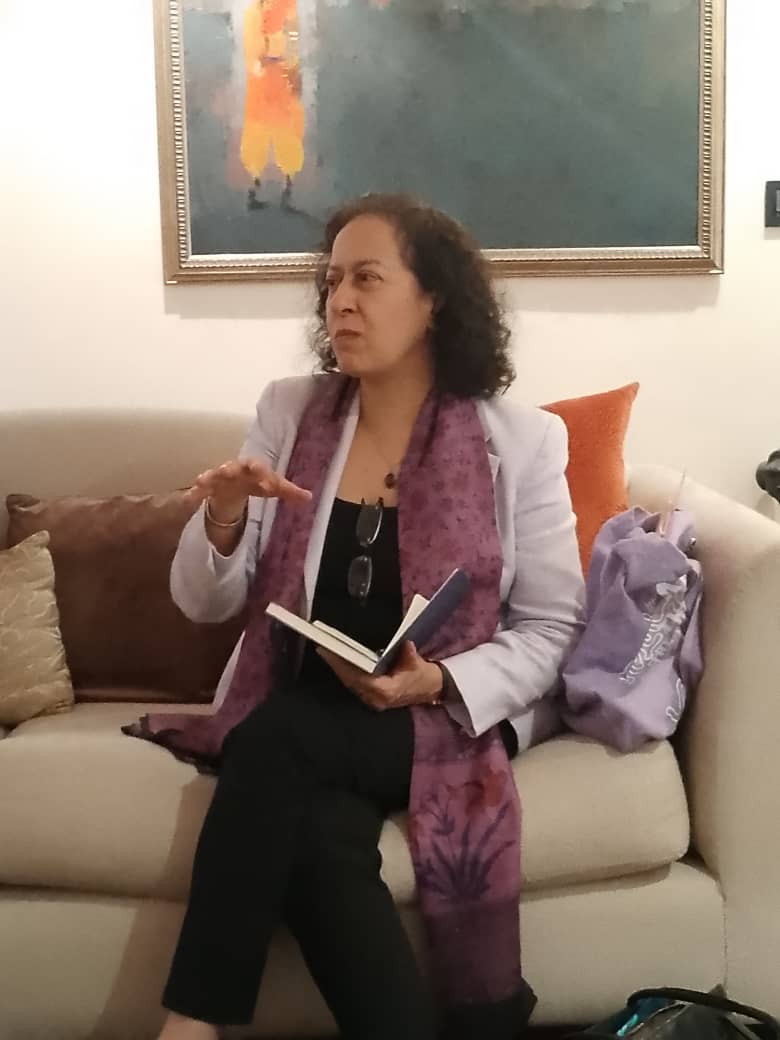
Prize jury chair, Dr. Maya Jaggi in Lagos November last year to sensitize Nigerian publishers about EBRD Literature Prize and encourage them to enter prose fiction works written in indigenous Nigerian languages but translated into English
What prize jury head Jaggi said of the three finalist books: “The first English translation of a classic Azerbaijani trilogy, People and Trees by Akram Aylisli is an enchanting coming-of-age story set in a mountain village in Soviet Azerbaijan amid an exodus of menfolk conscripted into the second world war. The child’s-eye linked novellas expose the brutality of women’s lives, but also their spirited defiance. My fellow judges and I admired the skilful indirection of the narrative, the boy ingenuously revealing adult passions and crimes he scarcely grasps. Katherine E Young’s vivid translation via the Russian opens a hidden world, conjuring a harsh yet magical childhood, filled with the taste of walnuts and pomegranates.
“Ice by Jacek Dukaj impressed the jury, in Ursula Phillips’s assured and ingenious translation from the Polish, as a sci-fi epic that transcends genre, moving from steampunk and gothic horror into existential anxiety, black physics, amorous intrigue and counterfactual history that asks, what if the Russian revolution had never happened and the Belle Epoque survived? Its fictitious Polish philosopher, told his gambling debts will be quashed if he undertakes a mission for the Ministry of Winter, embarks on a fantastical trans-Siberian quest for his exiled father. Yet the novel, whose historical characters range from Lenin to the inventor Tesla, is rooted in the realities of Polish colonisation by the Russian empire.
“On the Greenwich Line by Shady Lewis delighted the judges with its bold originality, absurdist satire and deadpan plot twists. Tasked with burying a young Syrian refugee who is a stranger as a favour to a friend in Cairo, the narrator becomes mired in Kafkaesque bureaucracy while pursuing his Antigone-like mission. As an Egyptian Copt, he mines the dark comedy of living in Britain as a Christian Arab, while, as befits a life straddling two continents, the setting is the notional meridian sundering East from West. Katharine Halls’ translation deftly conveys the mordant wit, pathos and freshness of the Arabic original.”
Speech by the jury head Jaggi at the awards ceremony in London on 2 July 2026
THE late Nigerian novelist Chinua Achebe once told me that what he most remembered about writing Things Fall Apart – his 1958 tale of pre-colonial Nigeria that became one of the most widely read modern novels – was that, ‘I must not make this story look nicer than it was.’ He was adamant in showing ‘both good and bad’ in his own society, ‘ordinary human beings as neither demons nor angels.’
Not making life appear rosier than it is is a core task of the fiction writer. This candour is their gift to us – however uncomfortable it may be to look into the mirror they hold up. Yet it can make writers both the consciences of their societies and thorns in their side.
The EBRD was set up after the fall of the Berlin Wall – a moment not just for free markets but cultural freedom from stultifying controls over thought and creativity. Its Literature Prize, now in its ninth year, has a proud history of rewarding writers and translators on three continents – and has recently expanded into countries such as Nigeria, Senegal and Iraq.
Its judging process, I can attest for my three-year term chairing the independent jury, has been a model of the arm’s-length principle – a principle invented by an economist and banker, Maynard Keynes, for supporting culture without political bias or interference. My distinguished fellow jurors have included Philippe Sands, Maureen Freely, Fergal Keane, Selma Dabbagh and Uilleam Blacker, as well as this year’s judges: Dr. Marek Kohn, Professor Chigozie Obioma and Professor Lea Ypi. No attempt was made to sway us. Locked in our jury room as literary professionals, writers, we judged the submitted books on their literary merits. Without fear or favour.
For the Bank with its shareholder countries, this must be a difficult act of forbearance. Yet it’s a brave, even visionary, stance that shows leadership and merits applause. For as long as it upholds the independence of the prize jury, the Bank fosters a robust literary culture built on free expression. Without the freedom to question, to remember, to remember differently from official histories, and to reimagine, no society can develop, or prosper. As a South Korean culture minister (Yoo Jin-ryong) once told me, ‘Building an economy without culture is like building a house on the sand.’
This year’s shortlist of 10 books – all of which we commend to you – ranges from a moving meditation on grief for a gardener-father, to a love-hate triangle in Budapest revealing how social inequality corrodes intimacy and trust. Artem Chekh’s Ukrainian Afghan-war veteran with PTSD will stay with me, as will Hassan Blasim’s women defying sharia law in Iraq.