Zahradeen Ibrahim set to adapt Bukar Usman’s ‘Tatsuniyoyi’ into film

By Godwin Okondo
ONE of the deficiencies many critics point at is the seeming disconnect between Nigeria’s rich literary heritage and its filmic tradition, also known as Nollywood. This is because not much synergy takes place between these two entities, as very often happens elsewhere, where film adaptations of books is common. Only a handful of book have been turned into film since Nollywood took a major break from its celluloid format in 1992 with Living in Bondage. Wole Soyinka’s The Man Died and Chimamanda Ngozi Adichie’s Half of a Yellow Sun are the most popular adaptations Nigeria’s literary works have enjoyed till date. While this is a starting point, there is need for more adaptations for literary works.
This is why this recent initiative to adapt the works of folklore expert and folk archivist, Dr. Bukar Usman into film by Malam Zahradeen Ibrahim is a welcome development to Nigerian literature. Ibrahim had earlier visited Dr. Usman and broached the idea to him and later followed it up with written request that Dr. Usman readily granted.
Dr. Usman’s consent to Ibrahim to adapt his Hausa works into film format states, “This is to acknowledge the receipt of your email message of May 15, 2026 in which you outlined your proposal to use tales in my publications for your project that is intended to preserve the tales and also turn them into video for dissemination on various online platforms. As I informed you, the Dr. Bukar Usman Foundation welcomes your proposal and has no hesitation in granting consent to your request. It is therefore with great pleasure that I here formally grant to you the consent required for you to proceed with your project while the foundation wishes you every success in this and other endeavours.”
With permission granted, Ibrahim has the greenlight to proceed with his work of translating Hausa folk narratives into film in digital formats for a wider viewing audience. Like most, Ibrahim’s fascination with Hausa folktales is boundless, and having read Dr. Usman’s works, he felt compelled to translate his passion into practical resource. Like Dr. Usman’s passion for archiving Nigeria’s folk tradition in books, Ibrahim shares similar passion and is willing to archive these stories in digital format for a ready audience.
In his request to Dr. Usman, Ibrahim had stated, “I am writing to formally follow up on our recent conversation, during which you graciously received me and listened to my proposal regarding the preservation of our cherished Hausa oral tradition — the tatsuniya. As I shared with you in person, I grew up in Northern Nigeria listening to elderly women narrate these timeless stories, and it is with a deep sense of cultural responsibility that I now seek to ensure that tatsuniyoyi are not lost to future generations.
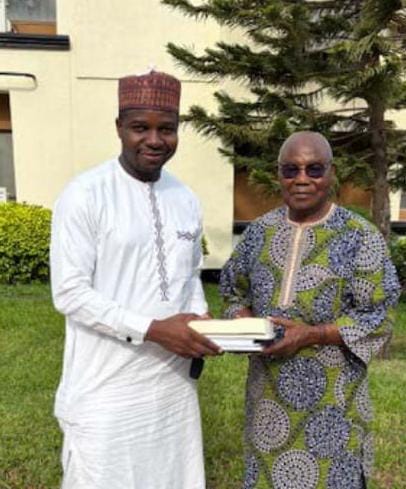
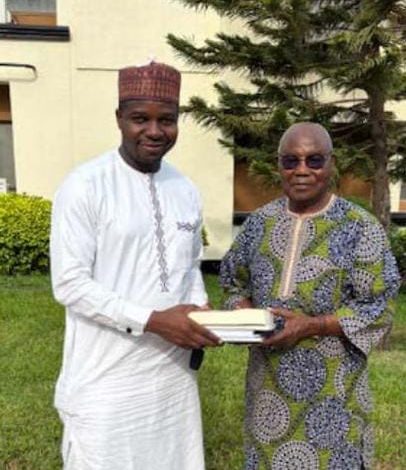
Malam Zahradeen Ibrahim (left) receiving books from Dr. Bukar Usman
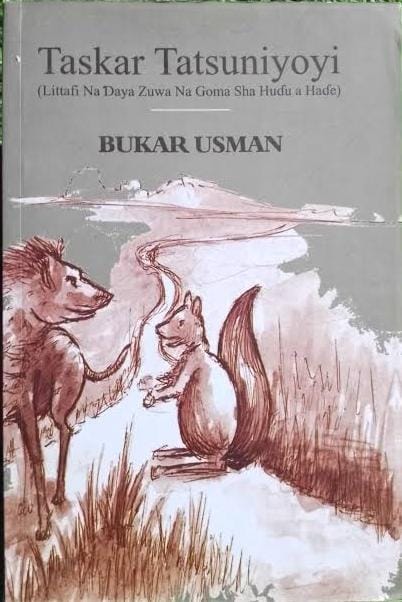
“Having come across your remarkable compendium, Taskar Tatsumiyoyi, as well as your other folklore publications available at www.bukarusman.net, I am convinced that your body of work represents the most authoritative and comprehensive collection of these stories available today. I am therefore writing to formally request your written authorization to adapt your published tatsuniyoyi into video productions.”
Ibrahim was quick to outline the both the scope, purpose and other areas the adaptation of the works would entail for clarity. Accordingly, he stays, “This request covers all tatsuniyoyi and folklore content you have published to date — including but not limited to Taskar Tatsuniyoyi and all related publications on your website — as well as any future tatsuniyoyi you may publish going forward, subject to your approval for each new work or collection. The sole purpose of the video adaptations is cultural preservation and education — to present these stories in a format that is engaging and accessible to the younger generation, who are accustomed to digital and visual media.”
Ibrahim further outlined other terms of the adaptation to include attribution and credit, noting, “All video productions will clearly and prominently credit you, Bukar Usman, as the original author and source of the tatsuniyoyi. Your name, authorship, and legacy will be fully preserved in every production, including in the video itself, its description, and any associated promotional material. All video productions will be shared free on social media platforms like Youtube, Facebook, Instagram and other channels I deem appropriate to enable maximum reach as well as preservation of the work, under my learning platform Mukoyar. The stories will be adapted faithfully and respectfully, without distorting their original meaning, cultural context, or moral lessons. You retain the right to withdraw your authorization for any future works at any time, with written notice.”
Ibrahim ended his request thus, “I kindly request that you confirm your authorization in writing — by signing a simple letter of consent — so that we both have a clear and documented understanding of our agreement. I deeply appreciate the trust you have placed in me during our meeting, and I assure you that this project will be carried out with the utmost respect for your intellectual property and for the cultural heritage of our people.”