

Survival, scale, sustainability: Nigerian publishers chart new future at NIBF 2026

By Olufemi Timothy Ogunyejo
THE prestigious Wole Soyinka International Theatre, Iganmu, Lagos, became a melting point of intellectual engagement, policy reflections, and industry foresight on Thursday, May 14, 2026, as the Nigerian Publishers Association (NPA) hosted its Executive Roundtable and Panel Discussion during the second day of the ongoing 2026 Nigeria International Book Fair (NIBF) 2026. With the compelling theme, ‘The Future of Publishing in Nigeria: Survival, Scale, and Sustainability,’ the session transcended a routine conference discussion and evolved into a strategic business forum for leadership insight into the future of publishing in Nigeria and across Africa.
The atmosphere inside the hall was both relaxed and intellectually charged. Stakeholders across the book ecosystem – publishers, booksellers, scholars, educators, printers, librarians, authors, policymakers, and readers – converged in a conducive environment where ideas flowed freely and divergent opinions were welcomed with mutual respect.
At the centre of the discourse was the growing tension and harmony between traditional publishing and digital disruption. The robust engagement revolved around hybrid publishing, the sustainability of print, the inevitability of digital innovation, affordability of books, infrastructural challenges, readership culture, collaboration, technological adaptation, and the urgent need for publishers to carve strategic niches in an increasingly competitive global environment.
Opening the session, the Nigerian Publishers Association’s President, Alhaji Lukman Dauda, delivered a thought-provoking welcome address that set the tone for the day’s deliberations. He described the gathering as timely and significant, stressing that the publishing industry globally is undergoing rapid transformation driven by technology, changing reading habits, digital innovation, economic realities, and what he termed “excruciating government policies and pronouncements.”
According to him, Nigerian publishers must continually re-evaluate their operational strategies to remain resilient, competitive, profitable, and sustainable. He noted that the roundtable was designed to stimulate meaningful engagement, collaborative thinking, and practical solutions capable of repositioning the Nigerian publishing industry for growth and long-term relevance.
The NPA president further emphasised that publishing remains central to knowledge dissemination, intellectual development, creativity, education, and cultural preservation. He urged stakeholders to participate actively, exchange ideas freely, and build strategic partnerships capable of moving the industry forward.
Perhaps one of the major highlights of his remarks was the announcement of the proposed commencement of the Publishers Institute, a developmental initiative aimed at strengthening professionalism, capacity building, and institutional advancement within the publishing sector.
The session itself reflected the scholarly depth and academic rigour of its moderator, Dr. Samuel Okere. With intellectual dexterity, analytical precision, and practical industry understanding, the moderator guided the conversation beyond mere rhetoric into evidence-based engagement.
His interventions consistently connected technology, communication, publishing realities, and the future of knowledge systems. Okere argued that technology was not taking books away from society but rather creating new pathways for accessibility, engagement, and knowledge distribution. He explored concepts surrounding augmented reality, feedback systems, and evolving technological realities that are redefining publishing globally.
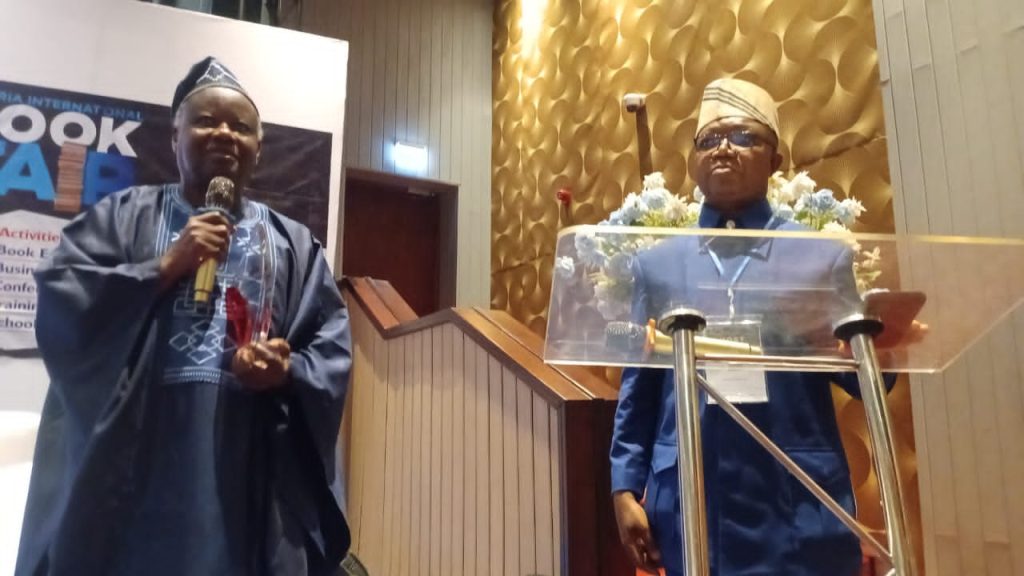
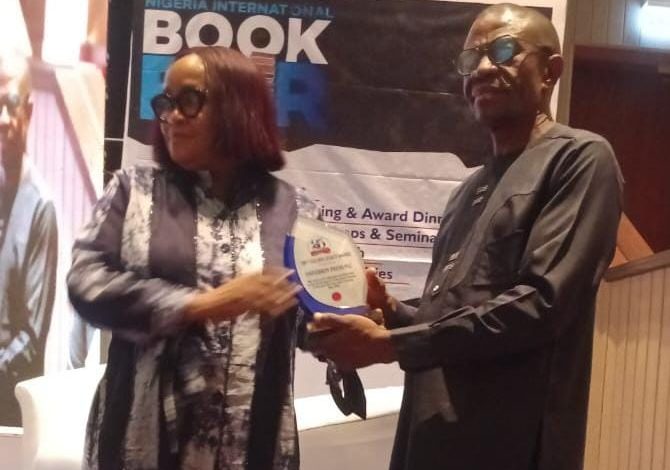
Former National Librarian/CEO of National Library of Nigeria (NLN), Prof. Lenrie Olatunbosun Aina (left) and the President of Nigerian Book Fair Trust, Mr. Dare Oluwatuyi
The panel featured respected industry voices, including Alli Semako Okunade, Dapo Fisayo, Msurshima Comfort Chenge, and Kayode Adeyemo, and their submissions reflected varying perspectives on how Nigerian publishing can survive harsh economic realities while scaling sustainably in the digital era.
In one of the memorable moments of the session, Fisayo quoted late Moshood Kashimawo Olawale Abiola, popularly known as MKO Abiola, saying: “You cannot clap with one hand.” The quote became symbolic of the collective responsibility required among publishers, printers, booksellers, educators, government institutions, and readers to sustain the Nigerian publishing ecosystem.
Participants repeatedly applauded Nigerian publishers, readers, and printers for their resilience and commitment towards making reading accessible to all through multiple platforms. The moderator particularly commended stakeholders whose collaborative efforts continue to keep the culture of reading alive despite economic and infrastructural limitations.
Contributions from the audience further enriched the discourse and demonstrated how deeply the issues resonated across sectors. Stakeholders raised concerns surrounding end-user experiences, particularly the challenges of payment systems, book returns, and the growing menace of pirated copies being sold alongside original textbooks in the market.
Speaking from the perspective of rural education, a participant called attention to the social responsibility of publishers toward schools in underserved communities. Responding, Mrs. Chenge highlighted ongoing efforts by publishers to support rural and interior communities through book donations and reading initiatives aimed at deepening literacy culture.
On the same issue, former NPA President, Chief Cyril Anioke, advocated for the formation of reading clubs and literary associations in underserved areas. He also encouraged publishers to produce low-cost editions for economically disadvantaged readers and urged industry players to leverage book fairs as platforms for engagement, networking, and expanding readership reach.
Chairman of the Fair, Dare Oluwatuyi, revealed how publishers and the book fair trust had donated books across several states and was championing a visionary project involving the donation of 10 million books across Nigeria. According to him, the initiative seeks to penetrate every nook and cranny of society while integrating young pupils into the conceptualisation and development of book engineering processes.
In another critical intervention, the Chairman of both Accessible Publishers Ltd, Oxygen FM 96.9 and REPRONIG, Mr. Gbadega Adedapo, stressed the importance of visibility, data, and technological integration in modern publishing. He noted that the publishing industry is changing rapidly and advised publishers to invest heavily in technology, hardware, content architecture, and algorithms as foundational components for future growth.
While identifying technology, organisational limitations, environmental factors, unstable electricity, and unfavourable government policies as major industry challenges, Adedapo nevertheless insisted that digital adaptation remains inevitable despite potentially slow adoption rates.
The continental dimension of the discussion emerged through the contribution of the Secretary-General, Pan African Writers Association (PAWA), Dr. Wale Okediran, who observed that across Africa there exists a significant gap between policies and enforceable laws. He therefore advised the Nigerian Publishers Association to intensify efforts towards transforming publishing policies into actionable legislative frameworks through parliamentary engagement.
Similarly, former National Librarian/CEO of National Library of Nigeria (NLN), Prof. Lenrie Olatunbosun Aina, eulogised NPA for its longstanding contributions to educational development within and outside Nigeria. He strongly recommended that the association should secure representation in all government agencies connected with education and intellectual development.
Throughout the engagement, one recurring consensus stood above every disagreement: collaboration remains the ultimate pathway to survival, scale, and sustainability in Nigerian publishing. Whether discussing digital publishing, infrastructure, affordability, piracy, policy formulation, readership culture, or technological adaptation, participants consistently returned to the idea that no segment of the book ecosystem can thrive in isolation.
The session also witnessed the presence of eminent personalities within Nigeria’s literary and academic community including Dr. Kolade Mosuro, Prof. Olu Obafemi and Prof. Chinwe Anunobi, among several distinguished stakeholders. By the end of the session, one reality had become unmistakably clear: the future of publishing in Nigeria will not merely depend on survival instincts, but on strategic collaboration, technological adaptation, policy influence, professional innovation, and a collective determination to sustain the culture of reading and intellectual development for generations to come.
* Ogunyejo is a member of NIBF 2026 Media and Publicity Team
nn


0 Comment
talk about sadness!