Canonising emerging texts: Writers, publishers, curricula developers, exam bodies tasked to forge stronger ties


By Celina Chinwemmeri Ikechukwu
THE Authors’ Hub, a WhatsApp group made up of writers from Nigeria and Africa, held its 12th virtual Monthly Panel Discussion with the theme ‘Interrogating the Absence of Emerging African Writers in School Curricula’ on April 25, 2026, from 4:3pm to 6:00pm via Google Meet. The session, which had a large turnout of attendees, brought together accomplished writers, scholars, and literary practitioners to discuss the absence of emerging African writers in school curricula. The old writers still dominate in spite of the sterling output of young and emerging ones
The discussion was moderated by an emerging scholar and poet and founder of STRIDA Club that has connected writers across 10 countries, Rashidat Ajakaye. She is the author of Shattered Shadows of Youths. She is a Graduate Assistant in the Department of Language, Arts and Social Science Education at Lagos State University, Ojo. She made history as the first First-Class graduate in English Education in over four decades (2022/2023) of the university. During the session, she brought both academic depth and practical literary experience to the conversation, steering the session with clarity and insight.
The panel featured an array of respectable speakers that include a distinguished scholar, award-winning poet and novelist, Fellow of ANA, and professor of Medical Geography at Bayero University, Kano, Prof. Yusuf Adamu, a seasoned administrator and literary figure who served as a Director at the National Youth Service Corps (NYSC), Dr. Ahmed Wada Ikaka, a distinguished academic, writer, and mentor, who taught for many years in the Department of English at Obafemi Awolowo University, Prof. Segun Adekoya, a renowned academic, writer, public administrator, a former Commissioner for Education in Anambra State, Prof. Ngozi Chuma Udeh and the recipient of Global Writing Company Award (2019) and Intercontinental Writers Award (2025), Bishop Sahr Isaac Peterson. The session was hosted by the founder and coordinator of Authors’ Hub, Sumaila Isah Umaisha.
The moderator Ajakaye formally opened the session by welcoming the panelists and participants. She introduced the discussion theme, ‘Interrogating the Absence of Emerging African Writers in School Curricula,’ and noted its relevance to contemporary literary development, cultural representation, and educational reform. She then introduced the panelists, highlighting their contributions to literature, scholarship, and cultural discourse. After briefly reflecting on the significance of the topic, she thanked Mr. Umaisha for providing a forum to discuss such important topic.
In responding to how interdisciplinary approaches strengthen the case for including African writers in traditionally canon-driven curricula, Prof. Adamu emphasized that writers from diverse academic backgrounds, especially the sciences and social sciences, bring valuable perspectives that enrich literary discourse. According to him, interdisciplinary approaches combine analytical insight with creative expression, thereby expanding the way literature is studied and appreciated. He argued that the exclusion of emerging African writers from school curricula is closely tied to the question of canonization: How do we canonize? Who do we canonize? Who do we give a read?”
Adamu further explained that many institutions continue to rely on already established names while neglecting newer voices, often because educators and critics are more familiar with older texts. He noted that this dependence on traditional literary canons limits innovation and representation. He stressed the need for scholars, critics, and curriculum developers, who are willing to research, evaluate, and promote contemporary African writers. He concluded that unless deliberate efforts are made to recognize and include new voices, the visibility of emerging writers within formal education systems will remain “very elusive.”
While addressing the impact of excluding emerging African writers from school curricula, Dr. Ikaka drew from his experience in youth development through NYSC, where intellectual and moral growth remain central objectives. He described literature as a vital tool for shaping young minds, noting that it strengthens critical thinking, analytical ability, emotional intelligence, and problem-solving skills, while keeping youths aware of events within their environment.
On moral development, he explained that literature serves as a mirror of society and a guide for navigating life’s complexities. According to him, texts help young people develop empathy, ethical reasoning, sound judgment, and the ability to make responsible choices.
Dr. Ikaka observed that many older canonical texts largely focus on precolonial, colonial, and early post-colonial struggles. While these works remain historically valuable, he argued that overreliance on them creates a disconnect with present realities.
“The society is dynamic, and the younger generation of Africans must move with the new order,” he argued.
Ikaka stressed that contemporary writers are better positioned to address pressing modern concerns such as corruption, insecurity, poverty, cybercrime, poor education, abuse of power, and economic dependency. For this reason, he strongly supported the inclusion of emerging African writers in curricula, stating that “the knowledge and wisdom of modern characters are found among the new generation writers.”
On institutional reforms, Dr. Ikaka recommended regular curriculum reviews every three years to accommodate newer texts, greater involvement of state ministries in selecting local authors, and policies requiring examination bodies such as WAEC, NECO, JAMB, and NERDC to include a percentage of works by new writers. He also called for publishing grants, expanded literary awards, stronger online platforms for publicity, and annual engagements between writers, educational agencies, and government stakeholders.
Prof. Segun Adekoya delivered a wide-ranging and intellectually rigorous intervention on literary criticism, canon formation, and the place of emerging African writers in school curricula. He began by explaining that critical criteria are the standards used to assess literary works. These include elements such as plot, characterization, language, rhythm, theme, setting, and point of view. Critics, he noted, examine whether these devices are effectively used and whether they produce a coherent, meaningful, and aesthetically satisfying work. In his words, literary judgment concerns “what is written, how it is written, and the value of what is written.”
Adekoya observed that critics remain divided on whether literary standards are universal or relative. Some believe enduring writers such as Homer, Sophocles, Euripides, Aristophanes, Chaucer, Shakespeare, Milton, and Alexander Pope achieved greatness by mastering timeless artistic principles. Others argue that values are culture-bound and constantly shifting. He stressed that while classical principles remain useful, contemporary writers must respond truthfully to present realities. Citing Ola Rotimi’s The Gods Are Not to Blame, he noted that though the play follows Aristotelian structure, it places responsibility for tragedy on human actions rather than divine forces. He also referenced Wole Soyinka’s ‘Dawn’ as an example of innovation within inherited forms.
According to Adekoya, modern society has altered the nature of tragedy itself, and science and technology have weakened older beliefs in fate and divinity while new global realities often make suffering appear absurd or “comically tragic,” as seen in Franz Kafka’s Metamorphosis. Yet he warned that modern inventions, including artificial intelligence, while promising liberation, also carry destructive potential
.
Turning directly to the panel theme, Adekoya argued that it is inaccurate to claim that emerging African writers are entirely absent from curricula. Rather, he said, they are underrepresented, and cited current WAEC texts such as Pede Hollist’s So the Path Does Not Die, Elma Shaw’s Redemption Road, Bosede Ademilua-Afolayan’s Once Upon an Elephant, Elizabeth L. A. Kamara’s New Tongue, and S. O. H. Afriyie-Vidza’s Hearty Garlands.
At tertiary level, he noted that institutions already have room to introduce newer voices. He referenced writers such as Chimamanda Adichie, Chika Unigwe, Helen Oyeyemi, Helon Habila, Kaine Agary, Onyeka Francisca Onyekuba, Chinelo Okparanta, Chinyere Grace Okafor, Chigozie Obioma, Elnathan John, and Segun Afolabi as examples of contemporary authors already gaining curricula presence.
Adekoya emphasised that selecting texts is never simple, adding that space, time, relevance, and quality all matter. Literary judgment, he said, often includes subjectivity, reminding participants that “Beauty is in the eye of the beholder.” He further noted that access remains a major barrier. Many writers self-publish, he said, as weak distribution systems mean books do not circulate across Africa. Teachers cannot teach texts they cannot obtain. He called for stronger public libraries and better publishing networks.
On canon formation, he reminded participants that literary reputation changes with time, stating that writers once considered “unpopular” or marginal, like Shakespeare, later entered the canon. “The world is a marketplace of ideas,” he declared, where newcomers must compete for space and recognition.
Adekoya therefore advised emerging writers not to lose hope or become impatient when society fails to understand them immediately. They should continue refining their craft, mastering the rules before attempting to break them, he advised. While many younger writers are bold and confrontational in tone, he noted that subtlety remains one of art’s highest strengths.
In one of his most striking remarks, he lamented that “art has lost its ability to speak,” urging writers to restore literature’s power to challenge, illuminate, and endure. He concluded that the surest path for emerging writers is excellence, persistence, and confidence: not shortcuts or connections, but the “craggy and rugged road” that leads to unquestionable greatness.
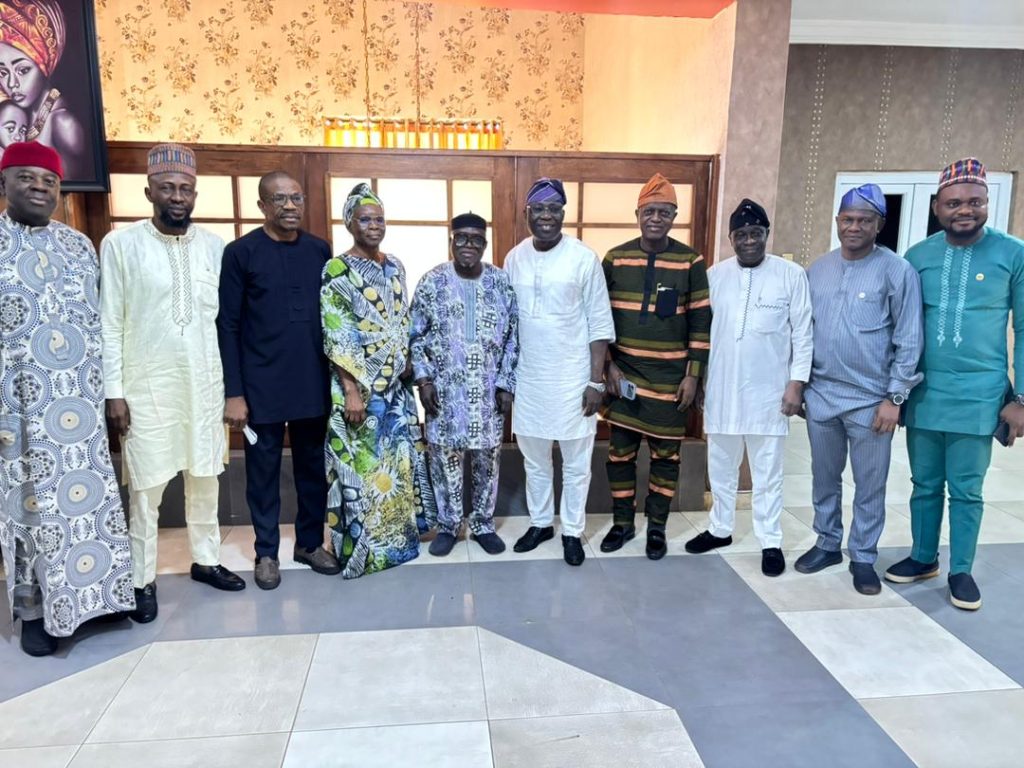
Former President of Nigerian Publishers Association (NPA), Dr. Uchenna Cyril Anioke (left); President, Association of Nigerian Authors (ANA), Dr. Usman Akanbi; former ANA President, Dr. Camillus Uka; MD/CEO of Showers Kiddies Publishers Ltd, Mrs. Yomi Ogunlari; former Chairman of REPRONIG and Emeritus Professor Olu Obafemi; REPRONIG Chairman, Mr. Gbadega Adedapo; Secretary-General of Pan-African Writers Association (PAWA), Dr. Wale Okediran; President of NPA, Alhaji Lukman Dauda; Deputy Director, Regulatory and Compliance of Nigerian Copyright Commission, Mr. Kunle Olatunji and Acting Executive Director of REPRONIG, Mr. Tosin Akeredolu at a recent REPRONIG sensitisation engagement… in Ibadan
Prof. Chuma-Udeh approached the discussion from an educational and practical standpoint, stressing that the issue is not the absence of African writers alone, but how curricula are structured and managed within a limited academic system. She noted that Africa and Nigeria already possess many gifted writers, including globally recognized voices such as Adichie and numerous others. However, she cautioned against overloading students with too many texts, observing that “there are so many wonderful writers in Africa… if the children are to read all of them, it’s going to be too Herculean for them.”
According to her, education operates within a system of macro and micro structures, where books are reviewed periodically and selected according to each level of learning. She maintained that African literature and African writers should continue to be adequately represented through these review processes. Speaking candidly, she remarked: “I am not going to be sentimental about it,” explaining that many writers strongly desire to have their books prescribed for secondary school classes, but curricula inclusion must go beyond personal ambition.
Chuma-Udeh emphasised that at every stage of text selection, indigenous works should be intentionally represented: “Between every set of books, at least one of our own books should be included, especially within the school curriculum.”
She then moved to what she considered a deeper solution. Literature, she said, should not be written merely to enter the curriculum, stressing, “Literature is not life, but literature is an imitation of life. Therefore, we should not write only for the sake of the curriculum; we should write for a general readership.”
For a book to attain lasting relevance, she argued, it must speak beyond the classroom. An engineer, doctor, farmer, and ordinary reader should all be able to connect with it. In her words, “That is the true representation of reality.”
She identified three qualities that elevate a book to greatness: It must pass from one generation to another and continues to be valued. It must earn enduring acclaim over time. It must transcend geography, so readers across cultures appreciate it, noting that a Chinese reader, a South American reader or an Australian reader should be able to encounter the text and say, “Wow, this is beautiful!”
She concluded by reminding participants that curriculum space is limited. While many talented writers deserve recognition, not every worthy book can be included at once. She referenced examination bodies such as WAEC and NECO, noting that several African texts are already in use. The real challenge therefore is not inclusion alone, but fair selection, quality, and broad relevance.
Responding with passion and conviction, Bishop Peterson affirmed that emerging African writers are still struggling for recognition, not only within school curricula, but within wider cultural, educational, and literary systems. Speaking from his experience in Sierra Leone and the broader West African space, he identified one of the greatest obstacles as the decline of reading culture. According to him, the rise of social media has shifted the attention of many young people away from books, with a large percentage now more engaged online than in sustained reading. This, he said, has weakened literary growth, readership, and intellectual culture. He also questioned the continued dominance of foreign texts in African classrooms. While clarifying that he was not opposed to Shakespeare, he argued that many classical texts contain language and expressions unfamiliar to younger African learners. Terms such as “thou” and “thee” may be difficult for children at foundational levels, making literary engagement less accessible.
Peterson maintained that if African writers such as Achebe, Adichie and others had been consistently prioritized earlier, foreign writers would not have occupied such overwhelming space in African reading culture.
A central part of his intervention focused on identity and originality. He argued that Africa has been gradually distanced from its own voice through inherited systems that undervalue indigenous creativity. In one of his strongest remarks, he declared: “We have been beaten out of our Africanness.”
Using the story of Kunta Kinte in Roots, whose name was changed to Toby, he illustrated how identity can be erased through imposed systems. He linked this directly to literature, stating that African writers are often pressured to abandon their authentic styles, names, and creative expressions in order to fit foreign expectations.
He lamented the growing culture of imitation among creatives, saying: “The writing system, we are all becoming copycats,” and further explained with a memorable analogy: “Just like an artist who performs another person’s song, you may appreciate it, but when it is not originally yours, the rightful owner remains the one who deserves the recognition. That is how Africa is.”
According to him, African societies often celebrate borrowed forms while neglecting the ones that are original to them. Many writers, he argued, are praised for writing in foreign styles rather than developing their own voices and techniques. Drawing from his own struggles within Sierra Leone’s literary space, he hinted at the difficulty younger writers face in entering or reforming structures that are slow to recognize new voices. He also expressed concern about weak coordination among literary institutions and inconsistent educational reforms across parts of West Africa, where new subjects or curricula changes are sometimes introduced without clear planning or long-term direction.
While careful not to condemn his country, he acknowledged that many of the literary works currently gaining broader recognition in the region are coming from Nigerian writers, who are intentionally developing their craft and engaging seriously with literature.
Peterson therefore called for unity among African writers, scholars, and institutions. In his words, “For African works to be known to the world, we should be united and work together to make them recognized,” and urged Africans to build a common literary vision to promote their writers, originality, ideas, and creative methods, so that the continent can speak confidently through literature rather than remain under the shadow of others.
Others who attended the meet lent their voices to the issue. Poet, playwright and culture administrator, Mallam Denja Abdullahi, highlighted systemic gaps in how literary texts are selected and integrated into Nigeria’s educational curriculum, stressing that the core challenge lies in weak coordination among key gatekeeping institutions. He observed that there is a disconnect between policy, implementation and practice, noting that although revised curricula exist, many schools still rely on outdated versions.
In his words, “the gatekeepers; those who determine what a nation presents, are disconnected.” This, he argued, reflects a broader failure of inter-agency collaboration and governmental follow-through. According to him, curriculum content is shaped by multiple stakeholders, including policymakers in education, literary scholars, publishers, and prize institutions. However, he emphasized that without a clear national framework, these actors operate without cohesion or direction. He raised fundamental policy questions: What do we want our children to read? Who determines this? Who assesses it? And who ensures implementation? For him, the absence of a clear literary and educational policy is the root of inconsistency in curriculum design.
Denja also drew attention to weaknesses within assessment systems such as Education Resource Centres, noting that decisions are sometimes influenced by lobbying rather than merit. As a result, substandard works may enter the curriculum while high quality Nigerian texts are overlooked. He stressed that effective selection cannot rely on advocacy alone but must be guided by transparent, rigorous evaluation processes involving qualified literary experts and experienced writers.
He concluded that Nigeria’s literary education system suffers from a lack of structure and alignment between policy, assessment, and implementation. Without this coordination, he warned, “all kinds of books find their way into the education system,” many of which fail to reflect national priorities or address contemporary societal challenges.
Ultimately, he called for a clearly defined literary and educational policy that determines not just what is read in schools, but why it is read, and how it serves the development of society.
While building on earlier submissions, Dr. Awele Ilusanmi, emphasized that beyond policies, frameworks, and institutional discussions, the central issue is care and responsibility. Aligning with Denja’s point on systemic gaps, Ilusanmi stressed that meaningful reform must begin from a place of genuine commitment. In her words, “Do we really care enough?” She further argued that until those responsible for education and literary selection take ownership with sincerity, structural reforms alone will not yield meaningful change.
She noted that the problem is not only about selecting or “logging” books into curricula, but about ensuring that the right people—those who truly care about educational quality—are involved in the process. Ilusanmi further emphasised that standards must not be compromised, and insisted on prioritizing quality over mediocrity, stating that Nigeria must avoid “low products” in its educational system.
She concluded that if stakeholders genuinely cared enough to make the right decisions, strengthen institutions, and prioritize quality education, then the broader outcome will be a more effective system and ultimately a better society.
Another attendee, Prisca Nwokorie, noted that many quality textbooks are often absent from school curricula not because they lack merit, but because of limited visibility, access or lack of institutional connections. She explained that even suitable books may be excluded if the authors or publishers are not well positioned within the system. She stressed that curriculum improvement cannot depend on individuals alone, but requires a collective and structured effort to ensure that good educational materials are fairly considered and adopted in schools.
The panel members had a moment to make closing remarks that reflected their broader submissions on the topic. Prof. Adamu noted that contemporary African voices are not truly absent, as literature now exists in both print and digital forms. However, he stressed that several structural challenges limit their visibility and impact. He identified key issues including very small print runs (often under 1,000 copies) with little or no reprints, poor book distribution and low purchasing culture, leading to limited readership, weak promotion and visibility of new works and inadequate book reviewing culture, causing delays or absence of critical engagement.
He further explained that efforts to document and highlight local writers are ongoing, including collaborations across disciplines. However, he acknowledged that attempts to spotlight certain voices can sometimes generate tension within academic and literary spaces.
He concluded that improving visibility, promotion, and documentation systems is essential for integrating contemporary African literature more effectively into academic and public reading spaces.
Dr. Ikaka emphasised that the goal is not to replace canonical texts, but to create space for emerging African voices within the curriculum. He used a simple analogy, noting that reading the same type of content repeatedly is like “eating rice every day,” which becomes monotonous, and stressed the need for variety in literature. He proposed key institutional strategies, including regular curriculum review (ideally every 3 years) to include contemporary writers, greater flexibility for state ministries of education to select texts from emerging authors and decentralization of curriculum selection to reflect regional and local literary realities.
Ikaka further argued that just as past educational reforms allowed structured language teaching systems, similar openness should now be applied for literary inclusion.
He concluded that a more flexible and decentralized approach would make the curriculum more inclusive, dynamic and responsive to contemporary African realities.
Prof. Adekoya stressed that the literary space is now heavily influenced by economic and political realities, where publishing has become highly commercialised and competitive, making it difficult for emerging writers to break through without strong support structures. He noted that political and economic narratives often dominate public discourse, reflected in what he described as Buharinomics, Abachanomics, and even Tinubunomics, which illustrate how political contexts shape writing, publishing, and attention in the literary space. He recommended practical solutions such as increasing annual literary awards and ensuring that winning works are adopted into school curricula.
He also raised concerns about the decline in reading culture, linking it to the influence of social media and digital distractions. According to him, “this Gen-Z era” has significantly shifted attention away from books, as many young people spend more time on phones engaging with entertainment content rather than reading.
Adekoya concluded that while the challenges are significant, strengthening recognition systems and rebuilding reading culture are essential for sustaining literary growth and relevance.
The key takeaways were that curriculum and canon inclusion is structured but limited. African writers are present but underrepresented due to selection systems, institutional constraints, and weak coordination among education bodies, publishers, and policymakers. Writing today demands both craft and strategy requiring emerging writers to focus on strong storytelling while also understanding audience, visibility, marketing, and publishing as part of a growing creative economy. Also, sustaining African literature requires systemic and cultural support such as improved reading culture, stronger policies, better promotion/distribution systems and intentional collaboration among stakeholders as essential strategies for literary growth and global recognition.
* Ikechukwu, a student and award-winning writer, served as rapporteur for ‘Authors’ Hub’