When myth meets imagination in Olugbile’s prize-winning novel, ‘Sanya’

By Godwin Okondo
WINNER of The Nigeria Prize for Literature 2025, Oyin Olugbile, has said her award-winning novel Sanya was borne out of curiosity, deep research and a desire to challenge how African stories, particularly Yoruba mythology, are told and preserved. In an interview following her win, Olugbile traced the roots of the novel to her academic background in Theatre Arts at the University of Lagos and a later career shift into social impact consulting. Although she stepped away from the creative arts space for years, she said knowledge never truly leaves a person.
“Sometimes knowledge stays with you, and sometimes it comes as a seed you don’t even know is there,” she said.
That seed was activated while she was consulting on a project focused on child abuse for an education foundation. During the research process, her curiosity unexpectedly led her to the story of Oranmiyan and, from there, to Sango. What began as an incidental research soon deepened into months of immersion in Yoruba history, mythology and oral tradition.
Olugbile said she became particularly interested in the inconsistencies and gaps within popular accounts of Sango’s life, especially the relationship between Sango and his brother Ajaka, often referred to in Yoruba sayings as ‘Dada.’ According to her, Ajaka was historically portrayed as a weak king, possibly with physical deformities, whose rule was challenged by Sango’s growing influence and military strength. She explained that Sango and Ajaka did not grow up together, a detail that opened new creative possibilities for her.
“You can imagine the mind of a brother thinking, ‘Who are you? Where are you coming from?’” she said, noting that this tension formed the emotional backbone of Sanya.
Her reimagining of Sango as Sanya, a woman who conceals her identity to rule, emerged from this line of inquiry and from her reflections on betrayal. Olugbile questioned why Sango’s eventual betrayal was so devastating that it led to his suicide, arguing that such a wound was more likely inflicted by someone emotionally close rather than a general or rival. Drawing on Yoruba proverbs and family dynamics, she theorised that the betrayal might have come from within.
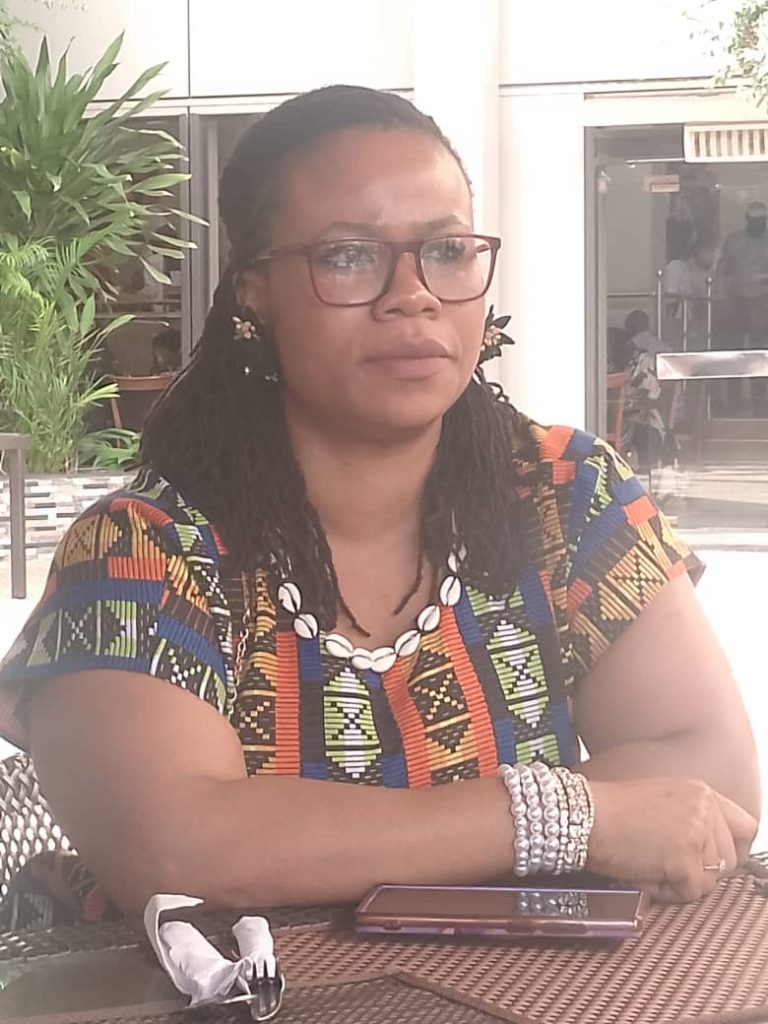
Oyin Olugbile
She acknowledged that her interpretation would be controversial but said that was partly intentional: “The idea was to let the controversy come, so that something can change.” Describing herself as rebellious, Olugbile said she was prepared for any backlash from cultural custodians and readers uncomfortable with re-examining revered figures.
Responding to accusations that the novel was a feminist project aimed at diminishing men, Olugbile rejected the label, arguing that feminism has been widely misunderstood in contemporary discourse. She said feminism, as originally conceived, was about giving women a voice without putting men down.
“If someone hates men, that is not feminism, that is misandry,” she said.
According to her, the decision to present Sango as a woman was not ideological but narrative, adding, “This is how the story made sense to me, based on the information, the characteristics, and the way the story has been handed down,” adding that she was not attempting to argue that a woman would have been a better ruler than a man.
Addressing concerns from traditional institutions, including hypothetical objections from Oyo or Ife royal palaces, Olugbile offered an apology while insisting that her work was not an insult to the throne. She disclosed that her mother’s family is from a royal lineage in Iwo and that she grew up around royal and cultural institutions. She suggested that the strong resistance to the idea of a woman ruler raises its own questions about whether female leadership might have existed historically but remained hidden due to cultural restrictions.
Beyond mythology, Olugbile described Sanya as a story of becoming, drawing parallels between the protagonist’s journey and the experiences of Nigerians and Africans navigating identity, failure and reinvention. She reflected on her own nonlinear path through software engineering, theatre, business and back to the arts, arguing that detours do not equal failure.
Expanding the conversation to nationhood, Olugbile urged young Nigerians to engage more deeply with civic education, the constitution and the electoral process. She argued that ignorance allows poor leadership to thrive and insisted that meaningful change often begins at the community level, just as Sanya’s transformation began in small, personal spaces.
Looking ahead, she said she plans to give back by supporting emerging writers, with discussions already underway with her publisher, Masobe Books, to identify and publish promising new voices, regardless of genre.
On the process of writing Sanya, Olugbile said the idea first took shape in 2017, when she wrote a summary and an initial chapter. Progress was slow due to family life and other responsibilities, but she stressed that writing itself, not ideation, is the real labour. Accountability, she said, played a key role. Her husband consistently pushed her to write, while a professional editor provided critical feedback and structural guidance.
She cautioned emerging writers against seeing writing as a solitary pursuit. “Writing is not a one-man journey,” she said, urging writers to seek editors, mentors and accountability partners.
Olugbile revealed that her path to publication was not without setbacks. An early draft of Sanya, submitted without professional editing, was rejected by a publisher. Rather than submitting elsewhere immediately, she returned to the manuscript, reworked it extensively with her editor and only then resubmitted. The revised work went on to win The Nigeria Prize for Literature, Nigeria’s most prestigious literary award.
She said the win has been both validating and inspiring, noting that Sanya is her first published novel. “It shows that you don’t need many books out there for one work to be exceptional,” she said. While she has co-written a nonfiction book and is currently working on several manuscripts, including screenplays, Sanya remains her only novel for now.
Sanya continues to sell out in bookstores across Nigeria, including major outlets in Lagos and Ibadan, reinforcing its status not only as a prize-winning novel but as a catalyst for renewed debate on African history, mythology and the freedom to imagine.
AND at the award ceremony on October 10 in Lagos, Olugbile gave a heartfelt address while receiving her prize from the organiser and sponsor, NLNG:
Good evening, distinguished guests, kindred spirits, fellow storytellers.
I stand before you tonight, not simply as a writer, but as a witness—to memory, to imagination, and to the quiet, persistent power of the African voice.
When I wrote Sanya, I wasn’t trying to impress the world. I was trying to remember it. I was trying to return to a place—part memory, part myth—where grief and beauty could sit at the same table. Where silence could speak, and where language could do what it was always meant to do: hold us.
I did not begin my life with the dream of becoming a novelist. My work started in the fields of advocacy and leadership, where I tried to shift systems and open space. But storytelling was always there, beneath it all—waiting, whispering. One day, I listened. One day, I said, ‘yes.’
And in that yes, Sanya was born.
This story is not just mine—it belongs to every African who has had to piece themselves together across borders, across generations, across silences. It belongs to the daughter who holds her mother’s sadness in her bones. To the son who can’t say I love you in his father’s language. To those of us who live between the ancient and the modern, who are still learning how to carry both with grace.
Writing for me is not escape. It is return.
It is not entertainment. It is reclamation.
It is not just craft. It is calling.
And tonight, this prize is not only an honour. It is a message.
It says that our stories are not footnotes. They are the main text.
It says: our languages, our metaphors, our ancestral rhythms, they belong on the world stage.
It says: we are no longer waiting to be discovered. We have arrived, and we are writing ourselves into the future.
To my husband—you have been my mirror, my courage, and my calm. To my children, whose laughter reminds me of what joy looks like when it’s still unbroken—you are the reason I write of wholeness. And to my father, who handed me stories like seeds—this is your harvest.
To every reader who found a piece of themselves in Sanya—thank you. You are why these pages live.
To my fellow writers—may we continue to write with fire and tenderness.
To Othuke and the entire Masobe team, thank you for believing in me.
To NLNG, thank you for believing that African literature is not charity—it is a legacy.
Finally, I dedicate this award to the African child who is still trying to find herself on the page.
She is not lost.
She is simply waiting.
And may this be her sign to begin.
Thank you.