
When English thinks in Igbo: The linguistic craft of Ashimole’s ‘The Other Insider’

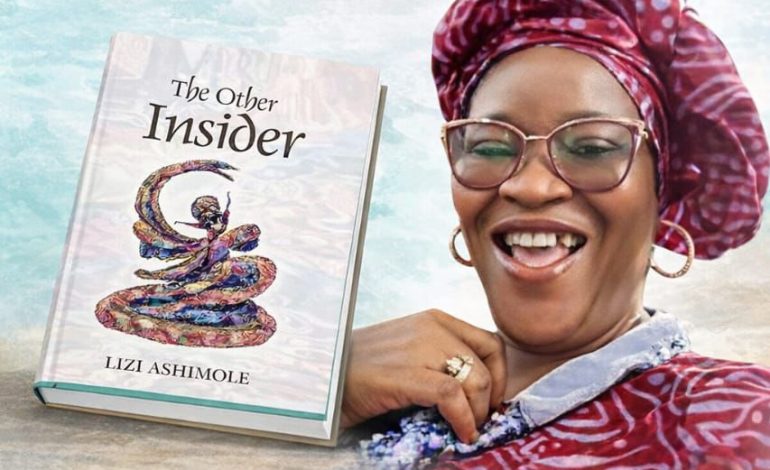
By Mazi Uche Ohia
IT takes time to find a book that titillates the taste buds of an old soldier in the literary field with refined expectations. I received a copy of The Other Insider by Lizi Ashimole with modest anticipation, not having read her earlier works. Yet, from the opening pages, it became clear that this was no ordinary narrative. It was a book written with high marksmanship – confident, deliberate, and deeply rooted in cultural consciousness.
In The Other Insider, Ashimole demonstrates an uncommon command of the English language and an uncanny ability to transmit Igbo concepts, values, thought patterns, and cultural perspectives into English without losing meaning, rhythm, or ambience. This is no small feat. English, for all its global dominance, does not naturally carry the tonal subtleties, communal sensibilities, and philosophical cadence of Igbo thought. Many writers lose something in translation. Ashimole does not. Instead, she persuades English to behave like Igbo.
Her prose is filled with poetic imagery and clarity of thought reminiscent of the great stylists – Chinua Achebe’s cultural precision, Cyprian Ekwensi’s narrative fluidity, and Chimamanda Adichie’s contemporary elegance. Yet her voice remains distinctly her own. She paints pictures with words so vividly that the reader becomes a ringside spectator, observing not merely events, but emotions, tensions, and silent cultural negotiations unfolding in colour.
Her vocabulary is vast, her command of structure assured, and her linguistic artistry deft. Romantic innuendoes are profuse yet tasteful; figures of speech are tactically deployed to liven and embody the storyline. Words roll out like the segmented sounds of a flute – each note unfurling gradually until the full message reveals itself. Reading the book is akin to savouring a chocolate bar piece by piece, reluctant to rush lest one lose the richness of flavour.
In all the themes the novel explores – love, tribalism, cultural conflict, youthful dreams shattered by adult prejudices, social discrimination, and stigmatization – the language remains poignant, sensual, picturesque, and gripping. It is a highly romantic story told with audacity and erudition in an elevated diction reminiscent of the constructive writing of earlier decades. In an era when literary minimalism and colloquial shortcuts dominate much contemporary fiction, Ashimole writes as a wordsmith – deliberate, crafted, and refined.
She is not merely a storyteller but a puppeteer, manipulating characters with carefully chosen strings of words that tug at the reader’s heartstrings. Just when one thinks the arc of tension has settled, she veers into another direction, unfolding new scenes, raising fresh issues, and renewing suspense. Her narrative architecture resembles that of a master mason laying bricks – discerning where to chip, where to smooth, where to apply mortar for maximum strength.
Particularly striking is her ability to embed social realities within dialogue. Strong words laced with bile and bitterness used by certain characters mirror prevailing social tensions – ethnic distrust, inherited prejudices, and the disaffection that has extinguished many innocent relationships and impeded national unity. Through these voices, the reader confronts uncomfortable truths about our society, yet without the narrative descending into polemic. The artistry lies in allowing characters to speak for themselves while the author maintains elegant composure.
The cross-cultural love story between Umar and Agatha is especially evocative. Many readers will relate to their journey – not necessarily in terms of tribal conflict, but in recognising the invisible lines and demarcations that surface when love confronts culture, family expectations, and inherited anxieties. As the younger generation might say, “life no balance”. Beneath the romance lies a profound meditation on identity and belonging.

Yet beyond its gripping storyline, what elevates The Other Insider into the realm of educational significance is its language craft. In a time when reading culture among young people is declining and expressive competence is weakening, books like this are invaluable tools. They build lexis. They refine sentence structure. They model grammatical precision. They demonstrate how elevated language can coexist with emotional depth and cultural authenticity.
Our post-primary and tertiary institutions would do well to incorporate such works into their curricula – not merely as literary texts but as linguistic training grounds. Students need exposure to prose that stretches their vocabulary, challenges their comprehension, and refines their expressive capacity. They need to encounter English that is not reduced to functional utility but elevated into artistry.
Moreover, narratives rooted in our own cultural contexts serve a dual purpose. They steep younger generations in reading culture while grounding them in themes that dwell on aspects of their own heritage. Language divorced from identity becomes hollow; language infused with culture becomes transformative. When students read stories that echo familiar customs, social dilemmas, and philosophical tensions, they do not merely learn grammar – they learn themselves.
There was a time when the works of Achebe and Ekwensi were staples in classrooms, shaping both moral imagination and linguistic dexterity. Those books did not only tell stories: they trained minds. They built writers, lawyers, scholars, administrators, and thinkers. We need that deliberate cultivation again.
The Other Insider belongs in that tradition of books that both entertain and edify. It demonstrates that mastery of English need not entail abandonment of indigenous intellectual architecture. It proves that one can write globally while thinking locally. It reassures us that our cultural narratives can be articulated with sophistication, sensuality, and structural elegance.
Not since my teenage years have I found myself so engrossed in a cross-cultural love story that grips from page to page. It is an exciting book written in picturesque language that elevates the soul. But more importantly, it is a reminder that language, when skillfully handled, becomes a bridge – between cultures, between generations, and between the local and the global.
Ashimole has shown that English can carry Igbo ambience without distortion. That is not merely literary skill: it is cultural stewardship.
Books like this should not gather dust on private shelves alone. They should circulate in classrooms, libraries, and reading clubs. They should provoke discussion, expand vocabulary, and inspire young writers to believe that elegance and authenticity can coexist.
In The Other Insider, English does not overshadow Igbo thought: it illuminates it. And in doing so, Ashimole joins the lineage of writers who remind us that language, at its finest, is both art and inheritance.
* Dr. Ohia, lawyer, farmer, cultural advocate, public intellectual and former Commissioner for Tourism, Culture & Creative Arts, Imo State, writes from Arondizuogu