Violence, trauma and memory in Jeff Iwu’s ‘Cold Things’

By Deborah Chinonyerem Uzoma
THE novel, Cold Things (Joyfid Afrika Publishing, Enugu; 2025) by Jeff Iwu, belongs to the class of Nigerian novels that treats issues of domestic violence, family disintegration and social suffering. The title is deeply meaningful. The 219-page work gives credence to timeless, often taboo issues that are not easily spoken about, yet are deeply seen and felt through the lens of violence, trauma and memory.
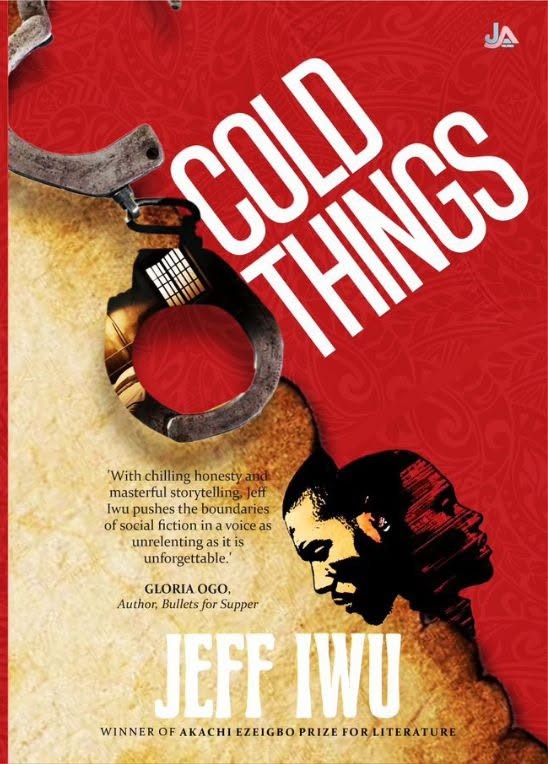
The cover page immediately reveals the trauma associated with confinement and imprisonment. Beautifully centred on the cover is a rust-pitted padlock, its chain cut off outside the frame. The keyhole is dark, with gaps that look like an open mouth that has swallowed all sound. The image suggests punishment rather than healing, which becomes significant in the Manjo Prison, where characters chained to guilt are never truly free. In the middle of the cover is a six-line poetic description of the book by Gloria Ogo, author of Bullets for Supper. At the bottom right corner are two human faces pressed together on opposite sides. Their faces appear in low relief, expressing an ongoing, silent and tragic experience. Their skins cling tightly to the sharp edges of their cheekbones, while their eyes seem deeply sunken. Their faces become a mirror of violence, trauma and memory. This visual representation becomes significant to the motif of the narrative. As the reader moves through the novel, it becomes apparent that the two male faces represent Ekene and Obioma, two cousins who find themselves sharing a prison cell and a common trauma of abandonment.
Strikingly, the title Cold Things is written in stark white against a red background. This contrast suggests the unstable promises and shifting experiences that the characters encounter in the city of Manjo, where life moves “from good to bad” and “from bad to good.” Thus, even before the story begins, the cover establishes a visual language of violence, confinement, loss and uncertainty that the narrative later develops.
The novelist’s concern with violence lies in the way violence enters memory, alters relationships, affects the body and crosses from one person to another. The night Popsy dies resurfaces as the beginning of a different life for the family, but it does not mark the end of the violence that has shaped them. Iwu’s description of “coldness” in the novel is not simply a physical condition; rather, it becomes a way of describing emotional distance, grief, fear and confinement. For instance, Ekene encounters a “cold stillness” after Popsy’s death, while the brief return of electricity exposes the dead man’s face. More significantly, the moment becomes disturbing because the light does not erase the darkness. It reveals what the darkness contains. Such a reading is justified because the novel confronts Popsy’s violence, Ijeoma’s suffering, the psychological damage experienced by her children and the different forms of violence that later shape Ekene and Obioma.
In a close reading of the novel, the reader encounters trauma as something that does not always remain in the past. An experience may have ended in physical time, yet continue to return through memory, behaviour and emotion. Popsy is dead, but his presence remains within the family. Chika dies, but his absence continues to affect Ijeoma. Lucy’s death follows Ekene into prison, while Lambert’s death becomes part of Obioma’s life history. Ijeoma leaves Manjo, changes her name and begins another life, but she cannot simply leave behind what happened there. The dead disappear physically, but their histories remain active among the living. The characters inherit not only names, possessions or family histories; they also inherit things that have not been spoken about. They carry memories they did not choose, fears they did not create and consequences they did not initiate.
Against this background, Cold Things emerges as a study of lives caught between injury and survival. Its characters occupy unstable borders between victim and perpetrator, home and prison, childhood and adulthood, memory and forgetting, and freedom and confinement. The novelist repeatedly shows that these boundaries are easier to draw than to maintain. A person can leave an abusive home and still carry that home within them. A victim can become a perpetrator without ceasing to be a victim of earlier violence. A prisoner can be physically confined while another person, apparently free, remains trapped by memory. In this sense, the border in Cold Things is not only geographical. It is also psychological, moral, social and bodily.
Furthermore, the storyline weaves through the idea of selective memory, exploring how the characters reconstruct or distort their histories in order to survive the present. Chika bears this burden in a tragic way. His suicide cannot be separated from the psychological environment in which he grows up. Ijeoma remembers the changes in him, from the “good boy” she knew to a child marked by anger, suspicion and withdrawal. He does not commit the violence that defines his family history, but he becomes one of its casualties. The recurring idea of departure also gains significance as the story unfolds. Popsy dies. Chika dies. Ekene moves towards another kind of disappearance. Obioma loses his home and eventually enters prison. Ijeoma leaves Manjo City and takes on another identity as Mama Onyema. These departures suggest that leaving is not always the same as escaping. Physical movement may create distance from a place, but memory continues to connect the characters to what they have experienced.
The language used in the description of “coldness”, “farewell”, “silence”, “blood”, “home”, “prison” and “memory” offers the novel a coherent symbolic structure. These images speak to one another. Coldness becomes emotional distance; farewell becomes repeated loss; silence becomes inherited suffering; prison becomes both a physical institution and a psychological condition and home becomes both refuge and danger. What begins as one person’s story gradually becomes another’s history, as the past continually resurfaces through different characters bound by violence, trauma and memory. In this way, Iwu’s Cold Things presents violence not as an isolated event but as an experience capable of travelling across bodies, relationships and generations. The novel’s power lies in its insistence that what is buried is not necessarily forgotten, and what is left behind is not always escaped.
* Uzoma, a budding scholar whose research cuts across the intersection of place and literature, author of My Father’s House and Other Poems, a children’s literature book, can be reached via uzomadeborah@gmail.com