Again, Ojaide, Ifowodo, Eze, Dzukogi make The Nigerian Prize for Literature poetry longlist

By Anote Ajeluorou
THE awaited longlist of 11 poets for The Nigeria Prize for Literature that animate Nigeria’s yearly culture calendar has been released on social media by the prize organisers and sponsor, NLNG in The Nigeria Prizes’ handles on Facebook and Instagram. The buzz for the longlist has been for a few days now, and when it seemed the publicised dateline was almost slipping by, writers began making enquiries as to the fate of the longlist today, 23 July 2026. But late in the evening, the longlist came out and 11 poets and their poetry collections were unveiled.
The winner will go home with USD$100,000 prize money.
And it makes for an interesting longlist, peopled with the old and familiar and new entrants. Two old faces are Prof. Tanure Ojaide and Dr. Ogaga Ifowodo, who finished in the final in 2018 when Ikeogu Oke won with The Heresiad. Ifowodo had contested with his collection, A Good Mourning. This time he returns with a question mark for a title, Why Does God Need a Gun. Ojaide too makes appearance with Adult Love in the Childhood Garden; his last outing was Songs of Myself: Quartet. Dzukogi also returns with Bakandimiya: An Elegy after being a finalist with Your Crib, My Qibla alongside his two poetic friends, Sueddie Vershima Agema (Of Memory and Call of Waters) and Romeo Oriogun, who won in 2022 with Nomad. James Eze too returns with Unbind Me Now after his last outing in 2021 with dispossessed.
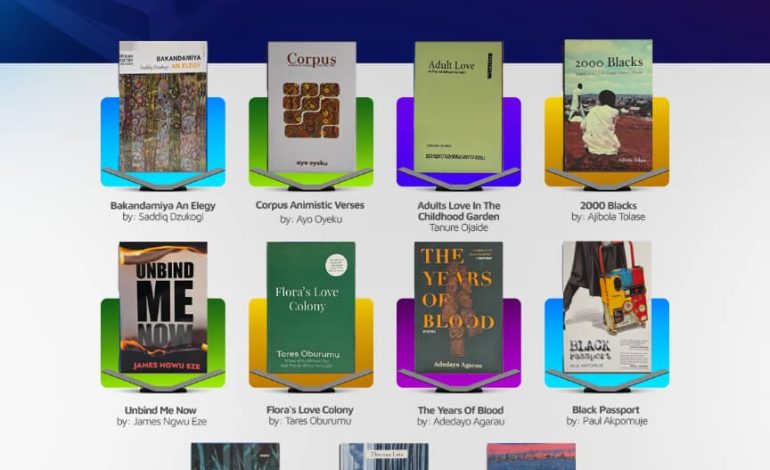
On the longlist this year for poetry are Bakandimiya: An Elegy by Sadiq Dzukogi, Corpus Animistic Verses by Ayo Oyeku, Adult Love in the Childhood Garden by Tanure Ojaide, 2000 Blacks by Ajibola Tolase, Unbind Me Now by James Ngwu Eze and Flora’s Love Colony by Tares Oburumu. Others are The Years of Blood by Adedayo Agarau, Black Passport by Paul Akpomuje, Why Does God Need a Gun by Ogaga Ifowodo, The Origin of Wounds by Rasaq Malik Gbolahan and Ceremony of the Nameless by Theresa Lola, the only female writer among the poets on the longlist.
Oyeku is appearing for the third time in a row in different literary genres. Two years ago, he was on the longlist for his children’s book, The Magic Jalabiya. Last year for prose fiction, Oyeku was also longlisted for his novel, Petrichor. And for poetry this year, Oyeku makes appearance with Corpus Animistic Verses. This is indeed a testament to his creative versatility in writing across multiple literary genres.
However, new entrants to The Nigeria Prize for Literature longlist in all genres include 2000 Blacks by Ajibola Tolase, Flora’s Love Colony by Tares Oburumu, The Years of Blood by Adedayo Agarau, Black Passport by Paul Akpomuje, The Origin of Wounds by Rasaq Malik Gbolahan and Ceremony of the Nameless by Theresa Lola. They are competing with the tested old hands mentioned above. But, of course, prizes do not respect age but mastery and deployment of craft.
A statement from the desk of The Nigeria Prizes praised the beauty of poetry in its language economy and enchantment and in reaching deep into the human heart and soul for the wordless, and how the 11 poets have shown language mastery in their craft.
“Sometimes, poetry gives language to the things we have felt but never quite know how to say,” the statement said. “The Nigeria Prize for Literature 2026 longlist brings 11 poetry collections that invite us to see familiar things differently. Each arrives in a distinct voice, carrying the experiences, tensions and hopes that shaped it. Today, the next chapter begins. Meet the 11 poets and collections on this year’s longlist.”
The Chairperson of the prize’s Advisory Board, Professor Adimora-Ezeigbo, described the announcement as an important stage in the 2026 edition of the arguably African biggest and most prestigious literary prize. She noted that the collections demonstrate the remarkable capacity of poetry to illuminate human experience through thoughtful reflection, cultural memory and artistic expression. Adimora-Ezeigbo added that the works revisit history while interrogating dominant historical narratives and exposing the forces that shape collective identities and social relations. She stated that despite their varied emphases, the books share a commitment to exploring the endurance of individuals and communities in the face of violence, oppression, and social fragmentation.
While commenting on style and language, Adimora-Ezeigbo said the books display an impressive diversity of poetic techniques marked by lyrical intensity, symbolic depth, and artistic innovation, adding, “Many employ densely poetic, allegorical, and elegiac modes that invite multiple layers of interpretation while others draw extensively on folklore, oral traditions, and contemporary realities to create a compelling fusion of past and present. Their language is generally fluid, evocative, and aesthetically refined, relying on vivid imagery, emotional resonance, and intellectual sophistication to communicate complex ideas. These works demonstrate how poetic language can illuminate social realities, challenge established perspectives and give voice to both individual and collective experiences. The next stage will demand a closer reading of each work, with attention to language, form, originality and lasting literary value.”
But quite uncharacteristically, the secretariat of The Nigeria Prize for Literature is yet to reveal the judges for this year’s prize, the three local and one international prize jury. No explanation has been advanced for the secrecy. In any case, the NLNG-CORA Book Party is expected to hold on 2 August at MUSON Centre, Lagos while the Grand Award Night (GAN ’26) is slated for 9 October 2026 in Lagos.