
Two plays, one meaning in ‘Death of a Salesman’ and ‘Death and the King’s Horseman’

By James Ene Henshaw Jr.
I was going to talk about Arthur Miller’s Death of a Salesman this week, but I figured it would be more interesting comparing it with another play dealing with a similar issue but in a different context. Death of a Salesman (1949) follows Willy Loman, an aging traveling salesman in post-war America, who clings to the myth that being “well liked” guarantees success. As his career collapses and his sons fail to live up to his fantasies, Willy’s grip on reality unravels, leading to his suicide — intended as a final act of providing for his family through life insurance.
Wole Soyinka’s Death and the King’s Horseman (1975) is set in the ancient Yoruba town of Oyo under British colonial rule. The play follows Elesin, the king’s horseman, who is ritually bound to commit suicide after the king’s death to accompany him into the afterlife and preserve cosmic order. British colonial officials, viewing the ritual as barbaric, intervene to stop it — with catastrophic consequences for the community’s spiritual balance.
The central characters in both plays emblemise the prevailing ethos in the respective societies. In American culture, the Salesman represents drive, ambition and unlimited possibilities; the Horseman in Yoruba cosmology represents continuity and balance.
Miller locates society’s despair in the interior collapse of an individual crushed by a system — American capitalism’s promise that hard work and charisma guarantee dignity and success. Willy’s despair is personal and psychological, but it indicts a broader society that discards men once they’re no longer “productive,” and a culture that confuses material success with self-worth. The despair is quiet, domestic, played out in a cramped Brooklyn house — the American Dream turned inward and soured.
Soyinka locates despair at the level of the entire community and Yoruba cosmology and. The crisis is not one man’s failure to meet a standard, but a colonial power’s violent misreading and disruption of a functioning spiritual order. When Elesin fails to complete the ritual (partly due to colonial interference, partly his own hesitation), the consequence isn’t just personal shame — it threatens the metaphysical continuity of the whole society, resolved only when his son Olunde takes his place in death. The despair is communal and cosmic, rooted in the collision between indigenous worldview and colonial power.
In comparing the approach each playwright uses, we see that Miller works through realist, intimate tragedy — one family’s disintegration stands in for a national mythology. Soyinka works through ritual, poetic language, music, and dance — one man’s failure stands in for a civilization’s rupture.
Miller blames an internal, ideological trap (the American Dream as false promise) that people impose on themselves and each other. Soyinka blames an external, historical imposition (colonialism) disrupting a coherent internal order — though he’s careful to show Elesin’s personal weakness too, resisting a simple colonizer/colonized morality tale.
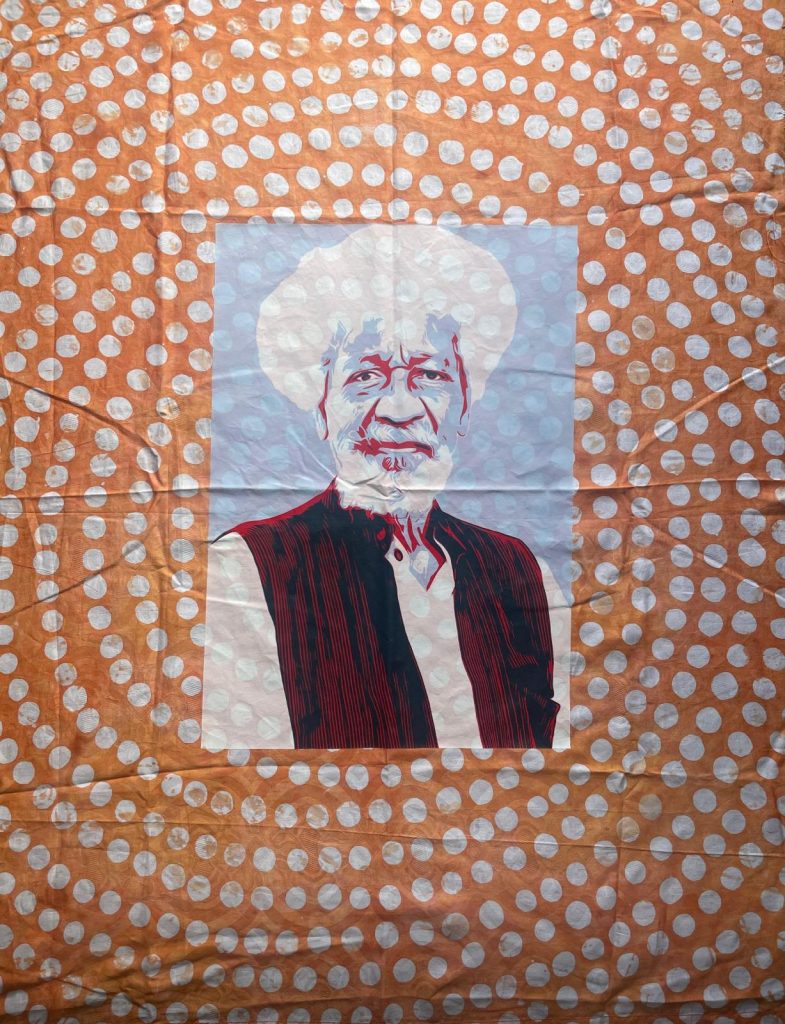
Wole Soyinka
Miller uses fractured realism — flashbacks, memory, expressionist staging — to dramatize a mind coming apart. Soyinka uses ritual drama, proverb, song, and Yoruba cosmology, insisting Western audiences meet the play on its own terms rather than as anthropological spectacle (he explicitly resisted reading it as a simple “clash of cultures” play).
Willy’s death is a private, a futile gesture that changes nothing for those who survive him — the despair is unresolved, absorbed into ongoing American life. Elesin’s failure is corrected by his son’s sacrifice, restoring the cosmic order even as it exposes the human cost of colonial disruption — despair is met with a kind of tragic restoration.
Both plays use a single death to interrogate a society’s guiding value system — Miller indicting capitalist myth-making, Soyinka indicting colonial arrogance toward a self-sufficient cultural order — but they diverge sharply in whether that society’s despair is self-inflicted or imposed from outside, and in whether the drama offers any form of restored meaning.
Why are these two plays important? Death of a Salesman arrived just as America was consolidating the postwar consumer economy and the mythology of the self-made man — the idea that charisma, salesmanship, and relentless optimism guarantee upward mobility. Miller wrote it as a direct challenge to that mythology at the moment it was hardening into national common sense. It suggested that the Dream wasn’t just occasionally unmet but structurally cruel: it discards people (especially aging workers) once they stop being useful, while blaming them personally for the discarding.
Soyinka wrote Death and the King’s Horseman after Nigerian independence, in a period when newly independent African nations were wrestling with how to relate to indigenous traditions that colonialism had suppressed or pathologized. The play was partly a response to a real 1946 incident where British colonial officers prevented a ritual suicide. Soyinka insisted — pointedly, in his own preface — that the play not be read as a simple “clash of cultures,” because that framing still centers the colonizer’s judgment as the deciding perspective. Instead, he wanted to dramatize a self-contained cosmology on its own terms, with its own internal logic and internal failures.
So, what can societies learn from these two plays? Each play warns its society against a single totalising value system that claims to explain a person’s or a community’s worth completely. Both suggest that when a society lets one narrow standard define meaning, the people who don’t fit it are destroyed, and everyone else absorbs the cost.
* Dr. Henshaw Jr., a playwright and culture promoter, is the founder of James Ene Henshaw Foundation (JEHF)