
Salmah Salam Oiza’s poetic leap of faith in unfamiliar bend

By Anote Ajeluorou
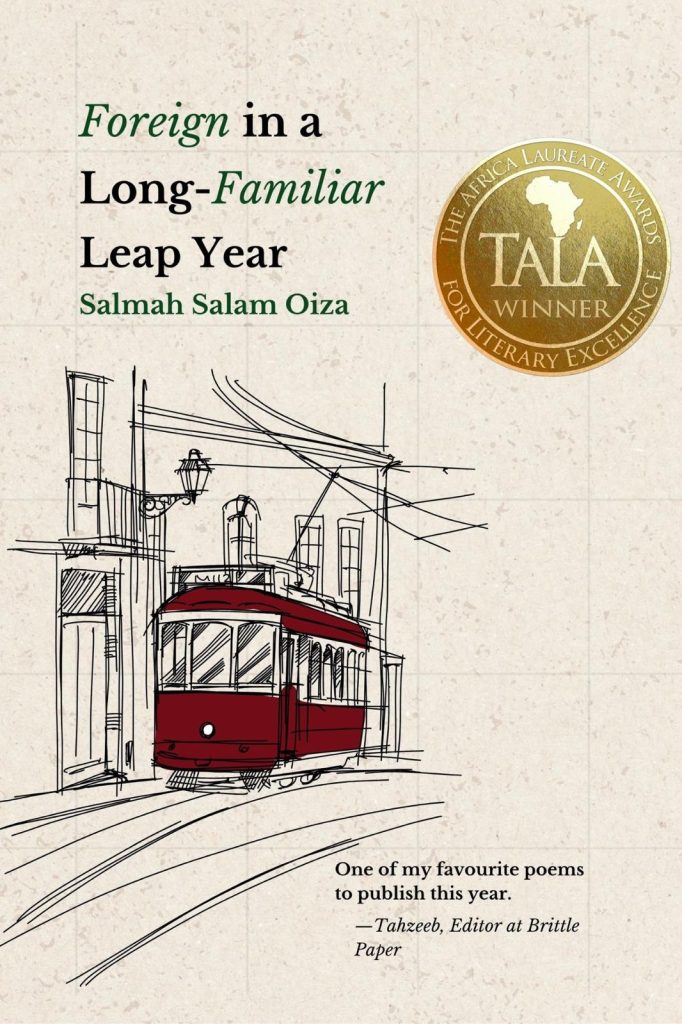
SOMETIMES, not even the prophet or oracle can tell you what’s ahead in the bend. You navigate you way there to see for yourself. And what you find? Familiar? Strange? It’s what you make of it that matters. Salmah Salam Oiza’s poetry chapbook, Foreign in a Long-Familiar Leap Year, falls into this mould in its meditation on an outward journey into the unknown that many yearn for. While some attain it, some don’t. But when she arrives at her destination, what next? No one is ever sure what the other side of the great quest is until they get there. In this season when ‘japa’ is a byword for survival, from the thought of it to actually travelling and settling in unfamiliar places, getting used to it and thinking back to the place of origin and all that is left behind, Oiza has crafted some poetic pieces that stir the soul in familiar ways, and the reader is richer for the experience.
She chooses the season in a leap year, a quaint year, to analyse her own feelings in her pilgrimage. Hers isn’t the ‘japa’ for survival like most, but a quest to get something better still. Hers is a quest for growth, a yearning for something beyond the self, something sublime. And so from January to December, she takes special notes of her being and how time stretches infinitely outwards and it seems she is a spectator watching herself perform for herself in her growth journey.
In January, the poet persona sets out on her trip abroad and mid-air, a feeling of unease invades her being about the correctness of her decision, but she gradually settles in and then ‘…Heathrow appears./ A slick cathedral of runaway and ice,/ her God is motion, security check/ and silent tears./ I have become a women fluent in departures.’ She has left a lifetime behind, and that uncertainty about the future gnaws at her to induce tears. For her ‘January is a one-way ticket,/ in disguise’, because she watches ‘home vanish before me.’
February finds her trying to get used to her new environment, but settling down is somewhat hard, because ‘February just can’t make up its mind’. She is in some turmoil, as February’s fickle weather and all that it stands for seem like a changeling that unsettles the newcomer. Coming from the sunny Abuja, Nigeria’s warm weather, the discomfort February induces on the poet persona is palpable, when she says, ‘The sun forgets it owes us more/ than one cheap kiss of warmth.’ And in her frustration, she calls the second month of the year ‘…you indecisive bastard!/ Just like basquiat,/ you never make up your mind.’
February 29th makes a particular year a leap year. Precisely that is when her mother calls in ‘Mother Calls on the 29th’, a mother who longs to have her daughter back beside her, so she can fulfill her feminine obligation like marriage, family and all that. Of course, the poet persona is already lost in her journey to centre of the world, claiming her back will be a tough job. But a mother persists nevertheless. A seemingly innocent trip abroad to get a good education turns out a pilgrimage of no return for the traveller. This unnerves the mother, who screams out her annoyance: ‘This is not the plan./ One year. A degree./ then home,’ but the daughter deflects, ‘Plans change./ Even the moon changes shape/ sometimes.’ It’s the capricious nature of the traveller, who having finally overcome the initial dread of the new place, becomes reluctant to return home, and keeps dithering and pushing forward the day of return, if ever.
The mother’s concerns about raising a family, what the neighbours are saying about a lost daughter, who lives a wayward life abroad without anyone chaperoning her all fall into deaf ears. And new ways of living abroad have sipped too deep into the consciousness of the traveller who seems to have forgotten the return route. ‘What do I tell everyone’, the mother wails her frustration, and the daughter says, ‘Tell them I’m well./ Tell them I’m thriving./ Tell them I’ll be home. Soon.’ The daughter also decodes her mother’s undertone of a daughter shaming the family with her decision and rallies finally to push back by saying, ‘What you call shame, mother-/ I call the soil loosening./ I call the seeds waking./ It is a garden-/ beginning again,’ an obvious allusion to a life of strictures back home that she finally escaped, and a return would mean embracing what she dreads.
While the month of march in ‘Last March’ is about weighing the poet persona on a scale and assessing what she comes up to, it says something about the measure of ambition and what the women in her amounts to: ‘Measuring the girl who was made for more,/ against the woman who calls enough by name,/ and lets it rest.’ And ‘April Baby’ is for rebirth, a new beginning, a month ‘of second chances’, and asks, ‘what is the price of beginning again?’, a forever quest to be better in the scheme of things.
‘May, as in Maybe’ invokes all the questions of being and indecisions ever contemplated by man and woman. This poem sums up the totality of man’s unique inner journey to gain clarity about his life. ‘May, as in maybe I wanted to go,/ but clung to what felt most secure./ Where nothing bloomed, but the ache to bloom…’ It’s the sum total of the indeterminacy that sometimes plagues man in his affairs. And it morphs into ‘June is for Leaving’ and its ‘swelter-/ yet London once groaned beneath/ sun’s amber lash,’ yet ‘June whispers with a voice so soft and sweet/ persuading me to postpone the reckoning-/ to sip, to kiss, to wander, to burn.’
‘The Turning’ (a split account of September) reads like the condition of split personality and divided between ‘Clarity’ – (I wake up knowing, finally) and ‘Collapse’ – (I wake up shaking, sweating). This spilt personality runs through the poem, and ends with ‘I name this healing. I name it mine’ for Clarity and ‘I name this haunting. It calls me back’ for Collapse.
And as the year runs deep into the ‘ember’ months and it seems the poet persona is far from fulfilling new year resolutions, ‘October: A Portfolio of Lies’ emerges as reality check with ‘Make October empty her bag of tricks-/ let her lay out her jars and serums,/ swallow her promises whole,’. And then ‘November’ ‘Splits its tongue into doorways,/ each doorway widening into rooms,/ each room multiplying like lies/ told too many times to count.’
Oiza makes clear her manifesto in Foreign in a Long-Familiar Leap Year clear from start, ‘This was my own scattered year – a year of growth and discovery, of feelings bother familiar and foreign in the same breath.’ These themes of growth and discovery, feelings familiar and foreign run through this important work that speaks to readers, as the poet believes we might each ‘recognise fragments of us, or of just yourself’ in the poems, a hope that speaks to the universality of her work in echoing what most people go through in her peculiar circumstance. These poems are evocative in their exploration of the familiar and the strange. A triumph of poetic voyage indeed.