Embrace business mindset, innovation, strategic positioning for sustainable practice, artists told

* Value perception, audience targeting, market strategy key to success, says Ovraiti
By Godwin Okondo
ARTISTS, curators, financial experts and cultural stakeholders have called for a stronger integration of business principles into artistic practice, warning that passion alone is no longer sufficient to sustain a successful career in today’s evolving creative economy. This was the central message at the Art Business Roundtable Mentoring Discussion held on Monday, April 20, 2026, at the Juliet Ezenwa-led Art Arising Festival 2026 that had as theme ‘Excelling in the Business of Art Practice.’ The session brought together leading voices from Nigeria’s art and financial sectors to interrogate the realities of artistic production, market access, sustainability, and global competitiveness.
Chairman of Art Galleries Association of Nigeria (AGAN), Mr. Moses Ohiomokhare, who anchored the discussion, set the tone by stressing that artists must fundamentally redefine how they perceive their profession. According to him, the romantic notion of art must give way to a structured understanding of art as both cultural expression and commercial enterprise.
“When you come to the real world, you begin to understand that art is not easy,” Ohiomokhare said. “It is important that you recognize the fact that you are not just an artist, but a business person. So, you must begin to understand very many important things that happen around you.”
He warned that neglecting the business side of art could have long-term consequences on an artist’s sustainability and reputation, particularly in relation to material choices and production standards. He explained that the durability of artworks plays a significant role in collector confidence and market trust.
“If you are using cheap materials, in another four to five years, they begin to give way,” he noted. “You need to ask yourself if you are doing the right thing. You are also shortchanging yourself because the collector will not look for you again, and the collector’s community might begin to talk and tell others not to buy because you are using cheap materials.”
Ohiomokhare also highlighted the untapped global potential of African artists, pointing out that Africa and South America together account for only about four per cent of global art production. He described this as a major opportunity waiting to be explored by emerging artists who are willing to position themselves strategically within the global market.
“There is a big space for you as an artist. You just have to find those key points that will help you,” he said.
Delivering a detailed framework for studio excellence, art consultant, administrator, historian and critic, Dr. Ekpo Udoma, outlined six core pillars that artists must adopt to achieve professional growth and relevance. These include having a clear artistic mission, developing style and technique, engaging in research, managing time effectively, documenting works properly, and maintaining consistent practice.
Udoma emphasized that without a clear objective, artistic practice becomes directionless. “If you don’t have a goal, it means anywhere is good enough, and you cannot excel,” he said, recalling an encounter with a young artist in a Lagos gallery who could not articulate why he painted beyond formal education.
He further stressed that style and technique are not accidental outcomes but deliberate choices shaped by vision and research. According to him, many of the world’s most celebrated artists, including Michelangelo and Picasso, were deeply committed to research and intellectual exploration of their craft, as were prominent Nigerian masters such as Aina Onabolu, Afi Ekong, Uche Okeke, and Bruce Onobrakpeya.
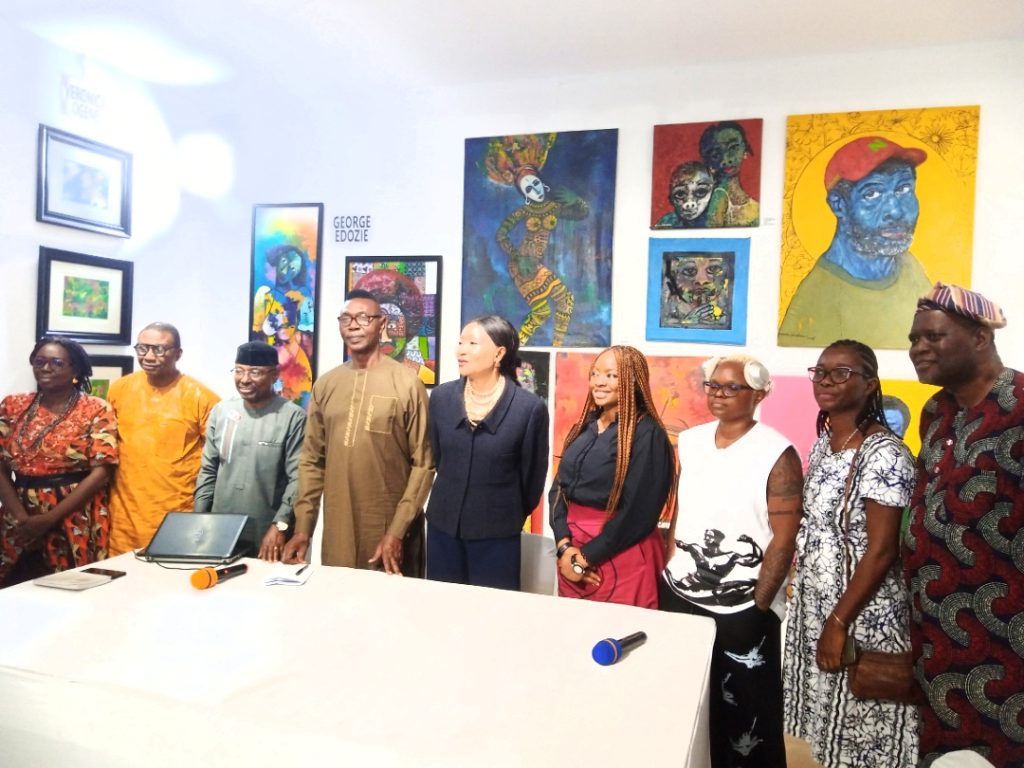
Founder, Arts Arising Festival, Juliet Ezenwa Pearce (left); art consultant, administrator, historian and critic, Dr. Ekpo Udoma; Chairman, Art Galleries Association of Nigeria (AGAN), Mr. Moses Ohiomokhare; Director, Harmattan Workshop – BOF, Mr. Sam Ovraiti; Q Gallery of Contemporary Nigerian Art, Madam Juliana Edewor; Head of SMEs, EcoBank, Omoboye Odu; Director, Eleez Art Studios, Elizabeth Chioma Ekpetorson and guests at Art Arising Festival 2026
Udoma also urged artists to improve their ability to speak about their work confidently, noting that communication is essential in building value and attracting patronage. He added that proper documentation, including clear signatures and titles, remains critical in ensuring authenticity and traceability in the art market.
Founder of Q Gallery of Contemporary Nigerian Art, Madam Juliana Edewor, shifted the conversation toward collecting, describing it as an evolving practice driven by passion, curiosity, and sometimes investment goals. She shared her personal journey into art collection, explaining that it began informally through the cutting and pasting of images from magazines during her teenage years.
“I was cutting pictures from magazines and pasting them on my walls,” she said. “I didn’t even know I was collecting at the time. It was just emotional attachment to images I loved.”
Edewor explained that collecting can be both emotional and strategic, depending on the individual’s intent. She advised collectors to clearly define whether their motivation is passion, investment, or a combination of both, while also stressing the importance of education and professional guidance.
“If you want to be a collector, you must educate yourself,” she said. “Collect what you like, but also take your investment seriously. If you don’t have the eye, get a curator or gallerist to help you.”
She also encouraged emerging collectors to start small, engage directly with artists, and set clear budgets to avoid financial overextension.
Representing the Managing Director of EcoBank, Mr. Bolaji Lawal, Head of SMEs, Omoboye Odu, positioned the creative sector within broader economic and financial systems, noting that art has become a significant contributor to Nigeria’s GDP.
“Art is not just a cultural expression, it is a powerful economic engine,” Odu said, disclosing that the creative economy contributed over N20 trillion to Nigeria’s GDP in the past year.
She noted, however, that despite its economic potential, many artists struggle with financial inclusion due to poor structure and lack of clarity in cash flow management. She emphasized that financial institutions are increasingly willing to support the sector, but only where clear data and returns on investment are evident.
“We are not an NGO; we are a bank with shareholders,” she said. “The truth is that we will sponsor when the ROI makes sense. To do that, you need to understand what your numbers are. You need to structure yourself in such a way that makes it easy for us to see why we have to fund it.”
She added that platforms are being developed to help artists access new markets, receive financial advice, and better understand their income streams, thereby improving their bankability and access to funding.
Founder of Eleez Art Studios, Elizabeth Chioma Ekpetorson, offered a personal reflection on discipline, reinvestment, and self-development in artistic practice. She recounted her early experiences as a student and emerging artist, emphasizing the importance of reinvesting earnings into professional growth.
“I told myself it would be a shame if, at the end of the day, this investment doesn’t make returns,” she said. “So I reinvested everything into my practice, from materials to books and travel.”
Ekpetorson highlighted travel and cultural exposure as essential components of artistic development, noting that interaction with different environments and people significantly influences creative output. She also emphasized self-evaluation as a daily discipline.
“Every day, I look at my work and ask myself if I’m getting better and if there is room for improvement,” she said.
Director of Harmattan Workshop at Bruce Onobrakpeya Foundation (BOF), Mr. Sam Ovraiti, addressed issues of value perception, audience targeting, and market strategy, warning that artists must be intentional about how and where they present their works.
“If your artwork is beautiful but it has no value to anyone, then there is no need for the person to collect,” he said. “We are in a world of exchange of values.”
Ovraiti cautioned against indiscriminate marketing, advising artists to identify appropriate platforms and audiences that align with the value of their work. He also shared personal experiences of strategic positioning early in his career, where he targeted corporate audiences and structured opportunities for direct engagement with decision-makers.
“Don’t take your work to just any gallery, and don’t show your works to just any person. You must be able to identify (your target audience and clientele),” he said.
Across all interventions, there was a shared consensus that the future of art practice depends on the artist’s ability to merge creativity with entrepreneurship, discipline, and strategic thinking. Speakers emphasized that while artistic passion remains fundamental, long-term success will increasingly depend on professionalism, market awareness, and the ability to position art as both cultural capital and economic asset.