
From Subject to Author: Women artists and the authority of presence at Mydrim Gallery

By Mudiare Onobrakpeya
THERE are exhibitions that gather works, and there are exhibitions that gather momentum. The 2026 International Women’s Day exhibition of the Female Artists Association of Nigeria at Mydrim Gallery belongs firmly to the latter. It does not request attention; it assumes it. What unfolds is not a plea for inclusion, but the visible confirmation of a presence refined through decades of persistence. Anchored on the theme ‘Rights. Justice. Action: For All Women and Girls,’ the exhibition speaks to a global discourse while remaining grounded in the lived textures of Nigerian experience.
It is fitting that this moment unfolds at Mydrim Gallery, a space known for disciplined looking and intellectual restraint. The architectural calm of the gallery creates the conditions for encounter. Nothing competes with the works; they are given the silence required to assert their authority.
The exhibition must be read against the history of women’s visibility in Nigerian art. While early modernism produced remarkable female figures, their presence was often treated as exceptional rather than structural. The emergence of organized platforms such as the Female Artists Association of Nigeria created continuity where there had been interruption. Women artists were no longer merely emerging; they were remaining—developing sustained practices and occupying the cultural field with permanence.
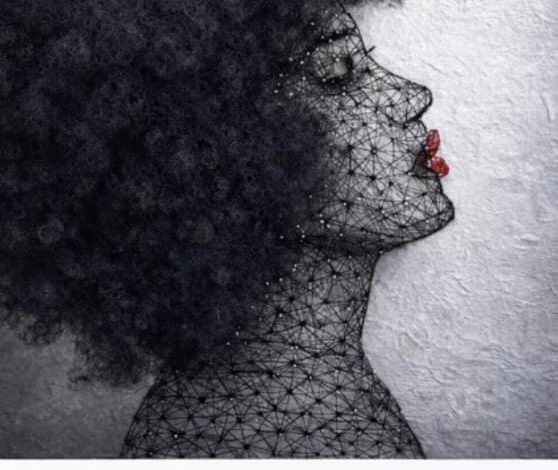
Portraiture dominates the exhibition, not as ornament but as declaration. Faces emerge from pigment and shadow with quiet certainty. These figures do not seek validation; they possess it. Fatimah Akindele’s ‘Botanic Dream’ dissolves the boundary between body and landscape, presenting identity as rooted and generative. Onyinye Ezennia’s ‘Crowned in Silence’ constructs its image through tension—threads held in equilibrium—revealing strength through endurance rather than spectacle. Maryam Maigida’s ‘Pages Unturned’ positions the female figure at the threshold of history, suggesting that authorship itself is being reclaimed.
Material becomes language throughout the show. Textile, thread, and layered surfaces—once confined to the private sphere—are repositioned within public cultural space. Their transformation is not decorative; it is structural. Abstraction and figuration coexist without hierarchy, affirming multiplicity and resisting any singular definition of women’s experience.
Standing within the quiet authority of Mydrim, one senses that this exhibition is not provisional. For generations, women were often subjects within Nigerian art—observed and interpreted. Here, they are authors. They define not only their image, but the conditions under which that image exists.
What emerges is not correction, but expansion. The field has widened, and within the measured stillness of Mydrim Gallery, that expansion feels permanent.
Exhibition runs from March 7 — 16, 2026.
* Dr. Onobrakpeya is an art historian and collector