Black History Month: A hundred years of memory, resistance and cultural continuity

By Salawu Oluwaseun Moses
ON a humid Saturday evening in Lagos, the New Afrika Shrine became less a performance hall than a chamber of remembrance. Lydia Ajoke Ogun Foundation’s Black History Month gathering unfolded not merely as ceremony, but as argument: that a century of documented Black historical consciousness is not a milestone to be admired, but a mandate to be deepened.
The three-hour commemorative programme was curated deliberately as a journey through ritual, rhythm, scholarship and fellowship. At its intellectual centre was the keynote: A Hundred Years of Memory, Resistance and Cultural Continuity, delivered by culture advocate and journalist Jahman Anikulapo, who framed the centenary not as nostalgia but as endurance measured in struggle.
“A centenary,” he began, “is not merely the marking of time. It is the measurement of endurance.”
The evening opened with a cultural invocation and libation acknowledging elders and custodians of tradition, grounding the gathering in ancestral continuity before a single analytical point was made. History here was not abstract. It was summoned.
The resonant voice of the talking drum followed, its rhythms rising and falling like speech itself. The performance functioned as living archive, underscoring the argument that long before formal institutions recognised African narratives, rhythm preserved them. “Our music, our rituals and our oral traditions have always carried what could not be written,” Anikulapo said.
Moving beyond symbolism, the lecture confronted tensions within the global Black community, particularly the widening distrust between Africans on the continent and those in the diaspora. Anikulapo recounted conversations with some African American scholars who voiced concerns that most African migrants tend to concentrate on pursuit of economic opportunity without engaging in the social justice struggles shaping Black life in the United States. The perception, he suggested, threatens solidarity rooted in shared historical rupture between Africans at home and those in the diaspora.
He also warned of policy shifts in the United States affecting African and ethnic studies programmes, describing them as signs of institutional amnesia. The weakening of Black Studies, he argued, is not administrative housekeeping. It is the thinning of collective memory.
“Symbolism is no longer enough,” he said. “If we fail to institutionalise our continuity, history will fragment our narrative.”
A curated Afrobeat tribute honoured Fela Kuti, whose legacy saturates the Shrine’s walls. Afrobeat, Anikulapo noted, was never merely entertainment. It was political language. It named corruption, confronted state violence and articulated the frustrations of a generation. Fela’s decision to live among ordinary Nigerians despite his privileged upbringing demonstrated a deliberate alignment with popular struggle.
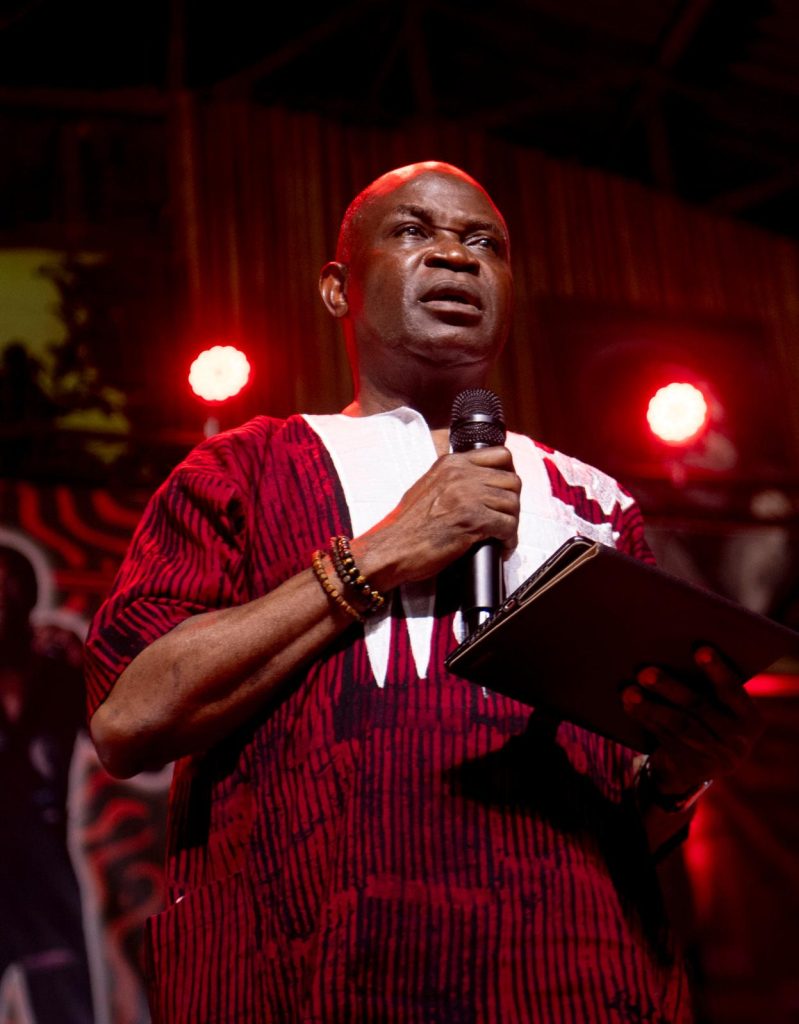
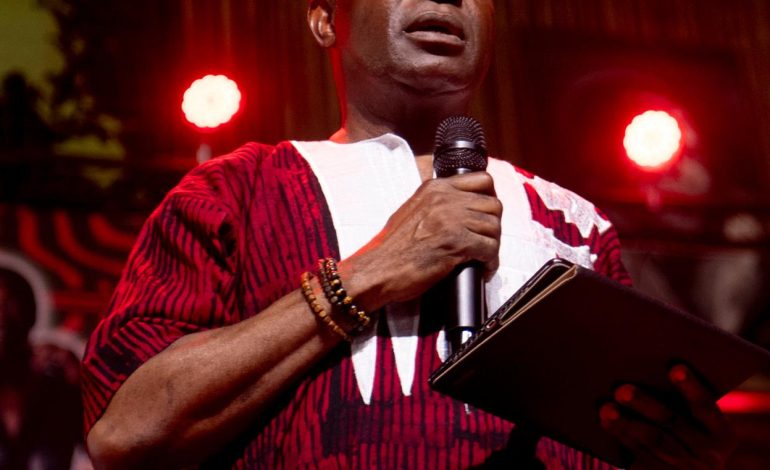
Mr. Jahman Anikulapo giving the keynote
That legacy endures under the stewardship of Femi Kuti and Yeni Kuti, whose continued guardianship has ensured that the Shrine remains both sanctuary and school. The active support of the Shrine’s manager was instrumental in hosting the gathering, reflecting a collaborative commitment to sustaining spaces where culture and consciousness meet.
Interwoven with the intellectual and artistic programme was the warmth of community. Guests were treated to African food tasting featuring pounded yam and egusi soup served traditionally in leaves and prepared by the renowned Mummy Ayo. The rich taste of ram suya prepared by Alhaji Isiaku added a sensory dimension to the celebration, reminding attendees that culture is preserved not only in sound and speech, but also in flavour and fellowship.
Beyond the physical gathering, Laffoundation extended the commemoration digitally through a Black History Month quiz hosted on its Instagram page and accessible via laffoundation.com. The interactive initiative encouraged participants to deepen their knowledge of Black history and cultural milestones. Winners were announced as follows: Omolola Feyisayo Akinyemi, 3rd place, Oyediji Blessing Olaitan, 2nd, and Oluwafemii John, 1st.
The quiz was not merely symbolic; it was competitive and reward-driven, with cash prizes attached to each winning position to appreciate excellence and encourage serious participation. By attaching tangible rewards to historical knowledge, the foundation ensured that learning was both engaging and impactful.
The quiz reinforced the foundation’s commitment to education, engagement and accessible historical learning, proving that commemoration can move beyond speeches into meaningful participation and celebration of Black excellence.
A community spotlight segment featured spoken word presentations and youth reflections, underscoring the urgency of intergenerational transmission. In an era increasingly shaped by digital culture and artificial intelligence, Anikulapo cautioned that historical depth must not be sacrificed for speed and spectacle. Technology, he acknowledged, is a tool. But without grounding, it risks severing younger generations from continuity.
The gathering concluded with a centenary declaration and archival group photograph, symbolic gestures pointing toward structural ambition. By 2027, organisers aim to establish a more formalised and institutional platform dedicated to research, archiving, performance and intergenerational education.
Partners acknowledged during the event included the Freedom Park, Ecowatt Nigeria, Bakacy Signature and Wale Owoeye Esq., reflecting a coalition of cultural and civic actors invested in sustaining heritage beyond seasonal observance.
If the programme spanned three hours, its argument stretched across a century. A hundred years, Anikulapo insisted, is not evidence of survival alone. It is proof of intentionality.
“We are not recent. We are not incidental. We are foundational.”
The 2026 Black History Month celebration concluded with an affrimation, a closing charge to the Black and African family globally thus:
Moving Black History Month from symbolism to structure
WE stand at a moment where symbolism is no longer enough. Black History Month must move from seasonal commemoration to structural commitment. Shifting from commemorative gestures to year-round documentation and institutional accountability, building frameworks for research, archiving, and intergenerational knowledge transfer, embedding Black history within national cultural policy, not seasonal programming and ensuring that celebration is matched by investment, infrastructure, and long-term planning. This shift requires frameworks for research, archiving, and intergenerational knowledge transfer. It requires embedding Black history within national cultural infrastructure, not confining it to a single month.
It must involve building toward an institutionalised cultural platform whereby 2027 becomes not an anniversary but a milestone—a point at which we can say: we built something that will outlive us. The work ahead is clear: Establishing a permanent, well-funded cultural institution rooted in African and diasporic knowledge systems, creating a home for research, performance, archiving, and public education, developing partnerships across universities, festivals, and community organisations and positioning 2027 as a milestone for structural change, not a symbolic anniversary.
Closing Charge: We Are Foundational, Not Incidental
We have established that the Affirmation for this celebration is “We are foundational, not incidental.” Let this centenary remind us of who we are. Our presence is not peripheral to modernity; it is constitutive of it. Our cultural labour is not supplementary; it is central as the backbone of global artistic innovation. Our histories are not footnotes; they are chapters without which the story cannot be told. Our histories are central to understanding ourselves, Africa, and the world. We stand in a lineage of endurance, rhythm, and resistance. We stand in a tradition that has carried memory across oceans, across generations, across attempts at erasure. And so we affirm, without hesitation and without apology:
We are foundational, not incidental!
* Moses is the media officer for Lydia Ajoke Ogun Foundation