World Theatre Day 2026: The Nigeria Prizes celebrates five drama winners

By Anote Ajeluorou
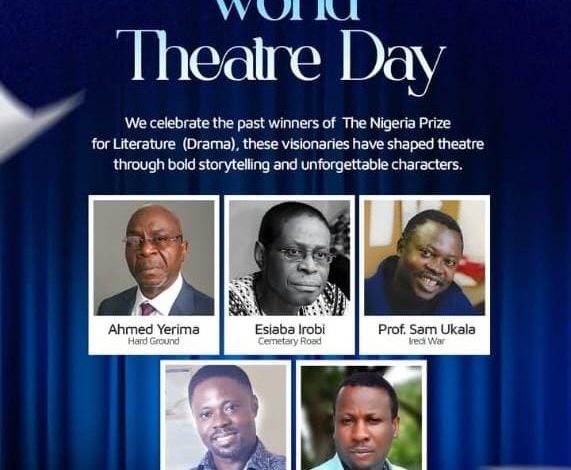
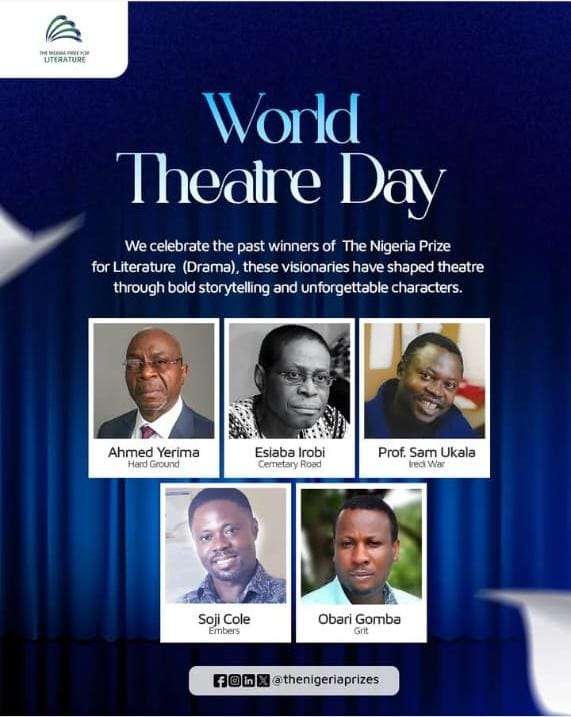
AS thespians and lovers of theatre performances celebrate World Theatre Day 2026 today, NLNG, the sponsor of Africa’s richest science, literature and creative prizes, also known as The Nigeria Prizes wiww.thenigeriaprize.org), is celebrating past winners of its drama prize, some of which have been put on stage for the enjoyment of audiences. The five winners to date are Prof. Ahmed Yerima (Hard Ground), Prof. Esiaba Irobi (Cemetery Road), Prof. Sam Ukala (Iredi War), Dr. Soji Cole (Embers) and Prof. Obari Gomba (Grit). Yerima won in 2006, Irobi in 2010, Ukala in 2014, Cole in 2018 and Gomba in 2023. What is most fascinating is the brevity of the titles – from single word to just two words!
Interestingly, all past five winners are academics. While two have since joined their ancestors (Irobi and Ukala), the remaining three are still active academics in various universities spread across the globe. While Yerima is the Deputy Vice Chancellor at Redeemer’s University, Ede, Gomba is Dean, Faculty of Humanities, University of Port Harcourt and Cole taught at the University of Ibadan before relocating abroad. Ukala taught at Delta State University, Abraka while Irobi also taught last at Freie Universitat, Berlin, Germany, before they died.
In Hard Ground, Yerima deploys dramatic elements to interrogate manifestations of corruption and internal colonialism engendered by violent struggles for oil wealth in the Niger Delta region. The playwright’s portrayals of corruption and various forms of internal colonialism generating the oil crisis are informed by postcolonial, multiple, contradictory, and complementary realities/truths, which often reveal the complexities of socio-economic and political crises in the postcolonial African state. Leadership egoism and failure are among the key factors that aggravate violent crises which recur in the region. Yerima’s Hard Ground calls for collective efforts within the Niger Delta region in particular and Nigeria as whole at finding lasting solutions to the region’s crises orchestrated by the violent struggle for oil wealth.
The inherent truth in Yerima’s Hard Ground still resonates today with the pipeline surveillance contract awarded in a monopolistic, exclusive and divisive manner that is about to generate its own crisis, as stakeholders are suing for a democratisation of the contract process, so each oil producing state secures pipelines in their areas. At the moment, the N2.1 trillion contract excludes many stakeholders in the region who argue that the process is not transparent and most ineffective.
Irobi’s Cemetery Road is a politically charged play that critiques the widespread corruption in Nigerian society, the continuing influence of foreign powers on Africa’s affairs, and the ongoing struggle between the privileged few and the oppressed majority with themes like neocolonialism, abuse of power, resistance, death, social inequality, betrayal, and oppression. Irobi’s Cemetery Road is a fierce and uncompromising drama about the struggles against corruption, social injustice, and imperialist domination in postcolonial Nigeria. It exposes the cruelty of corrupt leaders, the complicity of oppressive institutions, and the damaging influence of foreign media on African narratives.
If anything, the issues Irobi’s play highlights still resonate with us today 16 years after he wrote it and died of cancer. Nigeria is still plagued, not only by the issues, but they have even exacerbated in troubling dimensions, with the poor even poorer and the rich getting richer at the expense of the oppressed majority.
Ukala’s Iredi War is derived from a true life and historical event: the punitive expedition of the British army on the Obi of Owa in 1906, just like what happened barely nine earlier in the Benin Massacre of 1897 with Oba Ovoramwen being sacked from his ancient throne. Crew had visited and asked for more taxes and able bodied men to serve as carriers and runners. The people remind him that those who were taken in the past have not returned so they are not inclined to honour his request. The brash, arrogant and inexperienced Reed (called Iredi by the people) will not take ‘no’ for an answer. However, a meeting was agreed for the following day by 5pm for further deliberation. By 12 noon the shrines in Owa were burnt by overzealous new converts. The Obi of Owa Obi Igboba was tricked into the courts of Chichester for a peace meeting and was instead arrested. Chichester tries to make a deal with him for his freedom but like a messiah the Obi prefers to go to prison with his people.
Ukala brought the tragic onslaught of colonial evil on indigenous communities into dramatic relief with Iredi War using his pet dramatic folkism theory. It’s beauty lies in how history and folk theory converge to create the dramatic impact of exploring the evil visited on a community by a foreign power.
Cole’s Embers illustrates the ongoing problems of terrorist attacks and the paradox of their long-term presence in ravaged community. The audience is introduced to the experience of the internally displaced people, especially the female victims of Boko Haram terror group now in a government makeshift camp in the northern part of Nigeria. Rather than causing the Boko Haram terror group to crumble, it is government’s actions that serve as the sparks that add to it. The eventual outpouring of anger and resentment by the female suicide bombers in the play, as seen in Idayat, stem from the growing moral decadence of the political leaders and the military who are meant to stand up to care for the displaced people.
Cole’s Embers opens a festering wound on the soul of a nation that is still deep in parts of Benue, Plateau, Borno, Yobe and other places where IDP Camps still stand, as ironic testament to political and military inertia among Nigeria’s leadership, an unwillingness to tackle the problem head on and resettle victims of terrorism, who still live in IDP Camps in their own country. Indeed, the embers of terrorism is still smouldering eight years after Cole won the prize with his play.
Gomba’s Grit is about the two sons of Pa Nyimenu, Oyesllo and Okote, trapped by enemies in a politics of vendetta. Like Nmade, Oyesllo’s wife points out, the brothers are drowning in a politics whose waters are not stirred by them and they seem not to notice. While the Democratic People’s Alliance (DPA) offers Oyesllo their party ticket as their flag bearer on a platter of gold, the United Progressive Party fiercely courts the younger brother, Okote, who intends to run as an independent candidate. This creates the illusion of having their own candidate, Ralph Yasuo steps down for him, and posturing as his protective agents in crisis they fomented, in an evil collaboration with the leaders of the DPA.
Gomba’s Grit encapsulates Nigeria’s tragic democratic setting, with opposing parties contending for the soul of the country represented by the APC and the PDP leading the pack of political jackals feasting on the fortunes of over 200 million. As a character called Bambo aptly puts it in the play, “the pursuit of public good does not unite people as easily as evil does.” This is exactly what the DPA and the UPP represent, with both parties bent on liquidating a single family they deem as a stumbling block. And as another round of elections is upon the country, how would the contending parties disprove the accurate diagnosis Grit has rendered of the political process that’s skewed against the people for the selfishness of a few individuals?
Apart from Ukala’s Iredi War that is somewhat removed from Nigeria’s current soco-politiical realities, the other four plays pulses at the soul of a country in desperate times. From Hard Ground to Cemetery Road to Embers and Grit, Nigeria’s soulscape couldn’t have been better dramatically eviscerated.
However, performing the plays to live audiences across the country has continued to pose a huge challenge to the playwrights and independent producers willing to stage them. While theatre students may come handly as actors in this eandeavour since the playwrights are also academics, performing them to a wider audience beyond the university campus is a challenge. Nigeria’s current economic woes make it near impossible for independent producers and directors seeking sponsorship to stage the plays. And since the prize is awarded to the cold text and not because of their performance accomplishments, it will take a long time for winning plays to be staged in theatre before live audiences. This is an existential challenge for playwrights across the country. In today’s WTD 2026 celebration, only one play has been confirmed to hit the stage across the country – Erelu Kuti!
No doubt, The Nigeria Prize for Literature has enjoined the world to celebrate today’s World Theatre Day 2026 by remembering the gift of cerebral plays and playwrights the prize has thrown up from among Nigeria’s playwrights. This is moreso as its call for entries for this year’s poetry prize category comes to an end on Tuesday, March 31, 2026.