Nigerians in the UK lead collaborative response to knife crime through storytelling

By Editor
IN an effort to tackle the widespread knife crime in the United Kingdom, a series of interventions have been established with the launch of ‘The Jisike Collective’ which blends scholarship, film and storytelling to empower young people across the Bournemouth, Christchurch and Poole (BCP) region. A research-powered project, this initiative is a product of a think-tank comprising some distinguished Nigerian-British scholars and other artists.
Principal Academic in Film Directing at Bournemouth University, Dr. Samantha Iwowo, and Associate Professor at Birkbeck, University of London and Senior Fellow at the London School of Economics, Dr. Vanessa Iwowo, began this study in 2019 in collaboration with Nigerian-British actress Pat Micheals Odiatu and Principal Academic at Bournemouth University, Dr. Annie East. The Wole Soyinka International Cultural Exchange (WSICE) is also a partner.
The research examines some of the underlying factors that may expose young people to circumstances that place them at risk of knife and county-lines crime. It does so by exploring how leaders are formed from adolescence and how human identities are shaped by society, culture, class, economics, gender, age, colonial legacies and migration.
Academically, the project draws together insights from Postcolonial Studies, Leadership Studies, Transnational Cinema, and Intersectional Identity Studies, creating an interdisciplinary framework for understanding the cultural and structural dynamics surrounding youth vulnerability and leadership formation.
The study, temporarily delayed by the COVID-19 pandemic, later developed into a research film directed by Dr. Samantha Iwowo, Paintbrushed… This House Must Not Fall.
The project received seed funding from Bournemouth University, the institutional lead for the research. The film’s executive producers include pioneering Nigerian rapper and producer Weird MC, a trailblazer of the Nigerian hip hop and Afrobeats movement, internationally renowned Eurodance artist Dr. Alban, whose global hit ‘It’s My Life’ helped define 1990s dance music, Nigerian highlife icon Sunny Nneji, Dr. Uvie Brigue, consultant anaesthetist and clinical lead at Princess Royal University Hospital in the UK and community members from Peckham, including Mrs. Victoria Adeleke and Mayowa Ede.
The project has also attracted the attention of the Community Action Network (CAN) in Dorset. The organisation, through its Capacity Building Officer Tama Merdaci, is supporting The Jisike Collective in developing storytelling-based interventions for young people across the Bournemouth, Christchurch and Poole (BCP) area.
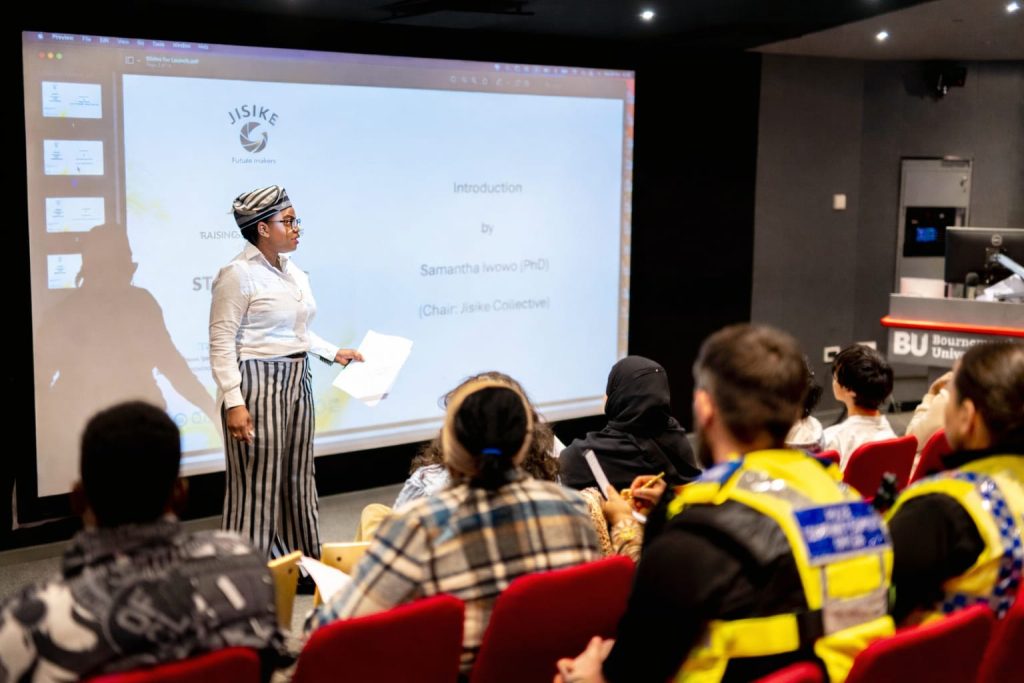
Dr. Samantha Iwowo at the event
Reflecting on the initiative, Tama Merdaci highlighted the importance of combining storytelling, creative education, and lived-experience dialogue in supporting young people facing the risks of drug involvement and knife crime. She noted that the launch event brought together educators, community organisations, and Dorset Police, helping to establish new collaborative workshops for ethnically diverse young people and international students. Emphasising the importance of youth voice, she observed that when young people are given space to tell their stories, communities can begin to respond collectively to the challenges they face.
This series of interventions, known as The Jisike Collective, was launched at Bournemouth University on Saturday, 28 February 2026.
The launch featured a screening of an excerpt from Paintbrushed, poetry readings by Nisola Jegede, and introductions from members of The Jisike Collective team. Samantha Iwowo presented an overview of how The Jisike Collective came into being and, drawing on statistics from the UK Office for National Statistics, highlighted the sobering realities surrounding knife crime in the UK.
Reflecting on the significance of the launch event, Project Coordinator Jegede noted that creating the space for conversation was essential, explaining, “Knife crime is often reduced to headlines, but behind every headline is a young life, a family, and a community. The conversations that followed the film showed how important it is for communities, families, students, and institutions to sit together, listen deeply, reflect and think seriously about the responsibilities we share.”
Samantha Iwowo, together with the Collective’s Secretary, Mira Sapudhzieva, have assembled a multicultural team drawn from the BCP community, including members of Chinese, Bulgarian, Nigerian, Pakistani, and Indian diaspora communities.
As Secretary of The Jisike Collective, Sapudhzieva emphasised the importance of multicultural knowledge exchange in the initiative’s work. She explained that her role includes helping to curate community dialogue and overseeing the post-production team responsible for editing the community stories generated through the project.
The event also reflected the contributions of the wider The Jisike Collective team.
The Treasurer of The Jisike Collective and Co-Chair of Bournemouth University’s Race Equality Network, Dr. Emmanuella Ejime-Okereafor, described the launch as “a powerful reminder that community storytelling can drive real change.” She added that initiatives such as The Jisike Collective help bring together lived experience, research, and community voices in confronting youth crime and building safer communities.
Media Communications Coordinator of The Jisike Collective, Qian “Jenny” Zhou, reflected on the atmosphere during the launch, noting that genuine dialogue emerged between practitioners and community members. She emphasised the importance of asking deeper questions about youth crime: “We do not simply ask how to punish. We ask why it happened and what circumstances led young people there. Through The Jisike Collective we are turning those reflections into action by building bridges across communities.”
Community Engagement Coordinator of The Jisike Collective and Vice President for Student Opportunities, Jeffery Ononiwu, highlighted the importance of ensuring that international student perspectives were represented in discussions about community safety and youth wellbeing.
The filmmaking dimension of the project was also highlighted by the Project Filmmaker for The Jisike Collective, Dr. Yuchen Zhou, who noted that the film created an important platform for reflection and discussion. He described the use of film as a particularly powerful way to open conversations about knife crime and community responsibility.
Cybersecurity and Compliance Coordinator for The Jisike Collective, Taiwo Olajide, emphasised the importance of prevention and awareness in addressing youth violence. He noted that alongside storytelling initiatives, the collective is committed to educating young people and parents through workshops that highlight prevention strategies, including digital safety and basic cybersecurity awareness, with future plans to develop digital platforms that can extend the project’s educational impact.
In its Facebook publication reflecting on the launch, Dorset Police wrote: “Last weekend, PCSOs Matt, Jason and Lydia from the Neighbourhood Policing Team (NPT) were invited to represent Dorset Police at ‘The Jisike Collective’ launch event, hosted by Bournemouth University (BU).”
They concurred with The Jisike Collective when they stated: “Addressing Child Criminal Exploitation and knife related crime requires a collaborative, harmonious approach, working together both proactively and reactively — a collective. ‘The Jisike Collective’ utilises these approaches to pull together communities, educational sectors, charities, businesses, local authorities, government and police — to protect our young people.”
A particularly striking reflection on the project came from Qian “Jenny” Zhou, who in her introduction translated the Igbo meaning of Jisike as “keep going in strength.” This name connects deeply to a core mission of the Collective which Dr. Samantha Iwowo describes as “creating youth hubs that provide skills training and support for young people to help them understand situations that can expose them to county-lines and knife crime, and to develop the confidence to make decisions that steer them away from such paths.”
At its heart, The Jisike Collective represents a collaboration between research, creative practice, and community leadership. By bringing together scholars, artists, and local communities, the initiative seeks not only to understand the structural conditions that shape youth vulnerability but also to create spaces where young people can develop the confidence, skills, and support networks needed to choose safer and more empowered futures—true to the spirit of its name: Jisike, keep going in strength.