Just be authentic to Nigeria the way Nollywood has been, Oloko advises writers

At the reading last year of his new novel, Juju Eyes, the Editorial Board Chairman of The Nation, poet, playwright and novelist, Mr. Sam Omatseye, Prof. Patrick Oloko, who teaches literature at the University of Lagos and on a Fellowship at Yale University, US, made a startling observation about what he perceived to be the new direction of Nigerian fiction in its tendency to mirror Nollywood. Oloko extended his observation in this interview with ANOTE AJELUOROU to indicate that many new writings do not attempt to pander to western literary tastes but remain rooted in Nigerian essence and authenticity
You said the Nigerian novel is finally returning to its true Nigerian form, highlighting the unique sensational storytelling that makes the Nigerian novel tick. What does this mean?
IT’S tied to what I was going to say about Nollywood. I’ve been watching many Nollywood films, and I’ve also been reading so many novels, especially many that are published or getting self-published since the New Millennium, and I have been developing the idea for a book about the transliteration of film into the novel. This might be what the Nigerian novel eventually needs (to be). You know, the novel is a European or an English form. As you know, there are many writers who are writing for a western audience, especially people like Chimamanda Ngozi Adichie and several others in the Nigerian Diaspora. That’s why you would find a glossary at the end explaining what garri or fufu means. Many go to the ridiculous extent of doing the explanation inside the novels. I have also noticed that that there is a new form that has emerged in Nigeria, which is not even concerned about the global audience (but just telling essentially, uniquely Nigerian stories).
These new writers believe that the 220 million Nigerians, if they can get one to five million readers from them, it’s okay. It’s the same way that you now have what we might call Nigerian music (styled Afrobeats), which has now turned itself away from the other global music genres, became authentic and is now selling to the world. It’s this authenticity that has been selling. My argument, so far, is that this Nigerian novel form is taking on the character of Nollywood sensational storytelling, which is what I think that Sam Omatseye read out to us in the prologue to his new novel, Juju Eyes. If you read that prologue again, I have not even bothered to look at it again, you will see the character and infrastructure of that (sensational) storytelling in it.
I’ve been thinking about this. In fact, I’ve developed a syllabus that I will teach at Yale, when I get there in a few months. It’s already on the Yale University website, because I’m going there for a one year visiting professorial fellowship with the Council on Arican Studies. So that’s what I’m going to teach, and that was why the thing was in my head while listening to Omatseye read. I’m just looking at the novel from this point of view, and what people are calling Afro-futurism, and that kind of thing, is re-emerging. It’s something that has always been there, but it is re-emerging. It’s been hibernating, but now it is coming out again. I’m saying that this popular entertainment form broke away from the original, conventional form that we had when the literature of political engagement took centre stage. These kinds of stories were suppressed, but right now, they are coming back in that soft form, central storytelling, sensational, and all that kind of thing.
So, those were the things I noticed, and I made that statement within the context of what Omatseye presented. Everything is there. At some point, when the girl-protagonist was going to give in to the goddess, fire broke out, that kind of thing. Those are the things we watch in Nollywood films and that’s why they think that Nollywood is unrealistic. Now, it is coming into the novel.
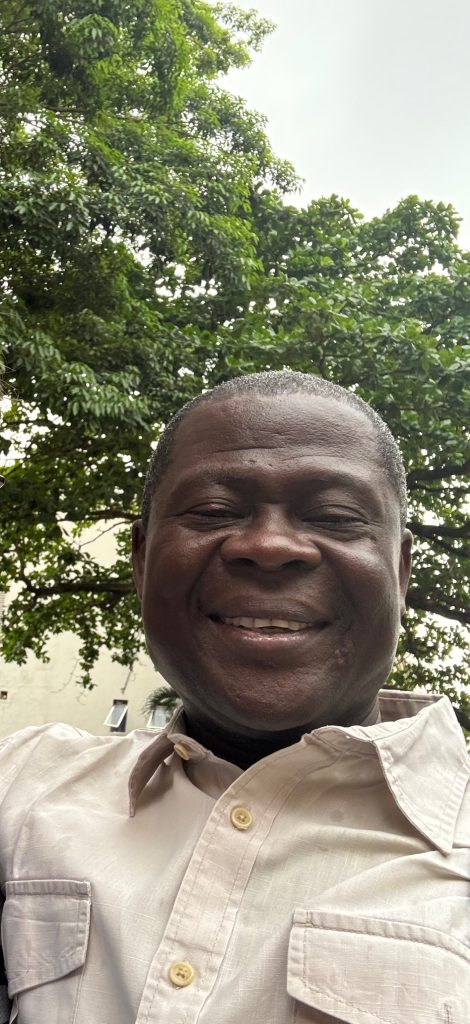
Prof. Patrick Oloko
Is that a plus to Nollywood storytelling format?
Is it a plus? You know, the point is just simply that these popular cultures are feeding into one another. Nollywood itself broke away from the celluloid film tradition. It just realized that that film tradition is very western and elitist and all of that. You must gain access to a film through a cinema house. What happens to those numerous people without electricity who live so far away from cinema infrastructure? So, in the same way that when Nollywood came in and people got fascinated by it, some of our novelists, not all of them, are only just beginning to realise that there is a need to catch Nigerian readers by telling Nigerian stories in print form, before thinking of the global audience or readership again. So, just be authentic to Nigeria the way Nollywood has been authentic and has exported itself. Maybe that’s the way that the novel would develop its Nigerian form and attain its own popularity.
Do you think it’s consciously cultivated, this new, sensational storytelling format?
The problem is, there is a very thin line between conscious and the unconscious, but I’m thinking that what is happening is that people are looking at what sells. In other words, money chases value. Now, if Nollywood can be so successful with this type of storytelling, why shouldn’t I write this type of story, and have it published? And in another sense, you could also fail, especially where your idea of consciousness or conscious cultivation comes in. It’s just simply that if Nollywood has become so popular, why don’t I write this type of story, first as a published novel, and then find a way of turning the novel into a film?
So, you write the novel that would be easily adaptable to screen, and I can give you one example. An example is Ebi Akpeti. She wrote a very small pamphlet. The title is The Perfect Church. The subject of that film-turned-novella is homosexuality within the church, where the main pastor of a church that was thriving very well was a homosexual. At the end of the film, the guy commits suicide because that kind of practice has not been accepted and all of that. In fact, when she spoke with me, she said she simply took that novella to Wale Adenuga, and Adenuga made it into a film that was screened in cinemas all over and it became a very great film.
At the moment, what you are seeing is the screen getting adapted to the novel, instead of the other way round where the novel gets adapted to screen. It’s some sort of reverse aesthetics. That’s the argument I’m trying to make.
Does that then mean that there is a real force behind Nollywood, even when some people criticize it for being shallow and not having the kind of cinematic depth you find in films in other parts of the world? Wouldn’t the Nigerian novel lose it salt, so to speak, if it adapted itself to Nollywood?
Yes, Nollywood has a secure grip on our popular imagination. That’s the point. The popular visual imagination. Actually, what has happened is that when we try to make the novel very elitist, or to conform to the taste of gatekeepers of the novel form, under such circumstances, what many readers have done is to abandon the novel as a form for us and to look for stories that would satisfy them. A hybrid is emerging to reshape the story as Achebe and others told it. We have to be prepared to accept it. That is what would define the Nigerian novel and give it the true national character to detach it from the ‘African’ or continental way of looking at the form. When you read a novel like Idede Oseyande’s Warri Nor de Carry Last, the malice of learning may compel you to dismiss it. But don’t forget that it stayed on the reading list of a popular examination body for three or four years, which is one the first uneasy steps towards getting into the canon. Not many will agree with me, but agreement is argument.
I was going to come to that. Have gatekeepers been banished from their post?
Exactly. Left it for us and started looking for something else more exciting. So, it is the case that these other people are feeding into. We need to do more research to find out how many of such published novels people are reading, and all of that. Prof. Akachi Adimora-Ezeigbo who chairs the Nigerian Literature Prize Advisory Board once told me that from the submissions for the prize, there is so much writing going on. Equate that with Nollywood production. Just compare it. Thousands of films are produced, people watch them and then they fade away, and others are produced again. So, it’s only the sophisticated novels that manage to stay in the shelves somewhat, only the ones that critics like us endorse and proceed to recommend to students to read and write essays about. That is the politics of canonicity and canonization. But ask yourself: how well written are those novels? That’s the point. ‘Well’ according to whose tastes?
Take somebody like Chimamamnda Adichie, for instance. As a critic trained to read novels in a particular way, I was never a great fan of her work; a feeling I developed when I couldn’t finish reading Purple Hibiscus. If you read Half of a Yellow Sun, which I have read, you would see that it’s a documentary. You would say that it doesn’t fit into that shape of the great tradition that F.R. Leavis formulated and wrote so passionately about and then proceeded to exclude Charles Dickens from, even from the canon of the English novel. Half of a Yellow Sun is a great novel shaping a Nigerian tradition by situating itself liminally between popular fiction and elitist literary fiction. Yes, that’s the kind of malice that people like us bring to views and reviews of the novel. But you must ask yourself, if it is just a documentary, why are almost all writers gravitating towards that populist mode? No one wants to listen to our recommendations. We just found out that we are speaking to ourselves. Readers are leaving us behind. Or perhaps I should ask you: are readers leaving us behind to face the story as leisure first and foremost?
There was a time that, I don’t remember who the organizers were, but I remember Prof. Hope Eghagha said to me, “People are coming here [English Department, University of Lagos] to do a ceremony on Crypian Ekwensi. I know you can do it. Patrick, give us a paper.” That was two days before the event and I just sat down and read some things and all of that, and I came up with a paper that I’ve published somewhere now. My argument was that Cyprian Ekwensi was a writer ahead of his time. He wrote at a time when people did not appreciate the kind of story he was interested in telling. I mentioned that he was accused of watching cheap American films and then translating the characters into his fiction, and I said people did not understand but dismissed him instead. He was there at that event. Even though he was very frail, they managed to bring him in,
But this is the important thing. I was sitting close to him when I presented that paper, and then he whispered to me after I finished and said, “Now I can die, because I have seen one person who appreciates what I am doing and who is making a statement about what I was doing at that time.” Two or three months later, the man died. That was three months before he died.
Is there any wonder then that Nollywood, unlike Hollywood, doesn’t look the way of Nigerian novels or short stories for adaptations?
Yeah, you see, Nollywood has its audience, while Hollywood has its own audience. Let me tell you one mistake that we are making. There is what they are calling ‘New Nollywood’. Most of these producers that pander to the taste of Hollywood, their interest is to feature their films at international film festivals, because they have a huge budget and that kind of thing. They say, “Oh, this is international, etcetera.
For Nollywood audience, millions of Nigerians located outside the urban centres and other spaces who still rely on CDs or just getting used to Android phones and other devices, they are more interested in the story as a story, rather than as political statement. They want stories that resonate with their experiences. So, when you mediate that story excessively because you want to win the approval of the organizers of some biennale in Italy, France or Canada, you stand the risk of becoming like us. You become too sophisticated for the 200 million people who are waiting to hear you in what they call ‘accented’ cinema. We should grow our audiences.
Or rather perhaps our art?
Well, art is art, of course. Every art is art. If the story has a plot, it has everything. Writers that we consider as serious, you know, they just simply want to tell a story that has something serious, or something they think is serious; social criticism, political statements and those things, something about emigration, migration, something trending and popular, but something with which the western audience can connect easily, not the kind of story that pristine Nollywood producers told in yesteryears. And we have come to believe that progress means transcending that storyline. What happens if they coexist?
And then, let me tell you something also very important. You see, the accent of Nigerian actors is so unique that it can’t appeal to a Western audience. If you took Nollywood film in a heavily inflected English to the world, it is like uprooting soukous from Lingala and rendering it in French. I assure you that the French would ask questions about your seriousness. What they are trying to do now, where a story is very captivating, is to render it in the local language, and then subtitle it in English so the global audience can understand it; I think it has to do with the audience. By the time you have a very wide variety of Netflix audience subscribing from Nigeria, you will see that Hollywood will come here, definitely. That’s the atmosphere we should create for the Nigerian novel.
Authentic