
Bukar Usman captures cultural transition moments in ‘My Involvement in the World of Folktales’

By Anote Ajeluorou
INDEED, the world is forever in transition. What was vogue yesterday soon becomes obsolete today, and by tomorrow a newness has entered into the human lexicon in a forever flux. The world of folklore in which folktales is an integral part is no different. Once in time past, it was the staple diet which mothers and fathers fed their children on the ways of the world and how to locate their place in it. These folktales were the nursery where children received their first communal education, which they were also expected to pass on to their own children when the time came. But times change and with it folktales, as the fireside, moonlight nursery became obsolete and a bygone era only remembered fondly now, as part of a once glorious past.
But that loss has also given birth to a newness with folktales now in oral to printed and even electronic forms, with the printed form trumping all other forms of folk narrative expressions. This is where retired public administrator, archivist and writer, Dr. Bukar Usman, has excelled in his continued interventions in the preservation of public memory about Africa’s cultural past that his effort ensures will still remain with us into the future. Usman does not just archive these memories, he is forever providing contexts. In fact, for him context is everything; no aspect of man is without some form of context – the fundamental principle that lends motivation to a man’s actions.
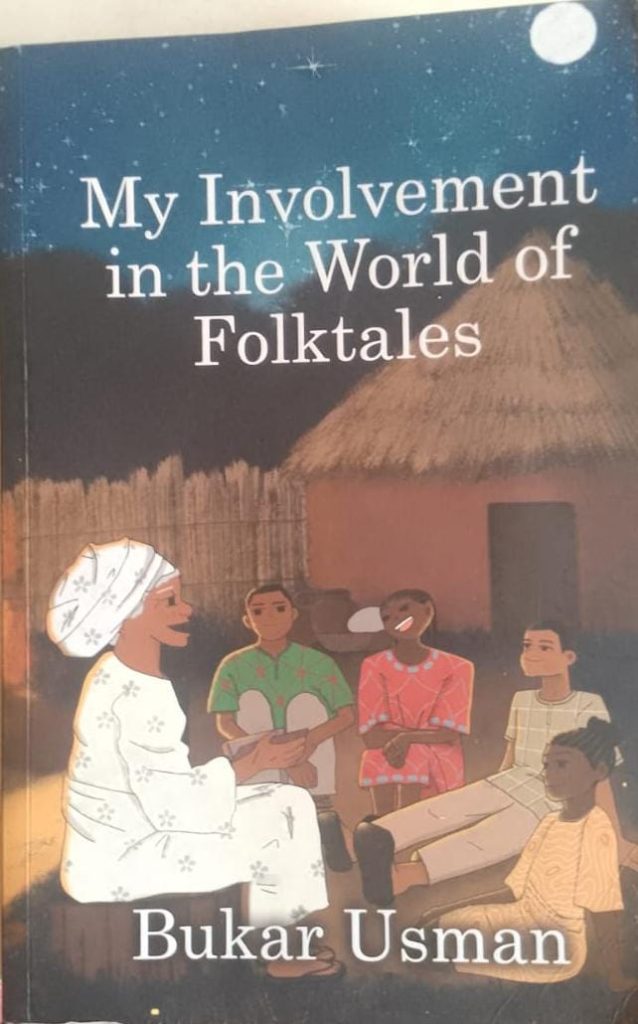
That is exactly what Dr. Usman has done in this latest work My Involvement in the World of Folktales (Klamidas Communications, Abuja; 2026). It explains some aspects of his life-long interest in archiving his activities from his days in the civil service down to his prodigious literary outputs. Some of Usman’s works in folktale archiving includeA Selection of Nigerian Folktales: Themes and Settings; People, Animals, Spirits and Objects: 1,000 Folk Tales of Nigeria andGods and Ancestors: Mythic Tales of Nigeria. Although the kernel of this work is by way of explanatory interview, it contains much more about his background and early years in his native Biu, Borno State. What stands this work out is that it is also rendered in Nigeria’s three major languages – Hausa, Igbo and Yoruba. This effort to translate the interview that he held with Khalid Imam in 2021 in English, into three Nigerian languages Hausa, Yoruba and Igbo attests to Usman’s desire to take the knowledge of oral narrative to every corner of Nigeria and beyond.
In the interview, Usman lays the ground work for what would later become his life-long quest to document Nigeria’s numerous folktales by putting together, both the ones he wrote himself and the ones he commissioned others to collect. His major published folktale in Hausa is Taskar Tatsuniyoyi (Gidan Dabino Publishers; 2012). It is a compendium of his 14 separate books published previously in Hausa. From then on, there has been no stopping the octogenarian from being chief promoter and archivist of Nigeria’s oral culture.
To understand Usman’s onerous efforts in folktales, one has to hear the driving force behind his work when he declares, “Folktales were indeed the ‘first school’ to which children were introduced in the African region. I dare say it was also the ‘first school’ for children in many regions of the world… The ‘first school’ where children were taught morals and the ways of life was the folktale arena. There were tales of animals, tales of man and animals, animals and spirits, etc, each of them laced with wisdom. At the end of each tale, lessons to be learnt were extracted. For example, obedience, acceptance, creativity, wisdom, courage, honesty, aversion to lies and stealing, importance of truthfulness and helpfulness…”
Usman’s focus in folktales is on many fronts. He does not only write, he commissions others to scour round the country to collect, as many as can be found and curated for the reading public. His organisation, Dr. Bukar Usman Foundation supports efforts in collecting and publishing folktales. Also, his involvement in the Nigerian Folklore Society (NFS), which he has been president, has served hugely to preserve this special area of Africa’s knowledge system. He explains the innovations NFS is involved in thus, “For now, the society is focusing its attention on compiling its history and designing curriculum on folklore to be taught as a degree course in universities. For this, the society is collaborating with the National Universities Commission (NUC) to facilitate a smooth and quick progress.”
Usman locates the centrality of folktales in human life in shaping who they should be as they grow from childhood, when these stories were told to them, till adulthood. Folktales were designed by our fore-parents as moral compass that would guide the ways of their children unto old age. Usman says of them, “Folktales are like gold and other precious mineral resources; the ground has to be dug for them to be found. That’s why I said it’s imperative that we look back and research on folktales, because in the tales that were told in the past, there are many lessons that champion good morals that one should embody. On the other hand, there are bad morals that people are encouraged to abstain from… Many of the problems faced by us today were narrated in folktale form and their ideal solutions given in a just manner. What we need to do is to modernise the art of story-telling, unlike the olden days when an old woman would sit children down under the moonlit sky to tell stories. In those days, there were no attention-grabbers such as television and radio sets (not to mention mobile telephones).”
In ‘Appendix II’ titled ‘Biu Special Report’, Usman acquaints his readers with a personal account of his early years when he listened to his mother tell folktales, the idyllic Biu landscape and how life was lived back then. He talks about his own family, his beloved mother and father and Biu as Edenic landscape that modernity has eroded into a concrete jungle. Usman invokes a nostalgic, not just of an idyllic, past filled with enchantments and a sense of what is lost and can no longer be retrieved. “Viewed aerially and against the background of the surrounding grandeur of the Adamawa environment and the watery expanse of the river Gongola, Biu lures every visitor with its somewhat Edenic appeal.”
Usman also gives a brief history of Biu, something he has done in a more expansive work. But here, Usman compresses Biu history in what can be gleaned at a glance. And to give more insight into his native land and acquaint the reader with Biu’s cultural ambience and enchantments, Usman includes journalistic pieces by Henry Akubuiro and Mohammed Umar Midala in the book. Akubuiro’s inputs are more indepth, as they explore aspects of Biu cultural life not known to the outside world, like the royal burial site of Biu kings or Kuthli that is guarded by bees and snakes.
Usman’s My Involvement in the World of Folktales is folk culture relived and reimagined, where the past interacts with the present and what this interaction holds for the future. This is a book to own especially for those wishing to relive the past and how it enriches the present and future.