The burden of memory: Love, loss and decay in Umaisha’s ‘Flames of Memories’

By Ezekiel Fajenyo
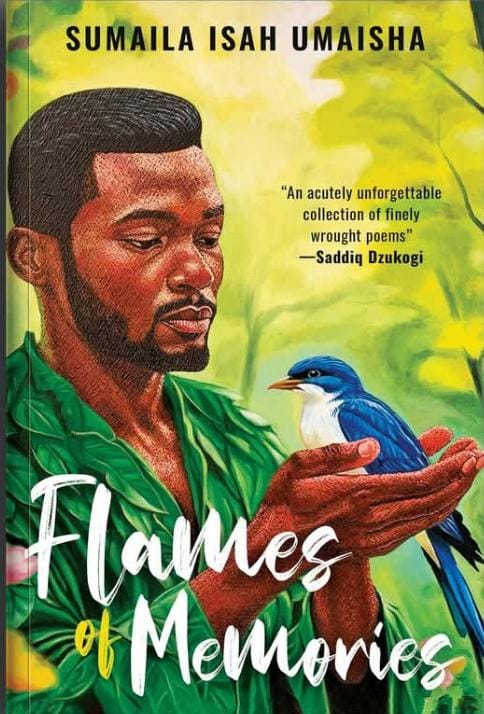
SUMAILA Isah Umaisha has worked tirelessly as a deeply creative journalist, novelist, poet, short story writer, critic, literary interviewer, arts administrator over the years, with a body of works to show for it. Among the works are; a collection of short stories, Hoodlums (2011), a novel, Glasshouse (2022), a play, Iburama (2023), a young adult novel, Lost in the Wild (2024) and now, a collection of poems, Flames of Memories (Masobe Books, Lagos; 2026). He has proved to be a growing seed quite capable of extending presence beyond a particularly fertilized farmland. The collection of poems, running into 153 pages, some of which were written over 20 years ago, and recently delivered by Masobe Books, simply tells of a heart full of unusual energy and adventurousness and breathing with much creative power, ability to spread words beyond their known meanings and pungent tendency to juxtapose situations and events from diverse backgrounds to yield shocking aesthetic effects.
The work, as stated in the “Author’s Note” is propelled by certain circumstances which tested his entire being and it is therefore a reflective “gathering of lived moments and missed ones; embers of what was, what never came to be, and what might have been. I’ve experienced heart-wrenching breakups leading to breakdowns that have left lasting emotional scars…. the loss of loved ones and other life-altering circumstances that trigger a state of mourning whenever they come to mind. I’m often lost in memories, replaying the scenarios.”
He has pointed out “the loss of my elder sister, my closest companion, the death of my father in 1976…subsequent losses throughout my school days” and among such losses, but ironically, the losses also influenced his creative intuition and commitment in a positive direction, for his “happier pieces, where revisiting joyful moments puts me in the right mood”. He maintains that though the work is “rooted in personal experience”, it illustratively demonstrates that “the writer has no secret when he writes from the heart”.
It is therefore not unexpected to find an avalanche of themes centred on life as an accumulation of stress, compulsive separation, loss of memory, crushed marriages and death all soaked in images of loss, past, pain, anguish, emotional dislocation and uncertainty and fleshed out in a tone and mood of sadness, pain, disbelief, confusion and suppressed anger, especially in Chapter One titled “Origins, Memory and Childhood” containing nine poems. The poems are largely a body of deeply autobiographical excursion into the poet’s beginning, experiences, losses and pain.
“We Live on Water” depicts the eco-reality of Umaisha as a riverine community in Toto, Nasarawa State, Nigeria, and from where the poet’s name is originally derived. It is a settlement surrounded by a river which obeys nature’s traffic dictations – it serves as a boundary, source of life and movement, major natural companion and definer of the people’s history and socio-cultural existence: “We live on water,/drawing peace from/the blue calm of/rowing surf”, “fish and honey,/a bequest free” and “We live on water/deep as dawn-sleep,/fed by the river’s/open palms” emphasize the fact that this water is a provider and supplier of needs, a parent-presence for the people – as suggested in the bountiful images as continued in the second poem, “Do You Remember?” which equally celebrates the abundance of nature’s gifts, beauty, friendliness, generosity, openness, reliability. There are images of childhood memories, togetherness, spiritual solidarity and oneness. The persona’s association with his sister becomes a defining measure for what obtains in this society when the young interrelate: “sneak out/to the moonlit bay,/cooking in the sand,/laughter stifled/by warnings”. It is a peaceful, serene atmosphere where children grow with the love of nature: “the riverside/where canoes carried/memories downstream/to villages swallowed/by harmattan?…/the fries schooling/at the shallow edges?…/Pestle and mortar/called us back home/to dinner mats of/pounded yam”, “the sun, homebound,/rinsed the village in colours?”
The poem aesthetically recaptures the playful moments, the freedom, which accompanied his and his sister’s growing-up years: “I remember us/husband and wife/with a wooden baby/cradled in pieces/from the tailor shed…./I see you rocking her/to sleep,/cooking bean soup/in broken pots”. The memory of this innocent past becomes the harbinger of pain when he loses his sister to death as “Now gone like fish/caught too early…./Do you remember/over there as we do here/with ceaseless tears/sucked by the hunger/for things forgotten?” The images, metaphors and rhetorical questions as used strengthen the memory theme as the reader is visually made to compare the past and the present situations, emphasizing the grievous pain of loss, not only of a person but the era of innocence. The generous use of water elements and images as “logs”, “bamboo poles”, “fishing nets”, “waves”, “canoes”, “riverside” depict the indigenous bearing of the community. The poet does not fail to depict some lines of paradox (“waking us/to sleep”), simile (“Now gone like fish…”) and personification (“Pestle and mortar/called us back…”)
Such depictions equally manifest in another poem, “Childhood Memory” which gives a true picture of a traditional society where morality, discipline, respect for others, count and sometimes enforced in the family. The images and metaphors reflect such orientation especially as seen when the persona, a stone thrower, carelessly hurled stone “at the hands that nursed me”. What followed was some acts of discipline: “I remember the headache,/mama’s bitter herbs,/the kicks from uncle,/empty knocks of aunties,/and the toothless laughter/of old witches…”. It is a superstitious society.
One impression the persona insists on is that the indigenous setting, the local environment has colour, life and remains unsoiled, uncontaminated in its raw essence, which is why he questions why people abandon it for urban environments where insanity, unease, tempest, immorality prevail: “idling in a fool’s mind/adrift on fancy” and “We build paradise,/incubating it for a/lifetime in mental wards…” And in “Remembrance”, he establishes the beauty, sumptuousness and productive features of his community in images and metaphors of steadiness, attractiveness, openness, abundance and cultural wealth as seen in “You stand steady,/the stark beauty/of a solitary sapling/on a cleared field”. He is pained that he has since left such a simple, serene and rich world for other places: “Alone, you stand,/a gazelle keeping/her own side,…./a stubborn neem/in the oasis drained…./Today reminds me/of what we left/behind those hills,/calling us at every step/away from each other”. He is understandably pained, distressed, unhappy and unfulfilled turning his back at such a village despite the losses and some hardships he experienced. The poem is rich in alliteration (“You stand steady…”) and end rhymes (steady/beauty; sapling/keeping).
“Ekaete” is also a celebration of natural beauty, as a love poem, though the persona sees her paradoxically as some burden who must still be sought for the quality of her elegance and blessing of natural gifts. But the poet, in “The Orphan” returns to a moment of gloom, beggarliness, hunger, isolation, starvation, suffering, neglect, pain and alienation – suffering as imaged in the title of the poem. The popular almajiri syndrome in our uncaring clime bears a true testimony to the life of an orphan, imaged as “down the gutter…/wayfarers lose their ways”. The lyrical energy of the poem, despite its saddening metaphors, is oiled with some end-rhymes: “borders/shoulders”, “streets/weeds”, “streams/streets”. The orphan is a wanderer who lives a life of uncertainty and never offered a semblance of assistance for personal survival in an insensitive society.
In “From A Distance”, the persona reveals, contrary to geographical definition of the earth as being spherical, that nature is flat, does not exaggerate, but can be quite deceptive from the level of different human perceptions; it is an equalizer of beings just as closeness to situations or objects breeds a new impression or perspective on what is sighted. The poet celebrates the power of multiplicity and mystery of the human space, as it is capable of diversifying people’s impressions, like a mirage. Umaisha’s use of personification as seen in, for instance, “rainbow smiles…lamps” is characteristics of his aesthetic juxtaposition of unusual words to produce diverse but bold meanings.
In the “Pyramids”, the persona sets out, with like-mind, to explore the background history of the Black race especially from what has been written on the Egyptian cultural history. The devoted group of researchers and scholars engage “searching the past”, cautiously touring the museum of history for details from “the shelves/of Alexandria and lost/crowns, scanning rust/for missing chapters,/gaps in time, and/truths bent askew”. They want to dig into the truth contrary to the often blasphemous, denial-edged tales heaped by foreign adventurers on the integrity of history. Metaphors and images used by the poet point to the desire to dig up the reality, using all available tools and cultural items to help the process and this is profoundly successful as “Speck by speck,/we pick the lies/left by passing dust”, provoking an intellectual atmosphere of sumptuous joy and satisfaction: “singing, dining with/dynasties from/legend scripts”, despite the fact that there are “bartered/ thrones…/empty palaces” reminding them of “masters turned slaves,/forgetting how to remember”. The happy-ending adventure is portrayed in the images of breakthrough, freedom, reaffirmation of integrity and acknowledgement of the power of self-discovery: “But now we know,/and someday we may…/locate our place/ in the book”. The mood and tone are understandably celebratory; the soul of Africa has been visited with liberation and all odious untruths about the race crushed forever!
In Part 2 of the anthology, “Love, Desire and Intimacy” is the general title, with the first poem being “Tonight”. It celebrates conquering through deep affection. The persona is captivated by gripping allure which unifies him with the woman, enveloping him with images of cheerfulness and tone of glamour. His conquest is total; he fears no more disconnect because the lady belongs to him and “Time is waiting/at the gate”; this love is no more about finding lips “in the dark” or “fingers/tracing waist beads” and no more “whispers’ because the love is all-defining and enervating “bond of boundless/rivers…”. The cheers-breeding unity is bound to exist forever, “of fate sought in depths…found at last/where deadlines meet”. Passion, hope, submissiveness, happiness, expectancy, fulfilment and nobly enriched souls are imaged in this powerful poem of love whose environment is colourfully shaped by lyrical sonority as equally found in another love poem of six stanzas, “My Love for You” in which the persona pledges a refined, endless unpretentious affection. His love is not the fleeting type empowered by sheer poet’s lyrical affectation nor “inspired memories/or losses remembered” and “not a tune borrowed/from old songs” but a fresh, creamy, heart-birthed “tendril wrapped in steel,/a skin the sun cannot bleach”; a product of “my flesh” which speaks only “in metal tongue/the eloquence of lighting/when doors are closed/against cold fingers,/dry knuckles knocking”. Having gone through some hindrance before winning her to himself, the persona maintains that his love for her “is endurance etched/in flesh and bone;/a life lived many folds/searching for you”. She is a clean product of his determination, zest for beauty and enduring spirit. The love ignited not by lust but strong, passionate desire. Lyrical cadence laudable personifications and end rhymes walk through the lines.
In “An Ode to My Love” the persona again maintains a unique relationship with this love, one of the qualities which draws him to her being her spirit of purity, service to God, a life of holiness, transparency and godliness. She is in her “Hijabed virtue” actually makes her a ready symbol of believability, truthfulness, spiritual perfection and unpretentiousness; it is “the look in your eyes” which sets “my watch” just as “your smile” is a “canoe wakes on/a calm river”. Through her, he attains semblance of calmness, humility, purity of soul and stability of mind, which is why” “I have nothing/that is not yours,/all my days naming/stars after you”. She is slim, fit “like/a sword”, “a queen hidden/from public claim”. He unquestioningly needs the lady to serve as his companion because he has experienced loneliness, unease, innate torture and pain by the loss of his loving and caring sister – the lady’s beauty he is associated with, as compensation, is not defined only physically but also spiritually. She is his life, his spiritual essence: “I lie helpless/before your henna feet,/my head on your lap…”. His confession attests to the mood of satisfaction and tone of total submissiveness.
In “The Love Birds”, the persona assumes, with his lady, a life of tenderness and radiant youthfulness as seen in their return to the age of innocence, chastity, untainted confidence. In that state, their innocence is proclaimed with all elements of its attractiveness, expectations and the “language of youth”. The visual purity, chastity, discipline and beauty are carefully laced out in the lyricality of the words. The images and metaphors of graceful submissiveness to the lures of passion and spirituality can be seen in, for instance, “my seeds in/the soil of your smile…/dreams”, “stolen moment/bring us down to earth/kids again in parks…/language of youth;/slangs, late nights,/fun caught by being funny”. Even when they temporarily part ways in school, they are always in one another’s desirous consciousness: “As we return…/assured./Two birds meet/at a crossroads,/part,/to meet again/after lessons”. The poet’s economy of words, personifications, symbolisms mark him out as a brilliant poet who knows his onions!
What he makes of this poem, as most others, is what the reader encounters again in “A Kind of Love” in which the cheerful persona celebrates individual parts of his woman – her enthralling lips, eyes, voice, legs and fingers in images of magnetic beauty and radiant attractiveness. To him, all her epitomized body parts work together to make her a total package in transcendental, exemplary and ethereal beauty, which equally defines her life of passionate commitment. Full of alliteration and images of beauty, the poet energises the work with unusual power of alluring lyricism. For instance, “those eyes,/those shifty flirts/of something else”, “your voice,/the call of a canary/on a bridal night”, “those legs,/the hot gait of grace/raised by nurture” and “the fingers,/slim, sneaking/down my back”. The descriptive energy fuels the poem’s power of aesthetic refinement.
The reader finds these qualities also in “I Wanted You”, another poem of passion. The persona wants a dedicated companion to replace who he lost in the past – a companion truly loving, caring, understanding and beautiful. The lady is expected to be in his “story long enough/to prove me wrong,/to ride waves/to the sea, dancing,/sails blowing,/mornings bright/evenings a breath/of delight”. The images and metaphors here remind the reader of his water-rounded past in his rural community whose memory gives him some pain and teary moments, especially the loss of a very loving sister! He needs that graceful touch of nature and sees the lady as “the missing part/recovered,/bridge to my youth/at this age”. He wants her to steady his wandering spirit and make his existence colourful, fulfilling and not only about remembering a missing part. But he is not so lucky: “But I see logs every way,/a curse on each luck,/no room for my story”. His wish is never achieved; there is a “receding/voice heavy with/unspoken farewell…/The last curtain/drawn…”. Images of shock, confusion, frustration, crisis reveal his inability to attain his desired goal. But he longs for the best life for himself as seen in words of brightness, sweetness, happiness and fulfilment which are employed. But those elements never drop on his feet. Some end rhymes like “bright/delight” and “dancing/blowing” give radiance to the poem.
In “Waiting for Your Touch”, the persona is determined to undergo whatever pain it takes for him to have this lady companion. He is still on a journey to win over a companion, moving to unusual places like “below,/rivulets flowing/through limbo…” with “a choked sigh” and “Beneath the sun’s whip/where burdens fold time…”. His destiny remains unaccomplished without her in his heart; she symbolizes life’s torture and helplessness as “Under the night’s gaze,/blinded by groping fingers,/I stand still like embers in/an abandoned fireplace…”. She is the only promised succour, bearer of his peace, “to/unbutton my heart/and torture me to death”. The reader also encounters well-placed similes, metaphors, personifications and gracefully juxtaposed words.
Such aesthetic elements equally dominate “Comfort Zone”, a poem eulogizing the multidinous relevance of nature as seen particularly in the symbol of the rain. The persona still wonders, in a moment of isolation and thoughtfulness, what life is really all about. He could only listen to the drums/of rain outside,/the whistling wind, carrying the scent/of wet banana leaves”, “rustling palm fronds”, “cupped against the chill,/dreams whisper promises/beyond the tattered fence”. The persona becomes a spectator, watching what nature does to, and around him; waiting for a time in which blessing would be heralded like the “wet banana leaves” and “rustling palm fronds”. He is alone even when it should be “a game for two,/bedfellows whiling away”. Life may be harsh, lonely, inscrutable, uncomfortable – the paradox here is associated with the title! There are end rhymes here: “comfort/fronds”, “presence/scent/fence” “silhouettes/scent” and “stilled/chilled”. There are brilliantly used metaphors like “naked comfort/of your breath,/I listen to the drums/of rain outside”, personifications: “dreams whisper promises” and a sexual imagery: “bedfellows whiling away”. While nature is full of power, blessing, movement and companionship, the persona’s life is an example of seedy contradictions, pitiable loneliness, isolation, hunger, uncertainty and discomfort.
A lady of perfect and elegant beauty is again celebrated in “The Burden of Beauty” as seen in images of sweetness, fragrance and physical attractiveness; she is a walking glamour, “cute as a cube/in a teacup, splendour/in the ides of man, perfect/perfume from Persia” with her “hips cutting/the air like daggers…”. The persona is enchanted, waiting to be a partner of this walking spectacle of beauty but she disappoints by falling in love with men of material means, people of wealth. Deflated and shocked, he feels the weight of disappointment as the lady “dissolved down bidders’ throats on/monopoly street, leaving/dregs for me to drain”. The metaphors and images of frustration, wasteful emotional feeling, poverty, isolation and abandonment are further reflected: “I am the drainage for their/sins and ours, tossed about by tattered winds”.
Indeed, the poet extends the theme of this poem to what bad leadership by political rascals and rapscallions has caused the society – social and sexual immodesty, denial, exploitation, pride, shamelessness, poverty and desecration of the beautiful land. The leaders, who are naturally materialistic and selfish in orientation, have turned young, warm-blooded beautiful girls to objects of manipulation and exploitation while mocking and condemning the poor, “tossed about/by tattered winds”. The persona is a symbol of all oppressed, exploited persons made to wear garments of shame and dishonour: “No name too ugly to wear…/I remain the dew at dawn…”. The use of simile like “cute as a cube” and alliteration like “perfect/perfume from Persia” beautifies the direction of the poem’s aesthetics.
In another poem, “An Ode to the King”, the persona lambasts a tyrant, dictator and bad leader who is only good at speaking “in sparks;/a stammering firestorm/of vomit and venom”. The poem is strongly satiric, exposing the evil-mindedness and oppressive and fear-drenched attitudes through which he governs his people – he is full of venom, meaningless anger, hatred, mischief; he is equally retrogressive, uncreative sadistic, monopolistic, undemocratic: “He attacks whom he likes,…/Whatever he touches/returns to the start…”. He is also morally reckless and loose, lecherous, vainglorious, oppressive, manipulative, domineering, selfish, and undignifying in socio-political conduct: “What he loves becomes – /no bride escapes the jungle/when she is a belle./Let the groom die/of crushed anger!” The tempestuous dictator symbolizes the kind of leaders found mostly in less developed societies, such as Africa.
In Part 3 titled “Loss, Absence and Emotional Rupture”, the first poem is “In Your Eyes”, a lamentation on the loss of glorious, beautiful, creative past as symbolized in a lady’s “eyes” in which the persona sees “distances/beyond sight”. What he sees in the lady are imaged manifestation of failure, sadness, stagnation, impurity, suffering, backwardness, loneliness: “tears of days gone/on your sun-baked smile,/lonely as a plucked feather…/lost peacock…/dimples of death”. There are also images and metaphors of “withered petals”, “scars on your back/in patterns of a raffia mat/wrenched by war”, “Like a bee dead on nectar,/your finger no longer trace/the veins down my spine./In your eyes/I see only grey,/all colours gone./Gone is the rainbow…/We’ve left the nest,/lost in the middle of/where we used to know,/In your eyes/I see a story/unfinished”. The persona is pained by the sense of loss, poverty, missed opportunities, deprivation, arrant hopelessness, hunger and starvation. The repetition of “In your eyes” shows the level of undisguised conviction by the present reality from which he cannot escape as seen through visual metaphors of an old companion now drained of energy and alluring physical features, depicting a life of deprivation, ugliness and pain.
In “The Tale Ends”, the persona expresses, in a tone of disappointment and frustration, his inability to influence the mannerism of his lover when the public get to know of the relationship which they swore to keep secret. Their avowed determination to keep sealed lips but allow love to flow between them unceremoniously interrupted: “the zipper’s piercing/whisper seals the fairy tales…”. The “footsteps” of the woman “down the passage” which “say nothing” and the “sweet deceits shaped/by distance, glossy pages/of nightmares…/stories told to keep sane/in the lock we vowed to keep” become public knowledge and affects the union negatively as “Now, footfalls down the/passage shut the past – key and all”. Images and metaphors of imprisoned feeling, failure, frustration and setback are accompanied with useful alliterations: “slides that speak standards” and “sweet deceits shaped”, personifications and paradox: “sweet deceits…”.
In “Broken”, the persona engages once again, on his contact with his lady imaged in a very tight simile of “a muted word/between dusk and dawn,/a flicker of shadow/searching for lamplight”. She sneakily reaches out to him but the experience turns out to be some mirage because both could not feel the true essence of their presence: “a touch that isn’t there – emptiness seeking/refuge in a crowded room”. She is an unwelcome visitor, an interferer struggling for space in an already “crowded room” though the persona is himself, indeed, broken as he is “also a wound/to be nursed, a canvas/smeared, aching for a brush/I am the wreck on your back,/stuck in half breath,/halfway home”. The diction suggests a life frustration, unease, sadness, unfulfilled love life, empty daydreaming and stagnated experience as the persona experiences in darkness, ‘emptiness’, ‘crowded room’, ‘wound’, ‘smeared’, ‘aching’, ‘wreck’, ‘half breath,/halfway home’ (the last, an alliteration). It is an agonizing life stuffed with loneliness, frustration, sadism, alienation. In another poem, “A Harvest of Silence” is indeed a harvest of frustration, loneliness, indifference and nonchalance which modern sensibility has built in the persona. Unlike in the past when, in the village, life was smooth and radiant with calmness, nature was playing out its role beautifully (“Breakfast smoke…/Palm trees sway/to the breeze,/sun birds – the same song”), the contemporary times especially in the urban centres has twisted such laudable values – there is now selfishness, wickedness, violence, mischief, lack of good neighbourliness and solidarity; there is no peace, understanding and desire to progressively influence others especially as the family system has horridly crashed! He insists that “the tone is different…/from neighbours,/and I will not care./In my bedroom,…/my wife turns in sleep,/reaches out her hand…./a cold sheet of absence,/a presence….. Life is sickeningly boring, tiresome, depressing, stagnant; the ‘silence’ imagery tells of loss of action, reason and potency! The visual metaphors and simile (“haunting like drumbeats”) tell of a life lived in detestable agony, distaste, confusion, self-hate. We also see it in the sharp paradox: “of absence,/a presence…”.
“Weight of Waiting” is another experience in which the persona seeks to read some meaning into his life “through thoughts/of a tide waiting/its own return”. The riverine background is again employed here, like in most of the poems in the anthology. He is sadly alone, “a shadow/on murky water,/waiting, wading…”; his heart is heavy and his crowded imagination is wild and wide: “we cannot see/in the shallows;/figures fighting facts,/rushing like harmattan/storm across the heartland”. He takes forceful solace in “arrogance/of patience” while thoughts of life and death assail his being as his heart becomes “a drum/for your pains”. The images, symbols and metaphors express feelings inner tremor, monstrous unease, confusion, hopelessness, perplexity and endless “waiting” even when he is “a shadow/on murky water”. Yet, he is determined to find significant answers to the multitudinous questions bred by his melancholic spirit; he seeks wisdom from nature, as a chosen path, in order to redefine the essence of his existence. Umaisha’s economized, well-chosen words, visual images, alliteration (“figures fighting facts”) and end rhymes (“wading/waiting”, shadow/shallows”, “harmattan/heartland”, “die/rise”) portray him as a poetic mechanic quite confident of his tools.
“A Wasted journey” is another confession of the emptiness of the human life, especially because man insists he is knowledgeable even when in total, pitiable ignorance. He lacks needed patience and humility, enveloping himself with meaningless “arguments/ruined by stammer/and strangled jokes”; he trudges but structures his mind to embrace atavistic ignorance, while his actions become “a spell/of voids, famished ghosts…/closed eyes for/wisdom in ignorance…/wandering/through infinity,/too wise to learn”. The poem on trip through life, is strengthened by unusual words collocations, bold metaphors of self-imposed limitations and paradoxes. In “At Last to the Sea”, the poet presents a picture of a dashed hope, a punctured celebration of a sudden but needed change in leadership structure which turns out to be a rumour. It begins with the mood of celebration: “Like rinsed glasses/waiting…/We raise a new flag,/lowering the past”. But rumours are part of life of a people most of whom live in ignorance, and when such rumours are expunged through appearance of truth, shock and confusion do envelope the atmosphere: “We stare, deaf-dumb…” and those thought to have been erased from the leadership plaform are seen again, being welcomed mostly by their earlier haters: “waves of welcome/undulating-heaven’s ovation for fortitude”. The dangers of inglorious rumour-mongering, darkness, ignorance and backwardness are the themes projected here through captivating diction, visual images, similes (‘Like rinsed glasses”; “lands like a sudden”) and end rhymes (“regaining/undulating”; “again/floodplain”). The poem, “Where Does Love Go?” is a deep reflection on life, asking universal question whose answers are difficult to provide; it is an exploration of life’s meaning, where man comes from and where he goes thereafter, after going through the journeys of his destiny. Filled with rhetorical questions, the poet treats themes of the shortness of life and human memory as past incidents and events are forgotten and fresh ones, though mysteriously unexplained, take over. The loaded past witnessed unrecorded or unremembered situations, happenings and stories most of which have no reflections in contemporary realities. Life runs in endless circles; as the past rolled away, the present will follow suit: “from where do songs come?…/Where do they go/after the party…/Where do strangers go/after their stay…/Where does love go/after heart break…./Where are those days/we had nothing…./Where are those tales/of old we told…./the hope we plucked/like ripe mangoes/from tall trees,/the laughter we shared…./where/will the lives we live go…./Where are we going from here…”. The past was nobly beautiful and satisfying; there was good neighbourliness and shared hopes and peace – these features have left and uncertainty, impatience, violence, selfishness, peacelessness, hunger and confusion are now in place. This theme of time as a feature of the human experience is treated again in “The Pain of Being”. Time robs us of what we know and we know that a lot is yet to be known by man soaked in arrant ignorance: “Knowledge of ignorance/becomes a pendant… never defeat”. What we think we know comes up with fresh, hidden details, leaving us in a pool of ignorance. Time moves very fast and the glory and beauty of yester years remain lost as we forget whom we really are. Man, lives in a world of which he knows close to nothing and makes pain part of his existence – the pain of being! The images and metaphors are sharp as there are generous historical echoes of, and allusions to South Africa’s Shaka and Egypt’s Cleopatra.
Umaisha’s preoccupation in exploring diverse realities of life, especially nurtured by the lost virtues of the past and the pneumonic sadism of contemporary times is most exemplified in Part 4 of the anthology titled “Identity, Self and Existential Inquiry”. In one of the poems under this, “Tell Me What to Sing”, the poet reveals that life itself lacks rhyme and rhythm and is quite disturbingly confusing and erratic. Man is fond of asking questions on what to do to live a satisfactory existence; he seeks to know how to respond to hatred: “the whispers of lethal/splendour harboured/in gentle looks”. Life is a dicey catalogue of deceits, mirages, gouty complexity and hypocrisy, in fact, “itch where my/fingers cannot reach” and “With arms so short/and the hours tightening/like a wrestler’s/stranglehold…”. Rhetorical questions are asked to expose such enormous complexity: “Where does one stand to lift the earth…” and “Where can I find a place/to hide my size/from eyes so vast?” The mood and tone here is one of sadness, uncertainty, perplexity.
Such a frightening picture of man’s experiences is again found in “All Alone We Die”, a poem which depicts themes of isolation, helplessness, life’s brutality, unhappiness, “a crowd/without laughter”. Existentialists maintain that life is complex, meaningless, inscrutable; the more the obsession with quest for knowledge, the more the cagey effect of crippling ignorance and actions breed inactions while mobility is defined by immobility. Life is harsh and cyclically impotent, claustrophobic. Indeed, life could be awful by serving as some waspis/santuary of failure, anguish, setback, afflictions, ignorance, drought, wilderness, wickedness, evil. We live and die in abject loneliness because those we claim to love, “we knew/without knowing”. Indeed, “Lonesome is the grave,/plush or poor” and “Lonesome is the night,/dark as a widow’s veil…”. We live in self-deceit and darkness. The reader encounters some Okigbo’s influence in “I stand,/clouded by moods…” and “I knew before you/with raised palms,/seeking not revenge…”.
In “I Will Wait”, the persona is held by the inevitability of patience because he has no power, potential, wisdom to effect any visible change in nature; he is being propelled by forces beyond his control, for good or bad. He has to wait: “I shall tarry till the tide/tunes…”; “We cannot bend time,/nor change the track/…travellers”. Life is programmed on chance: “We can only weave…/with the sea-wind/at the speed of chance”.
In such a situation, man turns to a pitiable creature – a theme developed in “The Gambler”. Ignorance and the quest to know self-spur man’s spirit towards finding a true definition for his life but he is destined to be unable to correctly prophesize on his life, encounters and know “the right/card behind fate or fact”. Tossed at will by life, the persona is “a wayfarer lost/in chessboard fog”, yet the “sun will soon be gone” because “The day is aging”. The metaphors and images suggest man’s life of darkness incompleteness and harsh reality which propel well-placed rhetorical questions: “Where will I find…” and “Where on earth”. There are some end rhymes which aesthetically lyricize the lines without diminishing the frightening tempo of the uneasy themes: “vice/lies”, “lost/fog”, “begun/be gone”.
In the poem “Nothing I Do Not Know”, the poet maintains that the efforts made by the man to understand life and grasp its immensity results in failure though, he has gone through various experience: “I’ve seen dusk… foothold” and “I’ve seen green turn/grey…footprints”. Accumulated experiences do not provide answers of noble import: “Then he found her/in the hem…/shame/taken for a prize”. His crushed curiosity makes him see life as riotously grotesque and a symbol of hopeless captivity; he becomes a wanderer – a helpless sponger, an unstable cadger, loafer, and inconsequential hibernator. Life reduces him to nothiningness and only remembered through “the smoke-stained/mirror on my table…/though he knows me not”. Inconsequentiality is a feature of existentialist reality. He could not clearly unmuzzle or successfully unkennel the hidden, unpredictable truths of life as reflected in the images and metaphors. In fact, in the poem, “Phoenix”, the persona volunteers a submission, a surrender borne of helplessness – he is immobile, hopeless and can only keep on waiting: “Caught in the storm/I sit in the rain/and wait for the sun”. His eventual emotional rescue emerges from supernatural force “whose finger tender/beneath my soul,/a caress,/a whisper,/ the playful touch/of a butterfly”. He is lucky, almost always to be rescued by force of nature when he feels he has lost it all! The “sun”, part of nature, wakes up the lovers (there is sexual imagery too) “with secrets/foreign to what we know,/known only to the/language of the body”. He is still ignorant and helpless but believes in the redemptive power of nature. End rhymes energize the lyrical movement of the lines, for instance: “storm/sun”, “tender/whisper”, “whole/soul”, “presence/caress” as well as the alliteration: “the hills,/like a lost song”.
“The Naked Age” tells of the contemporary times, as distinct from the past, with people’s obsession with gross imitations, sense of awkward drama, insensitivity and colourless moral choices: “We are the model of/our time, solid makeup…”. Hypocrisy, ugly and violent competitiveness, deliberate misrepresentations and flare for obscene outlooks make us a people soaked in muddy, undisciplined character playing: “We can be macho/or tender,/young or younger./We are the image of this era…/witness to the strength/of our weakness, the sagging/trunk of iroko”. The new socio-cultural obsessions are lifeless, unmotivating, unproductive and such choice of irregular attitudes is often modelled after foreign interests and tastes: “the rage of innocence,/ponds of frogs…/life elsewhere”. The past was simpler and few moral choices were non-discriminatory, noble, attractive and everyone lived in peace and with spirit of understanding: “In those days…/we dined with ants and lions” but today, the story is different: “free access to excess makes/us snatchers…”; we lack inventive spirit in this “bold age…/naked in the /arms of freedom”. Our world is morally deficient as we give honour to scruffy recklessness, sickening exploitation and septic selfishness and shamelessness.
“My Words” reflects the solid commitment of a member of the writers’ fraternity, defiantly insisting on what his art is focused on, through “words”. The persona repeats the “my words” as refrain because he is quite practically unhypocritical that he is a fearless and angry critic, moralist, innovator of ideas and an antagonist of ill bred, seedy mannerisms in society: “My words/drizzle like needles/phrased in anger,/sharp on the heart,/barefaced./They are razors…/cannonballs descending/on the world of letters…/My words/are magma…/My words/are lone travellers…/Every word is a spike,/a nail on the head/of deviants,/every verse/a butcher’s knife”. The artist is a conscious, uncompromising worker for change, a bold and assertive instiller of discipline, a radical purveyor of truth and devoted inspirer and motivator of social and political transformation in society. The visual images and metaphors tell the direction of his chosen mission: “needles”, “anger”, “razors”, “cannonballs”, “magma”, “warriors serving death”, “lone travellers”, “spike”, “a nail” and “a butcher’s knife”. He is a visionary never ready to compromise these principles, ideology.
In “A Wish”, through an avalanche of religious and scriptural images and succinct metaphors, the poet quests to be an object of worship such as would enable him to engage in “a silent escape”; he would have wanted to be “serenity in worship” or equally become “the last/word on a tombstone,/eternity engraved,/or something/in someone’s head,/forgotten”. It is because the tired persona has lost his human bearing; he quests for peace, “serenity”, “escape” in order to enjoy freedom, peace. He has suffered endlessly and the world has not offered him a privilege to know details of his humanity or the authentic reality of his mirage-garbed environment. He sees himself as dead to the world of humans and craves to be “the last word on a tombstone…” or a “forgotten” item “in someone’s head”. Though this is one of the simple-dictioned poem in the entire work, the images and metaphors of waste, meaninglessness, death align with the existential background of the part.
Part 5 is titled “Society, Power and Collective Decay”. The first poem here is “We Live in Vain”. This simple poem is unpretentious on its thematic focus: humanity is unserious, self-deceptive, hypocritical, nerveless, uncreative and easily deceived. Man seeks to consume what he does not produce and boast of what does not come off his personal sweat; he is carefree, manipulative, non-industrious, and without a spirit of determination and enthusiasm; “We live in vain/When we live/under mango trees/not our own./…living in trenches dug/by hands not ours”. We are a people who are sheerly proud, vainglorious, careless and unserious-minded: “We let down our guard/each time a doll smiles/the smile of decay./…as kings,/we choose to be clown/prince of the Sahel,/wearing dust as turban”. These are apt images of our inglorious clownishness,/asinine foolishness, loathsome false sense of empty religiosity and mutton-headedness. In the poem, “They came with Love Songs”, the poet is obviously saddened by what he imagistically perceives as religious indoctrination and spiritual inclinations which carry elements of deceit, exploitation, cultural despoilation, pretence and false teachings to our land from “across/the Atlantic” by religious purists and hollow-brained evangelists. He condemns the attitudes and strategies of these dogmatic religious zealots who “came with/songs rolled over,/scrolls of lies…”. They even attempts to speak indigenous tongues which “they could not/speak, leaking/through the nose”. There is satire here, exposing the cold-battered, diseased foreigners whose lives and existence were rather shaped by lack knowledge of the people and environment they came to spread their gospel of lies and falsehood: “They took our oil lamps…/stolen bits of/holy verses” as they were full of similes as armour,/guns, rose-tinted mirrors,/and love sung…”. The poet boldly retells past history of the introduction of foreign religions into Africa, with holy books and songs while given out “guns” and “mirrors” as gifts, to be accepted. It reminds the reader of the systemic colonization of Africa. The images and personifications are fresh, truth-edged and assertive in their visualness. There is a sense of drama and movement stretching out the lyricism of the poem. There is irony and humour on the insensitive attitude of the gift takers!
In “We Have No History”, the poet eagerly reminds the reader of the terribly ugly position and postulation of the foreign researchers and scholars who insisted that Africa has no history: “We have no history/but what they tell us/through the window/No records…/Our history is a play/at night,/everywhere asleep…/hope and /hardship exchanging/signals like kids/silenced at a meeting”. The images and metaphors point out the high level of executed conspiracy, wrongful theories and twisted standards applied by the self-motivated foreigners. Africans were treated like kids without any sense of maturity and intellectual discipline; over cultural life is derogatorily reduced to what “griots” try to “recall amid market noise;/failing each time” – we are seen in Africa as dishonourable daft, hopeless ignoramuses and “strangers’ to our own traditions, sheer “dancers shifting/between two drums…/We have no tales/to tell the pilgrims…”. Ignorant of indigenous traditions and deities, the odious foreigners and racial consciousness are heavily satirized and lampooned for seeing and interpreting our culture as “only fables of shrines…/monkeys” and as “fairy tales shared/under ceiling lights/over champagne” because “The stories we know/are not our own”. There is a brilliant use of ironies, satires and lampoons against the nosey and stupid agents of socio-cultural misinformation, miseducation and documentation. There is heavy use of humour, pun and personification. It is a similar body of biting satire, humour, ironies, and images that the poet employs in
“Pacesetters”, another poem of critical inspiration against foreign intellectual manipulators and research-touting twerps who insisted on blasphemously pooh-poohing Africa’s cultural treasures: “They came to use,/setting things right/by mixing them up/They came with long/words, sharp as swords…/They came with laughter,/loud, exposing fangs/they tried to hide”. These foreign interventionists in Africa’s affairs were pretenders, hypocrites, liars, manipulators, often using language as a tool to confuse the people and establish themselves: “verbs dripping like palm/oil on white…/old books upsetting/our pace to set theirs”. As intellectual confusionists and vampires, they exposed “fangs/they tried to hide/We were half-moon/to becoming…/when they came with/theirs and confused ours”; the infectious viruses they spread continue from generation to generation as reflected in the last stanza: “Each time we touch…/the next generation/of victims”. The crises caused by the interlopers negatively affected Africa’s socio-cultural, educational, political, economic and development policies, the effects of which are still being felt. The images and metaphors of stagnation, disease, pollution, backwardness and failure build the poem into a formidable statement.
That was the foundation of the crises in Africa in particular, today. Dishonourable and questionable leaders have since assumed power in most countries and, with some demonic connivance with the foreign agents, continue in their evil tradition of toxic leadership, as indicated in “They Eat Our Best”. The poet laments the exploitative, morbifically destructive strategies of such hellish beings, betrayers of common destiny: “We wear hope like jewels…./become a waiting/noose”. The land is full of hungry, helpless people while such greedy interlopers “eat our best/and crave more/by rights…/Belief is a play/they missed as kids…”. The images of hypocrisy, exploitation, ungodliness, greed and manipulation spread across the poem. Africa’s future is already polluted and pathogenically desecrated: “fenced with broken twigs-/fuel for the next fire”. Similar sentiments are expressed in “Rich in Poverty”, a poem like the above, rich in ironies and images and metaphors of wastefulness, underdevelopment, suffering, stagnation. Rich as the land is, the people only experience poverty, backwardness, hunger, decadence, and starvation: “We have everything;/Kola trees../diamond…/oil…”. The persona also lists the good fortunes and natural possessions of the land “corn fields”, “raw reserves”, “barns and stores”, “Cattle drip”, “gold” and “Grasscutters” – indeed, the forests are as originally blessed as the fecund land, yet such “abundance” has been ruthlessly wasted, “masking/gradual decay”. The people have become self-haters, disintegrated populace: “We are scattered litters/after the feast,/spilled from care/to roam the woods-/bandits to one another”. Unity, neighbourliness and solidarity are now distant dreams being the original intention of foreign interlopers.
In “Cage of Freedom”, the persona uses humour, ironies, sarcasm, euphemisms, exaggeration, and pun to depict the political situation in the land where democracy and freedom do not exist: “I love the ballot,/how it puts us in a box/like sheep squeezed/in a pen…”. Politics is full of manipulations, greed, exploitation, deceit, grandiloquence, and violence as depicted through the visual images and symbols: “The ballot is a fishing net/caught on thorns…/Liberty is fresh air/to do what we like;/eat our tomorrow…/I love madness,/how it covers shame/with new rags…/I adore the gentlemen/who make our heads/their stool of power…/I will sit by the roadside…”. Through such abundance of ironic, paradoxical lines, the poet condemns the evil political practices in the land, politics of violence, corruption, domination, sectionalism, greed, exploitation, entrapment, lunacy, class schisms, odious dictatorship, monopoly. It is a land where freedom is purulently caged, brutalized, mocked and frustrated. It is a land where lies and falsehoods prevail as depicted in another poem. “The Lies We Tell”. We build on flawed foundations and “let the flaws in us/nourish the soul” and plan in “a corner lit by/shadows”. All projections and strategies aimed at, since the end of the Civil War (1967-1970) have hit the rocks because they were based on lies and self-deceit, as a people: “raised our floors to/wonders in the skies,/and prepared the lies/to tell when rebirth/takes us home/in the sky”. The images of dubious plans and after-life point to the poet’s satiric arrows at our political system notorious for negative, toxic manifestations. There are a few end rhymes here: “soul/sowing’, “fruits/two”, “net/basket, “skies/lies.
In “The Law”, the poet reveals, satirically, the twisted value of the judicial system, personified here as a living being. In this land, law is dead, injustice prevails, conscience is massacred, lawlessness is language understood by the system itself. Law kills itself: “I’ve slain my love/and freed myself/from nagging/I’ve put a knife/to her…silence;/my last murder/before the next./I’ve killed myself,/feeling nothing/but freedom/from self and sundry”. Ironies prevail here because what the law has done should be what it should never attempt to do – our law system is weak, negative, porous, murderous, insensitive, unrepentant, lifeless, manipulatable, free to pursue inhuman wickedness. The power-that-be, symbolized by “I’m your prince”, utilize the law to satisfy themselves because it favours them, only: “your bygone/returned,/a stained knife/wrapped in white./I am the law!” Law does not serve the interest of the poor, wretched and hungry but the rich, powerful and the connected. The law viciously protects criminals and dangerous elements in society as depicted here and in another poem, “The Unknown Gunman”. The poem of four stanzas treats themes of official falsehood, purulent deception, evil protection of criminality, lawlessness and injustice. Those protected by the law, most often, are those working in solidarity, tandem with those in power or authority – to perpetuate multifaceted evil, openly rig elections, treacherously murder political competitors or disrupt elections. Instead of being caught and made to face the raw power of the law, they are often protected by those who should protect the law itself from abuse: “We do not know him,/though his name is a fingerprint on every/broken law, bold/like a bleeding knife”. The legal system preserves lunacy, uncouth mannerisms and official wickedness and the image and metaphor of “broken law, bold/like a bleeding knife” extend to the politicians in power as leaders. If law does not work, lawlessness, criminality and suppression of the people and bad governance become the order of the day: “His name is in every word…/He rakes mountains/of grain from the plaque/that leaves us numb,/deprived of the right to pain”. Democracy is destined to fail because the ignoble experience extends to every sector of society, in the colour of greed, violence and deprivation. It is only death that can remove such human plagues: “we wait for the day/he fades, leaving us alone/to face our death”. The image and metaphor of suffering, hunger, decadence, helplessness and wastefulness are rekindled here.
Part 6 of the anthology is generally titled “Protest, Violence, and Historical Trauma” end the first poem here is “Spirit of the Protest”. The persona sings an inspired song, inspired by the “spirit” of “protest”, a song which should awake a progressive idea and motivation in all who seeks some good for the society. The images and metaphors are of dissatisfaction, failure, setback and agony all of which have to be replaced when people take to protest and obtain freedom – this spirit is in people’s hearts and only need to be summoned because of its power of liberation: “Your words are swords/in the hands of warriors…/Your absence is a mask/hiding your presence…/You are everywhere/and nowhere…/the son of sandstorm/fighting fire barehanded…/You are the spirit/of youth twisted…/the baby abandoned…/You are the lone voice…”. It is the voice of revolutionary which has to be inspired to move people to action; the very radical expression of “vengeance’ which must be violently taken for purity and sanity to prevail in the cursed, much abused land: “We must kill joy/marching on dagger’s edge/sharp as a rattlesnake,/overturning the ruins/to recover the youth/lying beneath-/half-gone”. People will need to necessarily sacrifice through boldness, unity, determination and especially youth mobilization to cleanse the bastardised system. The images and metaphors indicated tools of violent, if radical change, as seen, for instance in “wounds cries”, “revenge”, “fight”, “swords”, “kill Joy”, “Dagger’s edge”, “rattlesnake”. It is time for a change and people need to embrace the call! The poem is lyrically blessed with panegyric repetitions of “Your words”, “Your absence…”, “You are…” just as their reflective end rhymes: “everywhere/nowhere”, “birthplace/snake” and “revenge/edge”.
In “A Battle Without Field”, the poet looks into diverse wars and their peculiarities – while one happens on the field, the other occurs without a field. In both situations, a war – the central theme – is a propeller of wastes, bitterness, unease, sense of loss, displacement, “darkness”, “death and disaster,/stained victory/and diplomacy-/a campaign./Restless peace for death,/agony for the living”. The visual images and metaphors suggest ceaseless violence, sense of victimization, terrible personal and collective encounters extending to feelings of fear, disintegration, chaos, hatred, and even the death of justice itself: “the first to die”. He maintains: “A battlefield is a fiery turf,/playground for the dogged”. But with a war of revolution, in which the “battel has no field”, “boundaries”, homes, lives are destroyed: “death closing the gate/gently, smoke rising/in place of flags./The wound may heal,/it is the scar that kills’. Both war types are brutal and destructive, but a revolutionary war has no “boundaries” and is often spontaneous because all people are involved. The effects do often leave some everlasting scars: “Each time we look back,/we see the gash-/and die again”. The pains of loss, regret, agony, bitterness remain forever! Characteristically, this poem is simple in diction but the elements of aesthetics – images, metaphors, lyrical energy-bathe it with refreshing power and drive. The personifications and oxymoronic “Restless peace” and “death closing the gate/gently” add to its power of appeal.
Satire, pun, irony, humour, rhythm are the aesthetic power-features of “How to Kill a Cockroach” because the poet highlights the toxically foolish, retrogressive mannerisms of leaders who demonstrate recklessness, spirit of blindness, planlessness and robotic tactlessness in handling state matters. In their dictatorial actions, they sickeningly destroy monuments without strategizing on what becomes of the experience: “bulldozers are for pulling/down Maroko and Kawo,/making way for waterways/to nowhere”. Maroko and Kawo are in Nigeria – one in Lagos, the other in Kaduna, where most poor people live! Destroying them means houselessness for and victimization of the poor in society (Lagos used to be the federal capital city, and Kaduna was the capital of Northern Nigeria!) The government’s action is thus retrogressive, toxic, wicked and inconsiderate and the poet lampoons such sightless, senseless leaders: “A cockroach is not a man…/No warhead needed to flick/a pest from your glass./firing squad/is a crude way/to cleanse the land”. What the leaders should treat with bold wisdom and tact is what they handle with plaguesome carelessness, crudely misapplied power, the result of which is destruction, setback, fear and death in the land: “No loud cries/of mangled daylight,/only silent gasps of kids/under boot,/men staggering under/the weight of death,/women laughing/because they cannot cry…/This is how/to kill a cockroach”. This is a tone of mockery. The poet’s mood is condemnatory as he satirizes the foolish, inconsiderate, ignominious tendencies of the evil leaders whom he also teaches: “You don’t waste cannons/on a cockroach…”. The alliteration: “making way for waterways/ to nowhere” adds colour to the lyrical delivery.
The poet again returns to the theme of imperialist occupation of Africa in “They Will Come for You”. Foreigners experts in deceptive strategies, acknowledged cajolers and adulators who also depend on arms to achieve their aims at territorial occupation – are shown through vivid images and metaphors as they came to Africa, pretending to be friends and lovers “with a smile taught to lie,/daggers drawn behind…/to throw us back./They will come,/knives in the night/beneath buckles to/drag us to trap doors”. These are dangerous beings bereft of progressive human concerns – they used “covered tracks, dim alleys,/on toes, toeing the terms to/lead us back to plantations”. Their ultimate desire was to sieze slaves, through force or otherwise, to work for them in their land. It was evil process that was used to kill Dedan Kimathi (the Kenyen revolutionary and people’s hero, used here as a symbol for all such murdered radical beings): “They have cocked;/the hammer will fall/to sacrifice Kimathi/on distant altars”. But Africans will never succumb to a regime of wickedness, perfidy, murder. The poet expresses hope of success, freedom and transformation: “Though they kill us,/they can’t shake the baobab-/deep-rooted,/we shall not die”. The persona is bold, sure of his conviction!
“Lamentation” is a poem of arrant, agonizing confessions of the brusque failures, tribulations, fusillade of setbacks suffered by people for many years. The harsh, unbearable circumstances have left bitterness on each heavy tongue; sweetness and fulfilment have since left the clime. People live in toxic fear and are covered by a deep sense of shame: “We cannot speak,/our mouths are full of/mushrooms…/our chest./The hood is removed,/left bare, vulnerable/like a child home/alone, roofless”. These images and metaphors tell of a life of suffering, hopelessness, alienation, isolation, lack, fear, trepidation, powerlessness, and uncertainty: “Severed from the head,/there’s no bite to fear”- it is an imaged life of horror, pain, sleeplessness, nakedness, torture, meaninglessness: “We can no longer rant…/when they shoot,/but endure the pain/of memory, the shame/of living, and the vague/sense of who we are”. The pneumonic experiences of people are rather compounded by bad leaders, a feather-brained lot without iota decency, human compassion and understanding as expressed in another poem, “The Roaring Souls” in which the common people become ‘the roaring souls’ sold out cheaply, ignominiously and brutally: “We are the roaring souls/sold for nuts we could/not crack, knocks too hard/for the heads that must/carry the pains of others”. Suppression uncurbed depression, untrammelled hunger, revolting victimization are visited on the people whose abject poverty (“We live by the roadside”) is stretched by “drunken drivers/and hawkers of hate/rule without border” (a clean reference to the so-called leaders!) There is a lack of direction, focus, sincerity of purpose; we are a pitiably conquered people: “The compass has lost/her grip…/We have lost our blindness/to strange knowledge,/stripped of what we knew/of source and origin/A back glance is scary…/Panic pounds the calm/turmoil…”. Efforts to liberate ourselves often compound the dilemma in which we have found ourselves: “Yet we move, dragging/down dragon after dragon/from fire to hell fire…/only to meet our end/where ends meet!” Too many inhibiting forces and retrogressive realities impede our progress as a people but despite the gloomy tone and sad mood of the poem, the poet maintains salient aesthetic elements of lyrical import strengthen the work – vivid and bold images and strong metaphors, as well as personifications, paradox and alliterations: “lost our blindness/to strange knowledge,/stripped …/of source” and “dragging/down dragon after dragon”. In another poem, “We Must Suffer the Light”, the poet is deeply concerned with the litigious realities of modern times – false religiosity, economic backwardness and indebtedness, socio-political stagnation and morbific increase in strangulating impecuneity. It is a satire on people’s enlightenment serving negative ends, servicing atavistic indulgences: We have sinned, sins/high as foreign debts,/repayable with death,/destruction as interest,/doubled, deducted daily./We have strangled faith/built on false returns…/stepping on water pots/broken by thirst and/promises turned down”. It is an imaged picture of national catastrophe, international indebtedness, economic recklessness, poverty, helplessness, infernal uncreativity, suffering, septic backwardness, insincerity of purpose. These images and metaphors are refreshingly apt, vivid, clear and helpful in interpretation. The use of alliteration, “sinned, sins” and “doubled, deducted daily” smoothen the satiric mode.
In “She Must Die, They Say”, the poet carefully imagistically explores the dilemma of one allegedly cornered in a crime for which she must die, yet, it is obvious that those in “the/chambers of hasty justice” have made up their minds to end her life: They’ve sealed their threats/in the sheets of death;/can they bear the slaughter?” The lady is isolated, helpless against defiantly hating voices and her arguments and thoughts become helplessly unhelpful: “She counts bits,/measures pits,/scopes and depths,/weighing hard ends”. In fact, the accusers – symbolic agents of judicial manipulation and social injustice – say: “She has crossed defence,/they say,/and roused volcanoes./She must bear/the weight/of her ways!” There is obvious, heartless miscarriage of justice and even the interlocutors are not sure exactly if they have to make her suffer: “can they bear the slaughter?” The end rhymes ignite the sumptuous lyrical quality of the poem revealing themes of mishandling of the judicial process and fear and terrorism created in the hearts of the common people in the land: “weight/ways”, “bits/pits”, “depths/threats”. In another poem, “Cacophony of Silence”, the poet discusses the elements of the unusual times – time of socio-spiritual confusion, noise, emptiness, admixture of strange convictions fuelled by unusual attitudes in our approach to politics, economy and poverty and enforcement of miserliness. It is a “time of hollow/voices, foaming,/the town hall/ sounds louder;/a private hiss…”. It is a period of much uncertainty, political falsehoods in which people do not enjoy peace, calmness, even “a private hiss” propels “calm breaking like/a sudden storm”; our days are “of measured cuts…/bare bodies leaning/on crutches, days of endless giving”. There is much poverty, lack suffering, and helpless; naked being pretend to be sick in order to attract “endless giving” which is tiresome – but this society is by itself, symbolically hellish badly governed, unpromising, selfishness-nurturing, exploitative and insensitive. Everyone talks of revolutionary change, in the spirit of “patriots,/comrades, nobody…” in a society of violence, mass unemployment, pathogenic diseases, suffering, hunger and hopelessness: “still, silent fingers/feed the toothache,/gagging mouths/with gabble”. The images metaphors are visual but tightly applied as well as the oxymoronic energy in “it is the age of bombs,/bombastic quiet/dropping on the mind/in bloody peace”.
Part 7 is titled “Faith, Spiritual Trial, and Moral Reckoning” and the first poem is “I Can’t Go Back There”. Written in a tone of defiance and mood of cheered freedom, the persona acknowledges his freedom from a doomed society which is unpromisingly backward, sadistically retrogressive and notoriously insensitive and pretentious. The theme is centred on escapism with elements of a promising future, fulfilling living: “I cannot go back/chasing rainbows…/I’ve left the rags behind…/I’ve journeyed so far/from the market…”. He is courageous, bold, determined to progressively experience a change in his destiny in the “market” tired as he is of weighty poverty, official neglect, hopeless, joblessness, inactivity, religious hypocrisy inhumanity, and political strangulation. Only his embrace of freedom in another clime can fetch him a moment of sanity, certainty and progress. The images and metaphors are partnered by personifications and sense movement to fuel the lyrical engines of the poem. This kind of irrepressible determination and zest for accomplishment is again what is revealed in the poem, “I Will Not Die” in which the persona, in a courageous tone and spirited moon insists that he will hold to the “majesty” (the symbol of God, the creator) “in depths/beyond borders” and “wait” until his prayer and supplication for a better life become accepted through “the weight of light,/I light the sky/with the pain”.
He is a believer, a spiritually endowed person who, having been dishonoured, maltreated, exploited by man, hopefully clings to God, the higher being, for assured sustenance, freedom from poverty and grief, homelessness and expanding tears: “There’s grief,/pain shedding tears/like rain through/a rusted roof./But I will not rest;/in rest we die”. The God that will assuredly protect and relieve him of pain will uplift him: “I may feel the pangs,/falter and fall,/I will not fail” and this is because he chooses to be faithful, loyal, prayerful and submissive to his creator – sense of his humility, quiet submissiveness, prayerfulness will work for him! God is light and he wants to be “laden with/the weight of light”, having escaped from the world of darkness, uncertainty, backwardness, grief, poverty, unkindness, dishonesty all of which launched a regime of “grief”, “tears’, “fears”, “rusted roof” and “pangs” on his life. The diction is simple and so is the body of visual images and metaphors. There is a bold simile in “shedding tears/like rain” and some end rhymes: “pangs/pain” and “fall/fail”. The tone of total submissiveness, tolerance and confidence work with the mood of innate satisfaction: “I will cling to you, with all my grip,/sweating blood/at the door/of mercy”. Though death will come when it will, but it is symbolically an assurance of eternal continuity: “It Kills me!/But dead in your arms/is not death”. It is another treatment of the themes of escapism, freedom, honour and humility extending to “Night Of My Soul” in which the humble, submissive persona also treats subjects of repentance freedom and wish for a symbolic death – change and a renewed life: “The bush paths/are nets of ambush/to waylay and slay./Fear in every curve…/I hear the cries,/spittle fires/cracking,/lashing!” The persona brutally participated in evil deeds and also witnessed many situations of inhumanity and wickedness in society and wants his life, conscience redefined by his new life in humility and godliness. He wants a total change, freedom from his past full of toxically negative experiences, when his “ego,/big as a king/rooted in temper/fuelled by hell,/rages…”: “I cry for my deeds,/the evils of my fingers,/my hands, my body,/the body of my soul/sold!…/I renounce myself!” He has come to the knowledge that evil is destructive, unheavenly: “Forgive/and release me/from the darkness/of this night,/and let me die,/let me die standing/to rise softly/with the light”. Symbolically, God is light; “death” means moral reformation and spiritual redirection; standing” suggests the spirit of his total submissiveness; “darkness” is the catalogue of evil deeds from which he seeks spiritual removal and baptismal purgation! Some of these evils are imaged through “bush paths”, “nets of ambush”, “waylay and slay” (this is also alliterative), “cutting through/defence like butcher/tearing flesh form bone”, “cries,/spitting fires/cracking,/lashing!” and “ego…/temper/fuelled by hell,/rage…”. These are images and metaphors of brutality, mischief, wickedness, violence, intolerance, tempestuousness, arrogance, dictatorship, evil, egotism. End rhymes include “night/light”, “soul/sold’ and “butcher/temper’.
In “Fasting”, one of the crucial elements of spirituality known to man, is treated through humour and satire. The persona knows the rule of fasting but playfully exposes the many temptations to which man, while fasting, may be challenged by. While man fasts, he is tempted by “the hidden/presence of aroma from/neighbours’ kitchens/drawing saliva./it is the craving for/crumbs from a suya tray/halted mid-air,/watering the mouth/dry in midday sun”. especially, when the poor fast, their spirits become restless, fearful, expectant, unsure of where the meal to terminate the fast would come from, in most cases when the unconcerned neighbours do not fast and have enough to themselves! Those who fast are uneasy bearers of hunger, deprivation; they are ironically those “trapped in the sweet/slavery of longing” – not hose without fasting. Spirituality is not best exercised in the midst of poverty, lack, hunger and starvation. Those with abundance hardly feel the weight of fasting. Fasting, spiritually, should be a symbol of total surrender to, and adoration of, higher powers, yet no man really wants to be hungry: “Like a rat…/has eaten”. He feels pulled to remember when next he would be free from the tough, agonizing experience: “No one remembers,/trapped in the sweet/slavery of longing”. The diction is quite simple and spiritually inclined while one of the oxymorons is “sweet/slavery” and “hidden/presence”.
The persona in “Songs of Silence” symbolically represents a “silent” but progressive force, a committed tears-remover, fighter for justice and initiator of peace and tranquility to a much-troubled soul. He is a tranquilizer and hope bringer in a land known for vast unease, turbulence, hopelessness: But he is not alone; he works with a team: “We are the songs/of silence…/We are the salt…/We come to your aid/when aid has failed…”. This society can make no progress when the poor/citizens daily experience turbulent moments “when night falls/like a shroud” – these people live in “pain’ in “cracked huts” wrapped in “bandages” and “bondage”. In the land known for violence and cheap death, who could have made necessary sacrifice to free “the land/from sleepless nights,/knife marks on doors?” it would take the committed, fearless, humane, focused, selfless “saviour/the landfall for the broken” to remove chains of agony, unfreedom, stagnation, even when such serve “interests/not our own”. As “songs/of silence”, they serve the interest of social “justice”, regardless of the troubles awaiting them, “till only/the soul remains…/floodwaters/retreating from homes”. The images are visual and metaphors, apt. in “The Finest Gift”, another poem, the persona boastfully establishes that he belongs to the class of the oppressors, grand promoters of class schism who are thoroughly given to enjoying unlimited wealth and grace of power and influence, making their presence forcefully felt by the poor and wretched: “Ours is the finest gift,/valuable, vulnerable;/we travel endless/miles without a step”. The images and metaphors indicate the world of peace, a succulent living and display of wealth and influence: “having fun, no trolls…/We have seized…/direction”. There are a few end rhymes: “gifts/bliss” and “way/highway” and an alliteration: ‘abyss of bliss”.
Part 8 of the collection is titled “Place, Culture, and Communal Life” and the first poem is “Ogani Dance”. It celebrates the gracefulness, unifying power, beauty and glamour of tradition, among a people concerned with their history and development over time. “Ogani Dance” is a unique symbol of what sacred culture does among people when rightly celebrated – as an umbilical cord, it brings sense of unity and fulfilment; it symbolizes identity, peace, one of the powerful key factors of togetherness and solidarity on which a people could rely to move their society forward. In this indigenous community, “the ancient stool/of Opanda by the river…/young men tease Eya,/the sacred buffalo…”. The mood of celebration and tone of honour cannot be missed just as the visual images and metaphors of dance, joy, “rhythm”, “dance ground,/each waist wriggles…”, “masquerade dance,/free will”, “the uneki tree spreads/her arms”, “grace and beauty”, “excitement/bubbling on cheeks;/giggles and tears” and “When the festival/is over and tomorrow/comes, no foot print/shall be left unmarked,/nor story untold”. Nature and man are integrated in the baptism of love. Quite a lyrical poem which moves with aesthetic power through simple diction, movement, personifications. It also has some effective end rhymes: “stake/stack”, “place/plains/proud” and “will/wind”.
In the poem, “Mushrooms”, the persona reflects on useful factors of high population, natural gifts and blessings which people have refused to utilize for development but tragically turn to waste and meaningless possessions: “Our strength is number,/large and loud, but soft/with rot down to the roots,/loose ends falling away/carrying dirt and toil”. The people noisily take to unproductive ventures and fight while neglecting to fruitfully explore the gifts of nature for self-enhancement and collective productivity and growth. The persona’s tone is of lamentation as he is in a mood of pain as seen in the alluring images and metaphors: “We have the fight/and all the bile/but not the bite/to back the claim/We fill the air/with clamours of war../dropping noise into silence,/leaving the fence to defend”. The people are admirers of discord, violence, misplaced priorities, indecisiveness, disunity and unproductivity as the promises of abundance of nature are neglected: “We live in a forest/I loud with growth…/rotting away/in postponed schedules”. This is criticism of government’s insensitivity, seedy unseriousness and leadership stagnation. The end rhymes – “roots/hooves” and “bile/bite” – add lyrical potency to the poem.
“A Passerby” is one poem which complains loudly about a deluge of underdevelopment, rural backwardness and government’s neglect despite the fact that the environment is blessed with natural gifts. In this rural place as broadly depicted through the images and metaphors are bad network of roads, “skeletal villages…/tatters scattered over/ primeval farmscapes,/running huts built/from holes – /children’s reservoir of play/fed by half-hearted rains”. The people are poor, live in darkness and surrounded by dust-covered environment lacking modern facilities: “unfinished huts…/green carpets/laid on shifting sands…/with the potholes…/dust stirred/by passing cattle,/beyond beauty’s veil/and nature’s hidden/hands of friendship…”. The unhappy persona is disgusted by the absence of contemporary facilities symbolizing development and growth at a time when the entire world is moving fast forward. Examples of end rhymes here include: “glare/stirred”, “holes/huts”, “baskets/carpets”, “grazing/falling”. But in the poem titled “Garden of Day light”, the persona, in a mood of happiness as a survivor and in a tone of glamour, expresses joy and fulfilment of his people who “no longer/ feel the strains or pains/lodged in the marrow,/they are buried in/dumps of rotten rodents,/mashed in a hurried burial./We shall weep no more…”. The metaphors and images suggest freedom from afflictions and diseases, as a mark of conquest of fear, backwardness and enforced shortness of life. The people now live in light, beauty, glamour and fulfilment, unlike in the past when “strains or pains” dominated their existence, and their “right of way/silenced by the hands/we thought were ours”. They now live in “a garden of daylight./So tell us not of/death any more than/of earth’s cracked lips;/we have left both behind”. There is a sense of celebration and liberation – an example of which all underdeveloped countries could tap from.
In “My Africa”, the poet’s exercise reminds the reader of David Diop’s “Africa” as it reveals the gracefulness and beauty of her gallant past, the sacredness of her ancient entity, “the sacred root of oracle/bearing epochs on her back/like Ngong Hills,/marking the land with/giant footsteps”. Africa used to be honoured for her deep, prolonged history, natural gifts, supernatural bearings; she was a giant among continents of the world because of the unique peculiarities of her possessions: “the land of a thousand hills”, but today, she has lost much of the glamour: “an ancient beauty/dried and paraded/in vales and valleys;/an eloquent silence/on polished corridors,/your crown of dust/rolled into parchments,/your smiles encased/for tourists”. Africa is only being decorated now for sheer sight seeing because she has lost the “crown” of her glory. Though rich in history, her future does not look promising: “the future lies bare like/a dry riverbed after flood;/a harlot to hungers/forced by spoils/of easy life”. She is subjected to exploitation, raped, manipulated, dishonoured by agents of evil as clearly made manifest in the accumulated images and metaphors. Indeed, Africans have become pitiable imitators of foreign tongues, traditions; they are mostly alienated from the symbolism of their world while backwardness, poverty, want, sense of slavery, disunity dominate our lives: “We sit on torn raffia mats…”. One element of the style here is humour which goes into the root of satire and lampoon: “copied vowels, speak/in snores, dragging words/through the mucus/left by long exposure/to cold freedom…”. There is an effective simile also: “her back/like Ngong Hills…” and an oxymoron: “an eloquent silence”.
In Part 9, titled “Renewal, Crossing, and Arrival”, the first poem here is “We Have Crossed”. It celebrates some development initiatives which have succeeded in moving society forward, by creating elements of unity in diversity: “We have crossed-/washed by sudden rain,/the line exist no more…/Night and day/no longer wait;/alternatives collapse/into one long day”. There is – as projected through images, metaphors, personifications – a new season of rich laughter, peace, joy, sense of radiant fulfilment as people have learnt through history: “Laughter, basketful,/rolls like thunder/…death”. Experience has been a tough teacher, trainer, infectious eye opener because it was after “death” that “laughter” comes! There is power in undisguised unity and tested determination to progress. In another poem, “Dance with Me” the persona, visibly rejoices in his survival, along with the others. The “dance” metaphors clearly points to a life of fulfilment, breakthrough, renewed energy and further determination to make fresh conquests. The sense of drama, singing, dancing, drumming suggests a planned celebration of major triumph over experience of setbacks, ludicrous frustrations, toxic disunity, dotty hatred morbific ethnic divisions and antagonisms and absence of development which had been the lot the people for many years. If gloom instability, darkness, stagnation, hopelessness, deprivation were the experiences of people, today, there is need for some “dance to the drum/of death deferred,/to the beat of returns/through the ages/back and forth/like a restless child”. The mood is deeply celebrative and the tone is of everlasting happiness and fulfilment while the simple diction serves as tool for lyrical gyration of the lines. The poet uses refrain: “Dance with me/steady steps”; the persona invites others to the event which even nature equally blesses: “I hear the songs/of river birds/tuned to the waves”. In another poem, “Tomorrow is Here”, the persona further demonstrates his readiness to keep on celebrating because his tomorrow is as assured of fulfilling potentials as his today; he has no reason to hold on to expressions of gloom, melancholy, hatred, hopelessness, toxic reflections. The terrible moments he went through, the losses, crippled ambitions, failed loves, poverty, uncertainties of his past cannot continue to expunge the spirit of self-love and happiness which he is already feeling. “Tomorrow is here/with all the regalia/of a perfect now…/my days filled/with giggling brooks,/egrets and roses/under the open sky,/blue-so blue!” The visual images, metaphors and personifications are pointedly in favour of celebration mood, both physically and accompanied by the power of nature: “amid the laughter of/sea waves lapping/far beaches./Ripples, oh, ripples,/dimpled smiles of a bride/roused by timeless/joy of what is coming/My tomorrow…/walking in easy steps,/in paces of breeze,/adrift,/counting my gait/like a model on stage,/a prisoner set free!” There is no moment of empty grandiloquence but of true, deeply felt appreciation for what the persona encounters – total freedom!
In “Night Falls on a Thief”, the poet condemns the evil lifestyle of a thief, a product of laziness, violent disposition, inhumanity, crude mentality, shamelessness: “He owns nothing;/his happiness/stolen goods/from butterflies,/his name, lifted perks/from public stash”. He a scoundrel possesses no sense of self-discipline and caution; all he relies on was “made but/from rivers/of forced labour,/warmth from another’s hearth”. The thief, ever churlishly desirous to snatch what belongs to others and sees no wisdom or virtue in self-integrity and honour, is never tired of rude manifestations and murderous intent as seen in the diction projected in violent images and tempestuous metaphors: “Screamed silences…/murder tongue…/soaked in blood…/shadows waiting…/shrouded shapes…/like daggers drawn…”. But he, “the fleeing mouse” eventually knows that “escape is a dead option…/a warrant signed/with a knife”. The dangerous fellow, who understands only the language of violence, massacre and cold murder could not escape “With the dogs out and/head-hunters shadowy/along the riverbank…”.
In “The Caged Bird”, the poet blames people who are always keen on carelessly pointing accusing fingers at the others thought to be criminals, thereby forsaking to crucially collectively name and capture known and common crooks in the society. There is no unity of purpose in getting rid of troublemakers of society and they often get away with crimes committed against the people. The persona thinks wrongful approach to checking the menace of crooks is the main defect of the process of bring them to justice: “Every caged bird/should blame himself./We are not slaves/but by the craving/to hook the next crook,/hooked, one rogue/to another, unbreakable/shackles-/captives to one another”. The tone is condemnatory because people carelessly make themselves into “slaves”, of which they should not be! Self-enchainment among people is a feature of communication crisis and judicial recklessness in society. There is the spirit of crushing censoriousness which weakens our process of social system and by turning against one another, “We are not their slaves/but ours…”. The exploitative cajolers and unrepentant betrayers in our political system create so much divisions among the people, and they cannot walk in creative unison: “else we should/be free to roam north, south, and home away./Every bird/should blame/his own desire. The images and metaphors are apt because birds should fly in total freedom, unmolested, unstopped, to wherever they choose to go. When arrested, it shows their lack of self-caution and insensitivity. Symbolically, the poet uses “birds” to stand for common humanity turned “slaves”, “craving/to hook the next crook”. In “A Chance Like This”, the poet expresses confidence in the worth of a progressive collective approach to handling crucial issues rather than stick to an individualist, personal approach which can be quite limited in effect. In collectivism is the power of assuredness, strength, wisdom, confidence, tact, trust, discipline and lack of failure: “You can save a place/on a chance like this./You can trust, trusting/yourself and others/like a star in a galaxy./You can lose yourself/feasting/on the birth of death”. Solo performance can always be negatively influenced by doubts, fear, uncertainty, confusion to change radicalize society cannot be a sole commitment of an individual but of collective individuals with collaborated principles, focus, discipline, determination and deep passion.
“I Know Her” is another poem in which the persona condemns prostitution, using the example of a azotically lose, carefree, reckless, money-driven, dangerously generous woman to illustrate his viewpoint. The visual images and metaphors reveal the slummy crumpet as simply immoral, shameless, mannerless, mischievous, cheap, tendencious, selfish: “She comes in skimpy/veils of shame toward/a hunger not mine./She comes with a/different face each time, in smudges and smears”. The lady is toxically uncouth and capable of blackmailing the men she pestilentially chooses for herself; she is loveless, disease-ridden, exploitative, blood-sucking and violent: “A bag in one hand, a bug/in the other…/to cut/the flesh of the apple”. Her pestiferous womanity has been monstrously desecrated, as these powerful images suggest: “I know the waterway,/the most welcoming/every bidder to swim./There are flames in/her eyes, peopled by all/she had drowned”. The loathsome litterer and mudlarkish character has no semblance of self-dignity; the persona satirizes her atabrinic, ignoble lust after men, using her” swings, a warning for those/with headless hearts./I know her by the hook/of her smile, sparing none/save those saved by luck”. The persona, knowing her cancerous, dubious, untidy, epidemically recklessly tykish ways, boasts that he knows “a pistol from a petal;/I know that roaring laughter/before thunder strikes”- he is knowledgeable, careful and sensitive. There is attractive humour which runs through the poem just as she is gracelessly lampooned, laced with pun. In another poem, “Your Beauty” the poet celebrates beauty but with a caution because powerful, attractive, unavoidable as beauty is, it is equally capable of ruining people: “Your beauty is the smile/of a flower placed on/the grave of the beloved…”. Beauty can be gravely deceptive: “rounded wreath/iced with tears/dew/dropping/on gravestone./You’re the face/of a day without sun,/the mirrored image/of looming disaster,/the source of milk and/memory of footsteps/long gone”. The persona’s sense of caution emanated from his personal experience of the past. We encounter contradictory pictures, through the images and metaphors employed, of the complex nature of beauty- good/dangerous, attractive/”looming disaster”, sumptuous/distasteful, fulfilling/damaging, love-inspiring/hypocritically-employed. It could be tempting, full of riddles and threatening. The persona makes out a body of epigrammatic lines to illustrate the inscrutable nature of beauty as an experience of man: “A mother’s sob/may be a song,/a baby’s cry/is not a lullaby;/every mother knows/the owl has no day/beyond her night”. This evidence of his understanding is also built from his diverse experiences that beauty can shatter dreams, dismantle progressive orientations and destroy noble achievements: “The sky speaks thunder/the earth reacts in anger/and shatters…/and the rest is beauty”. The end rhymes include: “thunder/anger/disaster”, “sob/song” and “cry/lullaby”. It is a poem so rich in personifications, contrasts, epigrams, sarcasm and alliterations (“bubbles to rubble/bits to pieces…”) all of which empower its uniquely lyrical grace.
Flames of Memories is a monumentally ambitious work of poetry which treats diverse themes through diverse structures and unique diction with spellbinding effects on the readers. The aesthetic intrepidity of the poet can be noticed in every poem. He deeply explores nature through images and metaphors of water, rivers, birds, fish, the rural ecosystem of his background, making them speak as humans to enrich our knowledge of life, rural communities, the existential mysteries of the universe. The poems are independent, yet united and richly diverse. The poet sometimes speaks for himself; sometimes he moves the words into others’ mouths and attains vibrancy, colourfulness, panoramic assessment and purity of scope. Umaisha loves water – its movement, attitude, provisions, troubles, and draws the picture of water as a symbol of life and death, calmness and eruption, mobility and stagnation, wealth and poverty, gain and loss; his environment is mostly governed by the movement of water for good or ill.
He may be saddened by some gory encounters at his background, but he insists that life itself is a symbol of inescapable contrarieties – the good, bad and ugly. It is about love and hatred, beauty and ugliness, joy and sadness, freedom and encagement! In the uncertainties of life, a man must claw at something dignifying, powerful, sustaining. He does not even insist that love is perfect also – it has its retarding elements, its claustrophic bearings. He celebrates and ennobles women, extensively, with captivating features and through whom he obtains some glorious moments of calmness, humanity. The potent regality of his love adventures is indisputably nourishing, beautiful, and surprising.
In this work, Umaisha shows his praiseworthy potential as a poet capable of being used as a good example of a major voice in contemporary African poetry a lot of whom are encountered daily.
Sumaila,Umaisha