
The evolution of Nigerian Folklore Society

By Henry Akubuiro
IN modern times, a national folklore society often functions to preserve cultural identity, protecting intangible heritage from misappropriation, and fostering social cohesion. It also facilitates the documentation of oral traditions, supports local communities, and promotes educational and economic opportunities, while ensuring that traditional knowledge is passed down from generation to generation. The Nigerian Folklore Society (NFS) was formed in 1980 to promote and preserve Nigerian folklore through research, journals, and conferences. After a lull of ten years, the society was revived, with Dr. Bukar Usman serving as President. He has been overseeing its restructuring phase for over a decade, which has seen the society recording a bazaar of accomplishments.
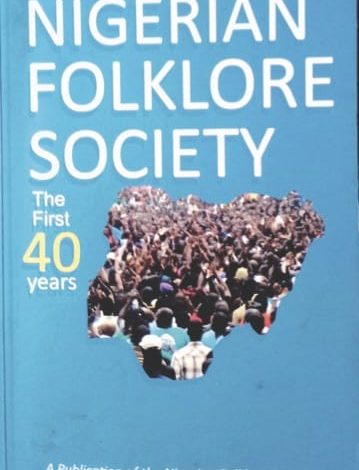
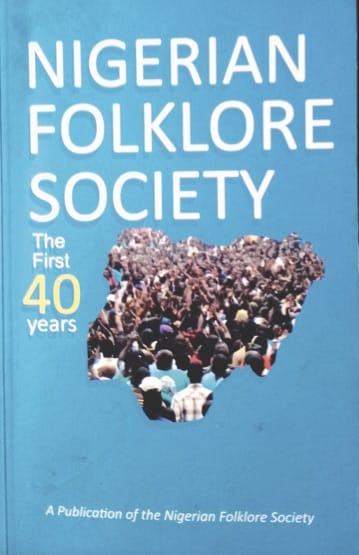
Forty years in the life of an intellectual organisation, such as NFS, is epochal. It marks a successful transition from a formative, teething stage to a dawn of stability. Not every association survives its first ten years, needless to say. Internal wranglings and leadership crisis could scupper its trajectory along the way. Nigerian Folklore Society: The First Forty Years, edited by Sani Abba Aliyu and Duve Nakolisa in 2021, “represents NFS’s attempt not simply to recall but also to analyse the challenges of its past in order to prevent a recurrence of identified pitfalls,” says Emeritus Professor Dandatti Abdulkadir OFR, former Vice-Chancellor, Bayero University, Kano, and former President of the Nigeria Folklore Society, in his Foreword. “Resilience,” he notes, “is an ingrained quality of every folklore artifact, and it is easy to see and feel this indomitable spirit in the revival of the Nigerian Folklore Society.”
The current association’s president, Dr. Bukar Usman, in his presidential remarks, pointed out that, since 2013, when the NFS was resurrected by concerned folklorists at Bayero University, Kano (BUK), the group, today, “is revived and vibrant, thanks to the collective resolve, enthusiasm, and cooperation of all members…” He informs that the book is a story of the NFS from its inception in 1980 and the year 2019 when it clocked forty years. He hints that the book does not celebrate what the current members, sponsors, and partners of the NFS have achieved; instead, what it celebrates “is the potential greatness of the NFS.” With this, he strikes an endearing forward-looking posture, which all have to lean on to accelerate the broad objectives of the association as the fulcrum of folklore research, coordination, preservation and promotion in Nigeria.
The introductory part of the book, Chapter 1, ushers us into an academic exercise – highlighting the distinctive features that constitute folklore. The book tells us that the term “folklore” appears to defy a single, unified and widely agreed definition, and “This is because folklore is of interest to many disciplines who proceed to define it to reflect their specialist concerns.” It goes on to cite the first documented use of the term by Eric Montenyohl (1996-232), the definition by William Bascon (1972: 398), the constitution of folklore by Alan Dundes, among other scholarly interventions. He reminds us of UNESCO’s definition that “folklore (in a broader sense, traditional and popular folk culture) is a group oriented and tradition-based creation of groups or individuals reflecting the expectation of the community as an adequate expression of its cultural and social identity; it’s standards and values are transmitted orally, by imitation or by other means.”
This chapter also educates us on what folklorists do, including using folk artifacts to identify or characterise the culture of an ethnic or social group. It itemises the features of folklore transmission, including passing on values and practices produced and used in the past. The modes of folklore transmission include oral instruction or narration, observation and imitation, and by performance. The book enlightens us that folklore is best conserved through the process of identification, collection and documentation, using a variety of media, print and electronic. We are informed about the importance of field work in folklore studies, which involves pre-field preparations, the proper fieldwork itself, and post-field reports.
Before the existence of NFS, various individuals and organisations, says the book, had been involved in promoting aspects of Nigerian folklore long before the Nigerian Folklore Society.
Explaining the pre-amalgamation forerunners, the editors cite Oluadah Equaino’s autobiography, published in 1789 in the UK, as an indicator that folklore had existed and flourished long before Nigeria was colonised by the British. “Equaino’s narration is the earliest account of aspects of Nigerian folklore to be written by an indigenous participant observer,” says the book (43). The editors also inform us about Ajayi Crowther’s 1943 book, A Vocabulary of the Yoruba Language, contains “over 500 scattered aphorisms with Yoruba texts and translations” (Bascom, 1964, p.24). Thus, Crowther “takes the credit of being the first person to publish a book on the verbal folklore of any Nigerian group.”
Other illuminating examples cited by the editors of Nigerian Folklore Society… include Koelle’s 1854 folklore book, published by Church Missionary House, London. Our knowledge bank is also swelled with the example of Rev. J F. Schon, who, from 1881-1886, published a text in Hausa language entitled Magana Hausa: Native Literature, Proverbs, Tales and Historical Fragments in the Hausa Language (The Ways of Hausa).
Early influential post-amalgamation forerunners, according to the editors, include the Zaria Art rebels, Nigeria Magazine, the Mbari Club, Black Orpheus, and publications by the Nigerian government. Of worthy note, too, are D. Amaury Talbot’s ethnographic work and Woman’s Mysteries of a Primitive People: The Ibibios of Southern Nigeria, published in London in 1915. M.I. Ogunmefu’s Yoruba Legends, D.O. Fagunwa’s first novel, Ogboju Ode Ninu Igbo Irunmole, published in 1939 and Amos Tutuola’s novel, The Palmwine Drinkard are described as illuminating works rooted in folklore.
From the third chapter, the book dwells on the Nigerian Folklore Society. The formation of the association, we are told, came as a result of the resolution adopted at the end of a seminar on traditional oral poetry held in Zaria under the auspices of the Ahmadu Bello University’s Centre for Nigerian Cultural Studies (now defunct). The inaugural meeting of the association was attended by forty-four persons. Since its inception, NFS has been led by Prof. Adeboye Babalola (1980-1983), Prof. Dandatti Abdulkadir (1983–1988), Prof. G.G. Darah (1988-1995), Dr. S.O. Williams (1995-2002), and Dr. Bukar Usman (2014 – date). The fourth chapter highlights the organs of the NFS, from the Congress to the Executive Committee.
The oft-talked about NFS’ period of dormancy and revival is treated in the fifth chapter. What this chapter does for the general reader is to revisit the mistakes that plunged a noble society into stasis and how similar associations can revive ailing professional groups and make them stand the test of time. While the sixth chapter details NFS’s conferences and partners during its first forty years, the seventh chapter takes us on a tour of publications by the NFS during its first forty years. In the next chapter (8), the book intimates us about the NFS’ future goals and projects. Comparatively, the American Folklore Society was founded in 1888, and it’s still waxing strong. It is expected that the NFS should aspire to make itself an enduring legacy for folklorists and consumers of folklore in Nigeria and beyond for generations to come.
* This review Akubuiro was originally published in The Sun of April 10, 2026, P. 16 and online at https://thesun.ng/the-evolution-of-nigerian-folklore-society/