The madman’s crossroads and poetry’s fierce reckoning with Nigeria’s Strangeland

By Leonard I. Ugwu
IN his book, Letter from the Mad Man, Chidi Nwakpa uses the persona of the mad man at the crossroads to prescribe a strong critique of a nation that has sacrificed hope for ‘booty’, justice for ritual, and sanity for show. This is no lament, but a collective wail written in satire, biblical ire and Nigerian diction. The binding narrative is prophetic madness: only the “mad” sees the world raw and professes it as it is. In this collection, politicians are nomads with party colours, elections are four-year cannibalistic festivals, leaders are elephants crushing dreams, and it is a Strangeland where pythons and gorillas live on our money while the people starve. The poems are critiques, elegies, erotic confessions, and symbioses, but the letter from the madman keeps peering into the national crime scene.
The opening poem wastes no time. It speaks to the gorging rich and the political hubbub; it invokes the transience of life and the triviality of high-caste politicians: “You, you suck to your fill from the filthy juice of her bloated breast. Nourished, thick flaps of flesh pad your bones like a cushion. A heavy clay pot of exotic foods cooking in your stomach, Tumescent, it threatens to tear your exquisite apparel Pregnant man brandishing a barren belly impregnated by the fertile sperms of wound-bathed Lazaruses.” (Letter from the Madman, verse 1, line 1-6. p. 2) The symbolism is hyperbolic, projecting the country raped and its “pregnant” leaders feed fat from the nation’s fertility. The madman then turns to the biblical allusion of Jonah to explain class exploitation when he declares that common folk are swallowed by the “gigantic whale” of corruption, but he predicts a happy ending: “Behold, I hear a voice thundering from on high with an order That Jonah be vomited onto the seashore of Paradise!” (Letter from the Madman, verse 5, lines 4 and 5. p. 3) The voice is defiant, messianic almost, yet rooted in the ordinary world of leaking cups, smashed banks and cars dancing on the new graves of the “greased hands”. This is the unique voice of Nwakpa.
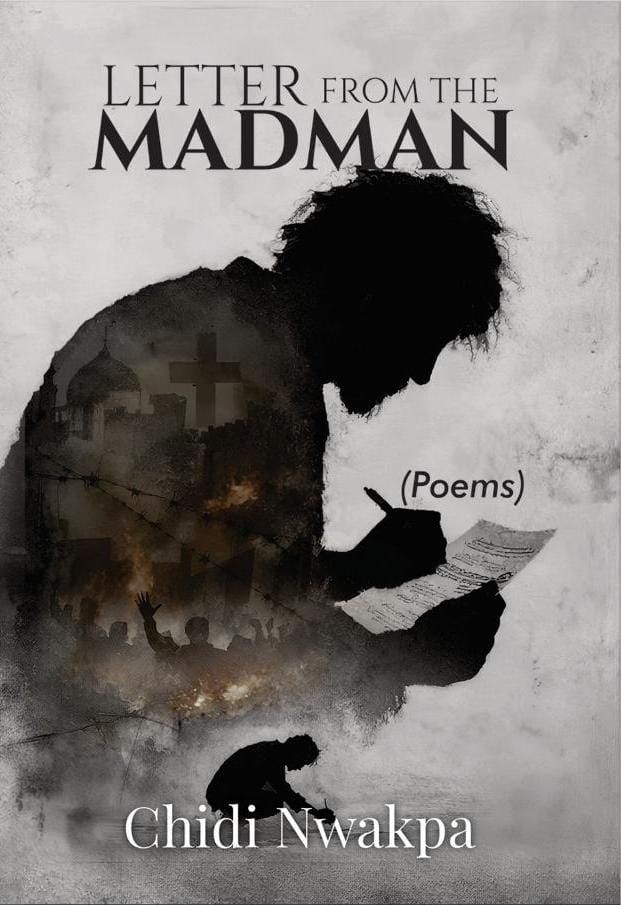
The poems of this collection resonate the letter from a madman. The poems seem to be a warning and a prophecy to the elite and society. It is self-indulgent and illuminating. There are subsequent poems that sharpen the blade of the collection. In “Elephants” for instance, powerful people are portrayed as blind wreckers of society: “A single sweep of the elephants’ mighty hands, trees of burgeoning dreams are mowed down from the roots, a flock of nesting birds takes flight, scattering.” (‘Elephants,’ verse 3, line 1-3. p. 4). This sharp image of nesting birds taking flight at the heavy sweep of the elephant is a metaphor of the elite influence on society. Also, the poem “Nomads” mocks politicians who switch from umbrellas to brooms, the collection in an attempt to solve sociopolitical problems in the country states, therefore: “squirrels jumping around in greedy exuberance From one palm tree to another,” while a chameleon changes party colours (‘Nomad,’ verse 3. Line 1 & 2. p. 6). Moreover, to buttress this point, the poem “From Change to Cage” chronicles the sour experience of betrayed hope: “You came riding on the lofty horseback of Change… Oh no! How wrong we were– in for a manacle of cage!” (‘From Change to Cage,’ verse 1, line 1 & 7. p. 10) The eight-year “voyage” ends in recession, herdsmen terror, and “Sniper is the new beer of the hopeless in affliction.” (‘From Change to Cage.’ Part II, Verse 2, line 8. p. 10). These are encounters in which the madman writes in his letter (poems) with force, regardless of the implications and interpretations that the critical reader will make in light of his message. Only a madman can write with such audacity.
The satirical high-point of the collection is reached in “Dollar Rain” and “Ritual of Four Years”. Here, corruption becomes meteorological as stated: “from the womb of corruption the waters break sending the pregnant clouds into sudden labour and in no time– delivering a torrential rain of dollars.” (‘Dollar Rain,’ verse 2 line 1-3. p. 13). Furthermore, elections become cannibal feasts where the madman boldly writes that “poli-tick-cians renew their evil oath of blood-sucking” and voters scramble for “sachets of salt, seasoning cubes, pieces of crappy wrapper And beggarly cash.” (Ritual of Four Years, verse 3, line 10 & 11, verse 4, line 2 & 3. p. 14). In the madman’s boldness, “Strangeland” distils his absurdity where he deliberately aims at annoying a class in the society and worse of all in a contemporary tone: “Where pythons, gorillas, monkeys, feed fat on hard cash, but human beings starve to death… Where the fourth person in an election contest wins, while the first loses.” (‘Strangeland,’ verse 1, line 3 & 4; verse 4, line 2. p. 24) The madman cries throughout, “I tell you, truly I tell you, this place we live in is Strangeland!” (Verse 8, line 12. p.25)
While the book doesn’t portray a vivid cry, the Sections titled “Threnodies” grieve specific horrors with measured sorrows like the faceless gunmen, the walking dead, the hawk-eyed herdsmen, the church turned funeral home. “In the Den of Lions (For Leah Sharibu)” and “Blasphemy (For Deborah Samuel)” are quiet tributes of faith in the face of terror. But later poems turn to private deprivation, displaying the trait of the madman, which includes irregularities like the poems (“The Building Collapse,” “When Two Friends Conspire Against the Third”) and unexpected tenderness in “ECHOES OF SYMBIOSIS,” where love becomes the one unlooted treasury: “Her statuesque figure towers over the tallest palm tree… I can’t help than gravitate towards her.” (My Greatest Gift Verse 1, line 1. p. 82). Even here, the madman’s eye remains political; the persona is never detached from the national wound. One sees irregularities between political turmoil, hope, and the sudden switch to romance and love.
Nwakpa goes beyond the extraordinary to portray the madman as personae that stylistically raises a relentless tone in the poetry yet ridicules himself with annoying poems. Mixing seriousness with strands of unseriousness, coming from no one but a madman. The poetry is immediate almost threatening, one that could only be written by a person who has already been dismissed as mad.
Letter from the Mad Man is not a comfortable read. It will infuriate some, shame others and make most readers nod sadly in agreement. But that is its genius. In a nation where the truth is often found irritating, the mad man at the crossroads has written the most honest letter. Nigerians should read it and tremble.
* Dr. Ugwu Jr., a lecturer at the University of Nigeria, Nsukka, is a poet and playwright