The writer as king

By Nengi Ilagha
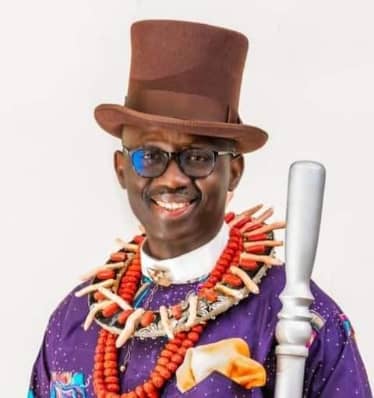
KING Bubaraye Dakolo, the writer, discovered himself rather late and has been trying to catch up on lost time. Little wonder that, within a space of six years, the young writer has grown into maturity with six books to his name, besides a quick ascendancy to the distinguished platform of becoming a Fellow of the Association of Nigerian Authors, ANA.
Dakolo, the king, does not like being described as young. He believes he is one hundred and six years old. He is as old as the sacred stool upon which he sits. He is the paramount potentate of Ekpetiama Kingdom, Agada IV, no less. He does not take that role lightly, especially because he presides over the affairs of the Bayelsa State Traditional Rulers Council. From the time he became king of his people, he gained automatic visibility in the affairs of the royal council. He was vocal, full of ideas, and full of propulsion.
He spoke like one who recognizes the power of the light in him and has since decided, in the sentiments of Jesus Christ, to place the bright light atop the bushel, not underneath, that it may illumine the room. It is a light of knowledge, an awareness that things can be better than they are at the moment, that the children of today deserve a better future, and that he is willing to give his very best in all he does so that posterity will be enriched by his input.
King Dakolo became Ibenanaowei of Ekpetiama Kingdom when his colleagues in the Nigerian Army had become Major-Generals. Many years ago, he began life as a boy soldier, and is still proud of his military experience. His memories of his days in uniform are so abiding that his second book carries an image of the young soldier on the cover, a stern, determined look upon his face. The office of the king at the Council headquarters is adorned with a gallant silhouette of the same young soldier in profile. The same iconic pose is to be seen at the palace of the king at Gbarantoru.
King Dakolo derives so much joy in writing that he wants everyone to share in it. Don’t be surprised, therefore, if you visit the Chairman in his office, and he tells you to sit back, relax and listen to him read a few captivating paragraphs from his latest book, his sixth so far, with the title Gateway To The Atlantic. The king does not leave it at that. He markets his own books, virtually, and creates public space for people to talk about them.
His books are all on the global Amazon network, and hold their places in the shelves of reputable bookshops. In a bid to cultivate an active readership and disseminate the message in his books, he is known to have given out complimentary copies to sundry visitors and guests alike, from the President to the porter at the palace. As far as stories go, King Dakolo has a lot to tell. That is why he has chosen a new career path in writing, and he is making appreciable headway in it.
King Dakolo was a cadet at the Nigerian Defence Academy, Kaduna, when the 1990 coup took place. His elder brother, Perebo Abela Dakolo, a captain, was involved in the coup itself. The younger brother had to convey the captain’s family from Zaria to Port Harcourt, in search of a hiding place. The cadet took off on the morning of the coup itself. By nightfall, the Major Gideon Orkar coup was formally announced on network news. It sounded like good news at the time. But by noon the following day, it had become bad news. The coup makers were caught, tried and summarily executed.
In the end, the cadet returned to the Academy to continue his training, while coping with the agonizing vacuum in his heart. A few weeks later, the coup became a serious point of discourse everywhere, and he could no longer hide. By family affiliation, the name Dakolo found him out. A higher officer felt the young cadet could not be up to any good if he remained in the service after his brother’s execution. That brought Bubaraye Dakolo summarily out of the army in 1991. A man of valiant character, he had no choice but to put all that tragic pain behind him, and forge ahead.
Out of military service, he did a bit of private business until 1994 when he gained entry into the University of Port Harcourt. He earned two degrees in succession, one in Chemical Engineering, and the other in Education. After that, for the better part of six years, he taught at the University of Port Harcourt Demonstration Secondary School, between 1996 and 2001.
Three years later, in 2004, he relocated to his home state, Bayelsa, in the days when Chief Diepreye Alamieyeseigha was Governor. As personal assistant to Oronto Douglas, Information Commissioner at the time, Bubaraye Dakolo was also in the thick of youth activism and the environmental rights movement which gave birth to the Ijaw Youth Council, IYC.
Long before he became king of his people, Bubaraye Dakolo had always harboured a strong zeal for his homeland, dreaming of a better bargain for the Izon people. As a much younger man, in fact, his favourite topic of discussion was the future of the Ijaw people. Even at the Academy, he was regarded as very mature in his political arguments, never descending to unguarded tantrums and fisticuffs, ruled by reasonable logic all the time. As he puts it, “I’m okay with politics so long as politicians remain true to their manifesto and their mandate. I have problems with politicians who default on their promises. It never goes down well with me.
“We live in the twenty-first century, not in medieval times. We should do things like civilized people. Life is too short to tell lies, and much of politics is about how good you are with lies. That is a very unfortunate legacy to bequeath to the future. Politics does not have to be an exercise in violence either. I’d rather settle for peace. Politics, for me, true politics is about service that would bring about happiness amongst the citizenry.”
King Bubaraye Dakolo
In that context, King Bubaraye Dakolo gives his honest assessment of the Douye Diri government, six years after being in office. Dakolo thinks Governor Diri is a personification of humility, and his performance so far has been remarkable. “He fits squarely into the description of a people-centered servant,” he says. “I am impressed by the fact that he is aggressively pursuing access to the swampy interior of the state.
“In times past, the Nembe-Brass road was a four million naira federal budget project. Today, it counts in billions, but the Governor has summoned the will power to undertake the project because he is looking at the larger picture. To start with, when Diri came into office, he addressed pension funds first, setting aside seven hundred million naira every month to cater to pensioners and retirees. That counts for something.”
Bubaraye Dakolo is the author of the very topical book entitled Riddle Of The Oil Thief, after which he published his autobiography, Once A Soldier. He became a first class traditional ruler in Bayelsa State in 2016 when the Ijaw kingdom of Ekpetiama rose as one and anointed him as the paramount traditional head and natural ruler of his people. His Royal Majesty Bubaraye Dakolo, Agada IV, Ibenanaowei of Ekeptiama Kingdom, as he is formally known, became Chairman, Bayelsa State Council of Traditional Rulers on March 16, 2022.
King Dakolo considers it significant that he was born in the mid-1960s at Otuabagi, the community where the first commercial oil well was drilled in Nigeria, and he has repeatedly underscored this in his books. He feels offended that Nigeria has been living with the lie that Oloibiri was the host of the first oil well when, in fact, the well in question is actually located in Otuabagi, his mother’s village. Dwelling as he does in his paternal hometown, Gbarantoru, along the banks of the famous River Nun, Bubaraye Dakolo survived the great flood of 1969, and lived through the deadly wave of fierce fighting that enveloped Ekpetiama during the Nigerian civil war.
Shortly after the war in 1970, he lived with his father and siblings at the residential quarters of Shell, Nigeria’s pioneer petroleum refining company, at Alesa Eleme in Rivers State. His father was then a brand new post-civil war employee of the Nigeria Petroleum Refining Company, NPRC. Unaware of the danger posed by exposed oil pipelines, the boy often walked the four-kilometer distance to and from his Ibuluya-Dikibo State Primary School, Okrika, Rivers State, on those pipelines, along with his play mates. From the back of his school, he also watched sea-going vessels as they shipped petroleum from the refinery jetty near his school at the Okrika peninsular to the western world.
Apart from being exposed early to the messy realities of the oil industry in Nigeria, Bubaraye Dakolo was equally exposed to the works of some of history’s most prominent and influential figures. He became well acquainted with the exploits of Marcus Garvey, Malcolm X and Martin Luther King Jr in his teenage years.
He identified with the fate and legacy of early African nationalists like Kwame Nkrumah, Patrice Lumumba, Ahmed Sekou Toure, Julius Nyerere, and Kenneth Kaunda. In like manner, his worldview was shaped by the revolutionary ideas of Walter Rodney and Frantz Fanon. What’s more, Nelson Mandela and Steve Biko helped to reinforce his pan-Africanist disposition into rock solid concrete.
He is quick to draw attention to the fact that he was born two decades after the death of Marcus Mosiah Garvey, in the decade of the wanton and ruthless assassination of Black nationalists in Africa and in the Americas. It was a decade that saw African nations breaking free from colonialism, and stepping into neo-colonialism and virtual imperialism. History unfolded before his eyes, and he came to understand the motivation behind some of the major characters who propelled events.
“It was a decade which saw western powers reluctant to let go of the Africa they were milking dry, a continent suffused with diamond, gold, platinum, uranium, plutonium and vast deposits of petroleum. It was a decade that witnessed the mindless plunder of beans, cocoa, coffee, and the open exploitation, rape and wastage of human life so long as it was African. Although the slave trade was over, other ways were devised to exploit the resources of Africa.”
Bubaraye Dakolo was born into that decade. He survived the tumult, lived through the challenges, and endured the countless tests that came with the time. He has also mustered the courage to confront inequity in society. Living as he does in Gbarantoru, virtually within a 500-meter radius of the onshore multi-billion dollar facility operated by Shell, with a production capacity of gas equivalent to 60,000 barrels of crude oil per day, Dakolo has been witness to poisonous gas emissions and the havoc it has done to the environment since 2008. As may be expected, he has since set out to contest this anomaly in his books.
The African Voice, the third book from the royal pen of King Bubaraye Dakolo, sustains this conscious advocacy. Adopting a surrealist mood arising from a trance at the waterfront of the River Nun where a young king ponders upon the fortunes of the vast estate handed over to him by his forebears, the author willfully indulges a dream state in which he contemplates a voice note which drops into his phone without a message.
The voiceless voice note builds up into a recurrent motif that provides resounding echoes from the voices of some of the most popular activists and leaders in Black African history, spanning Africa, Black America, and the Caribbean. As may be expected, all of Dakolo’s heroic figures – Marcus Garvey, Martin Luther King Jr, Kwame Nkrumah, Julius Nyerere, Nelson Mandela, Fidel Castro, Bob Marley and Fela Anikulakpo-Kuti, all come up for air.
What’s more, King Bubaraye Dakolo does not hide the fact that his model king in African history remains the warrior potentate, Mansa Musa. The Agada of Ekpetiama Kingdom comes short of revealing himself as Mansa Musa reborn in the lap of the Niger Delta. But at the heart of this book is an engaging adventure story told against the backdrop of a recent pandemic.
In a linear plot easy to follow, the author receives an invitation to a literary festival in Accra, Ghana, on the strength of his controversial book, Riddle Of The Oil Thief, an incisive foray into the criminal neglect of the Niger Delta, and an expose on the elaborate syndicate of saboteurs in the oil and gas industry. The opportunity gives King Dakolo a golden rostrum to pontificate on the real essence of being African.
To that extent, The African Voice is a story of love between a son and Mother Africa, the continent that bred him, a love affair across borders, between Nigeria and Ghana, holding possibilities of consummation between the author and the kindred spirit he finds in Abena, whom he calls his saving grace, if only more time and attention were given.
This book straddles two African classics in one. It carries echoes of The Voice by Gabriel Okara, the legendary poet whose poem on the River Nun speaks even to the present. The African Voice also recalls the quality of innocent inquiry, the awakening to a new reality, for which The African Child by Camera Laye is known. King Bubaraye Dakolo may well have written a radiant book that could safely take its place on the shelves between The Voice and The African Child.
One particular strain of argument is unmistakable in all the king’s books. Like a recurrent decimal, it preoccupies the mind of the author, and overruns the pages of each book. Dakolo posits repeatedly that the real oil thieves in the Gulf of Guinea, encompassing the creeks of the Niger Delta, are not the restive militants mining crude oil in small camps, but the big-time power brokers in high places who hold the license for ocean liners and sea-going vessels, while controlling oil wells far away from the polluted swamp.
This sentiment runs through Riddle Of The Oil Thief, Once A Soldier, The African Voice, and receives ample expression in Pirates of the Gulf and the Kingfisher. In all five books, Bubaraye Dakolo is the principal character, and the tireless narrative voice. It will be a revelation if Dakolo can test his potential for pure fiction in a subsequent book, without putting himself upfront all the time.
Even so, Bubaraye Dakolo, king of the Ekpetiama people of Bayelsa State, is ready with a new book, his sixth in the catalogue. In this new book, Gateway to the Atlantic, the author makes capital of his trip to the source of the River Niger, in the spirit of Mungo Park. Following the flood disaster of 2022, which caught him and his family in dangerous straits, the king embarks on a journey, tracing the origins of the river to the Foutah Djallon highland in Guinea, and actually sipping from the cool, calm waters of the Tembi Stream from which the floods originate.
It comes to him as a revelation that, after a convoluted course downstream, over a vast and changing landscape, this same stream bulges into the nerve ends of the Niger Delta swamp of Nigeria, and at due season causes so much havoc. The only difference between this historic trip and that of the nineteenth century sailor and explorer is that Dakolo commandeers a private aircraft and traces the twists and turns of the river to its terminal point in the Foutah Djallon mountains of Guinea, and benefits from a dazzling aerial view of West Africa.
With the keen eye of a writer on a mission, the author keeps a regular tab on people he meets along the way, captures the fascinating scenery in contemplative snatches of thought, and narrates the stages of his journey with an abiding spirit of wonder.